











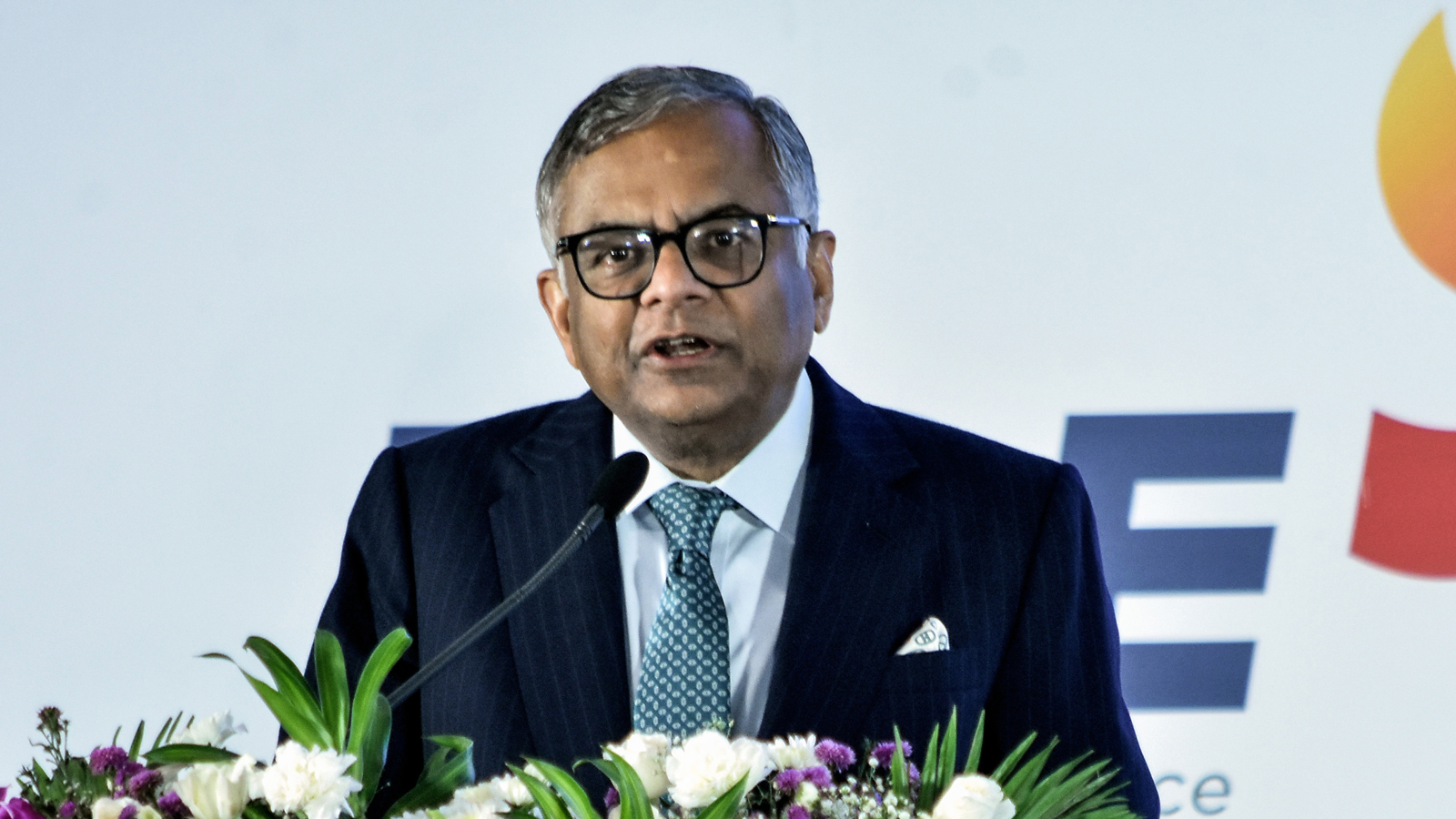
Artificial intelligence is the next major form of infrastructure that will profoundly transform societies and economies, much like the steam engine, electricity and the internet did in earlier eras, Tata Sons chairman N. Chandrasekaran said on Thursday.
Speaking at the India AI Impact Summit 2026 in New Delhi, Chandrasekaran described AI as the “infrastructure of intelligence” that will shape the future across sectors and geographies.
“AI, in my view, is the next big infrastructure. It is the infrastructure of intelligence. It will have a profound impact, just as past infrastructure revolutions did – whether steam engines, electricity, or the internet,” he said.
He stressed that the collective mission should be to ensure AI benefits every individual. “Our mission should be to make AI work for every individual and every citizen in this country. We must place AI tools in the hands of the last person in the country – and indeed on the planet. That is the mission we should all work towards,” he added.
Highlighting AI’s accessibility, Chandrasekaran cited a recent example from an event at Bharat Mandapam, where 1,500 rural women with no prior experience in computing or digital tools were introduced to AI. Within a few hours, he said, they were able to build products, create marketing materials and design campaigns before a global audience. “They achieved this in just four hours, demonstrating how intuitive and empowering AI tools can be,” he noted.
Chandrasekaran described India as a nation of “AI optimists,” driven by its track record in building large-scale digital public infrastructure. He pointed out that India has created the world’s largest digital identity system, covering 1.4 billion people, and a digital payments platform that accounts for nearly half of global transactions.
He said that under the leadership of Prime Minister Narendra Modi, India has treated AI as a strategic national capability and is building capacity across the entire technology stack. “From chips and systems to energy and applications – through initiatives such as Semiconductor India and the India AI Mission – we are building AI at scale with trust, resilience and long-term competitiveness,” he said, also referring to recent clean energy reforms aimed at supporting this growth.
Describing AI as a foundational, cross-sectoral technology, Chandrasekaran said it continuously learns from data, improves over time and is not constrained by fixed rules. This adaptability, he added, enables rapid scaling and drives innovation across industries.
(With ANI inputs)












