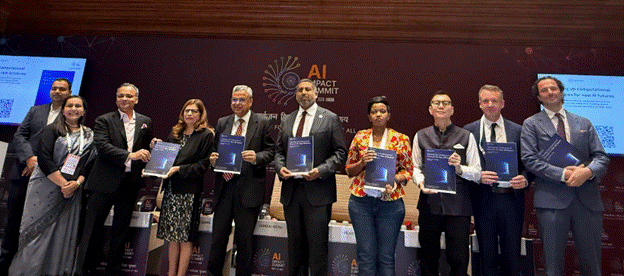
Artificial intelligence infrastructure must be aligned with clearly defined public-interest goals rather than capacity creation alone, experts said during a session on equitable access to computing resources at the India AI Impact Summit 2026.
The discussion, titled “Building Public Interest AI: Catalytic Funding for Equitable Access to Compute Resources,” also marked the release of the working report “Opening Up Computational Resources for New AI Futures” by Dr Saurabh Garg, Secretary, Ministry of Statistics and Programme Implementation.
The panel brought together government leaders, philanthropic institutions and global AI experts to examine how catalytic funding, new institutional models and South–South cooperation can make advanced computing affordable for the Global South. Speakers stressed that shared infrastructure, demand aggregation, skills development and mission-driven governance would be key to translating compute access into real-world deployment across sectors such as health, education and agriculture.
Placing equity at the centre of the AI transition, Garg said, “We are of the collective opinion that AI will transform the world. The defining question is whether this transformation will be equitable, inclusive, and aligned with the public interest. That is the issue at the heart of the current global conversation.”
Martin Tisné, CEO of AI Collaborative, warned that infrastructure without adoption could widen the impact gap. “I do have a worry that we could end up in two years’ time in a world where we succeed in having computing capacity in several countries, including in the Global South, but where effectively, the data centres are not used,” he said.
Vilas Dhar, President of the Patrick J. McGovern Foundation, emphasised the policy dimension of scaling AI services. “Transforming AI into a scalable service for consumers and creators is not just a product challenge; it is a policy challenge. This progress won’t happen through the private market alone, nor by asking frontline nonprofits to become developers. Our work over the next 12 months must focus on building the institutions that ‘connect the dots’ and support this transformation at scale,” he said.
Highlighting development-oriented demand, Shikoh Gitau, CEO of Qhala, said, “It’s not just about facilitating the GPU. It’s what the GPU is in service of solving for health, education, and agriculture. When you have clear use cases, then the GPU demand becomes an obvious task, and the governance framework to bridge these gaps also becomes clearer.”
Shaun Seow, CEO of Philanthropy Asia Foundation, underlined the role of skills and access models. “When you think about the emergence of new clouds, or GPU as a service, these developments are going to be good for unleashing AI for social impact and economic capture. How do we make it more accessible for startups and impact organisations? You need to think about the ecosystem you’re building. The skills gap in Asia is actually huge, and that could be what’s stopping us from really optimising and maximising this power,” he said.
Experts underscored that catalytic public and philanthropic funding, shared computing infrastructure and interoperable governance frameworks could together enable AI to function as a global public good while ensuring equitable access.