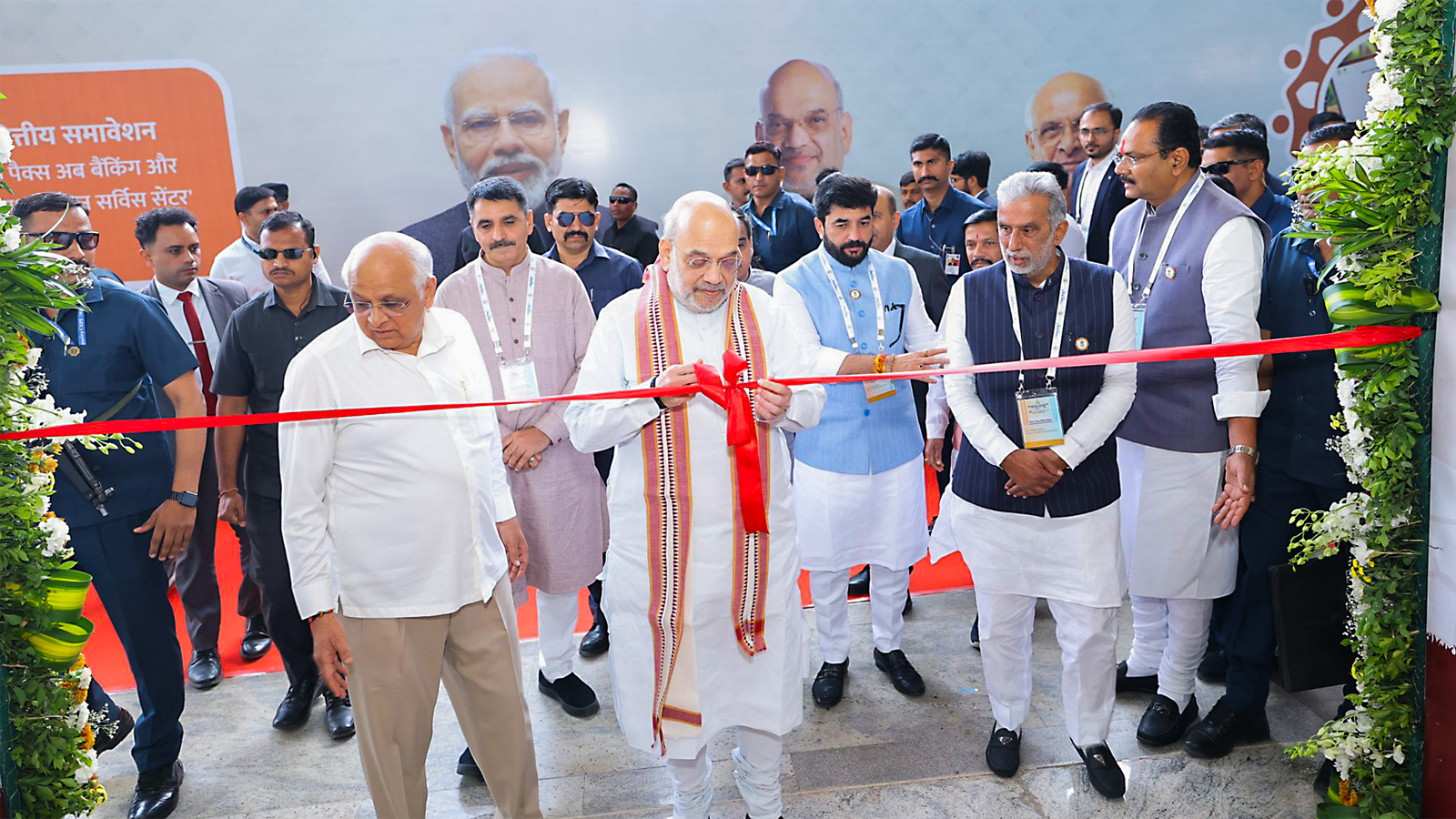

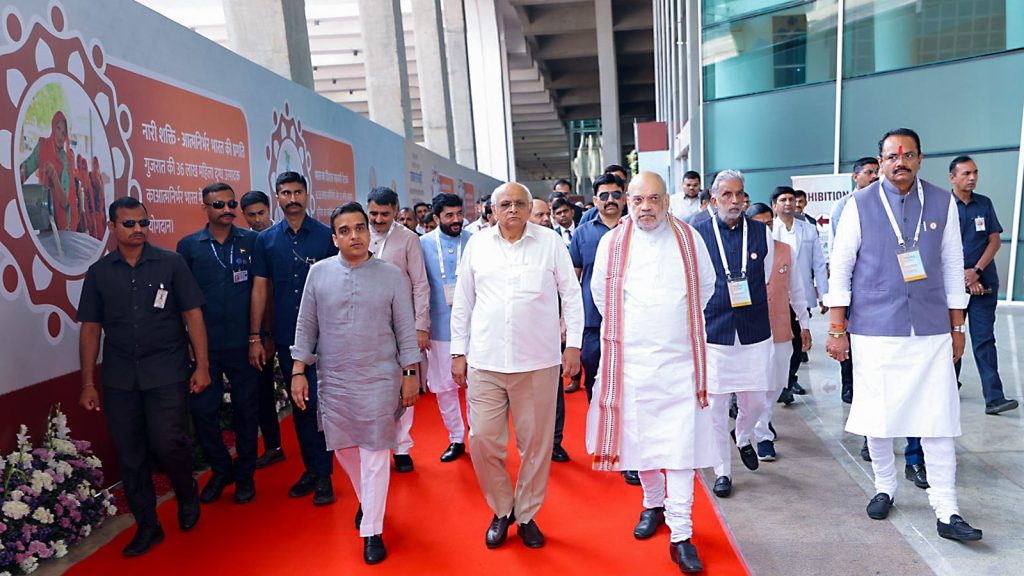
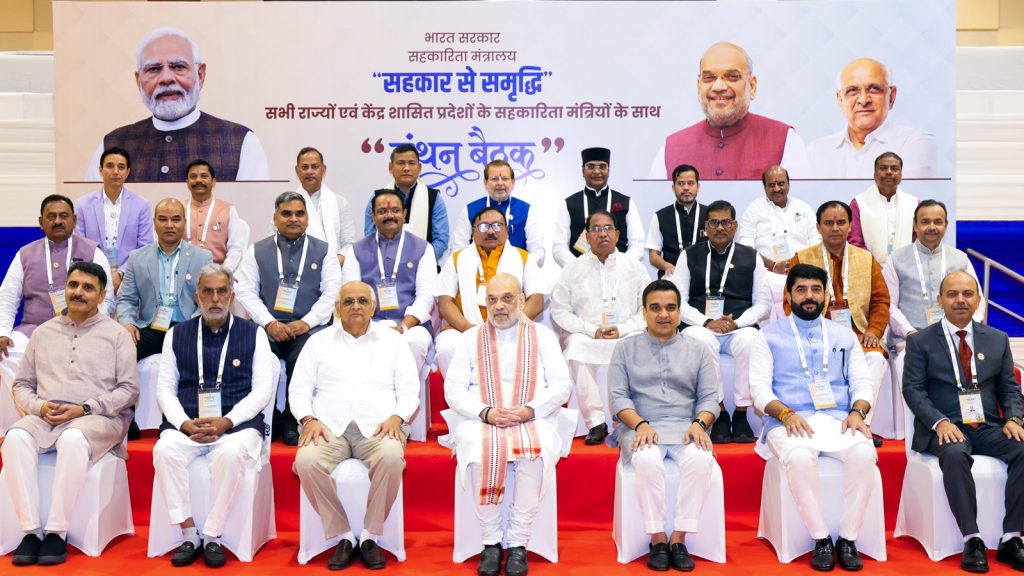
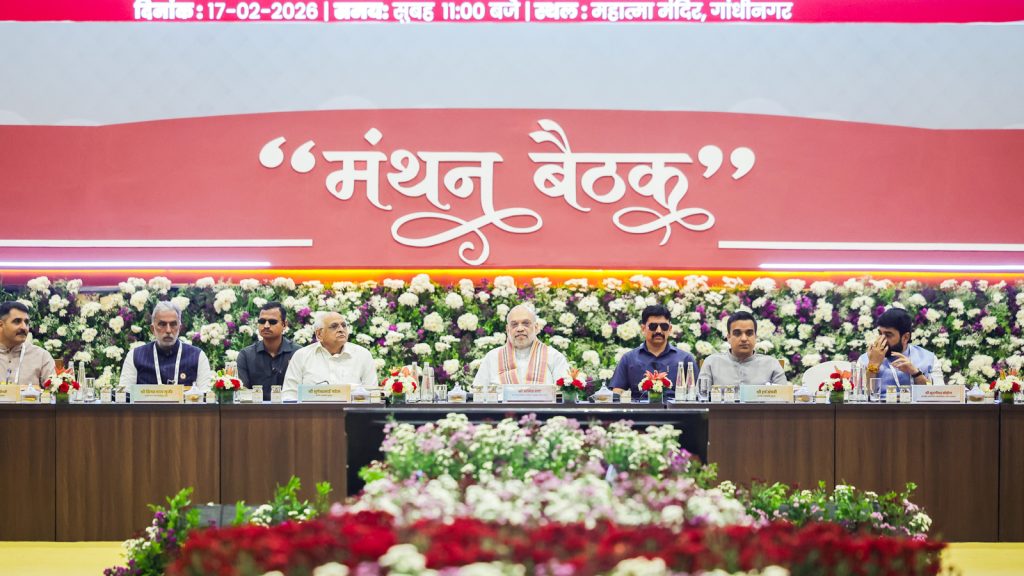
Union Home and Cooperation Minister Amit Shah on Tuesday chaired a high-level ‘Manthan Meeting’ in Gandhinagar, bringing together Cooperation Ministers from all States and Union Territories to chart a roadmap for strengthening India’s cooperative movement under the theme ‘Sahkar se Samriddhi’.
The meeting, held in Gujarat’s Gandhinagar, focused on expanding the role of cooperatives in achieving the goal of a fully developed India by 2047. Shah said that mere economic indicators do not define a developed nation; rather, it is about creating a system where 140 crore citizens can live with dignity.
“In the past four years, we have advanced the cooperative sector in a scientific manner, and positive results are now visible,” Shah said, adding that cooperatives can serve as a vehicle for inclusive growth across agriculture, rural development and animal husbandry.
During the event, Shah inaugurated and laid foundation stones for projects worth ₹265 crore related to ethanol, energy, organic potash, warehouses and protein powder plants. He also released a report on best practices in cooperatives and the International Year of Cooperatives.
Union Ministers of State for Cooperation Krishan Pal Gurjar and Murlidhar Mohol, along with senior officials including the Secretary of the Ministry of Cooperation, attended the meeting.
A key priority discussed was food grain storage. Shah stressed that India’s storage capacity must increase nearly threefold in the coming years, with the cooperative sector undertaking two-thirds of that expansion.
He called for coordinated efforts by Primary Agricultural Credit Societies (PACS), cooperative dairies, state marketing federations, district cooperative banks and sales-purchase unions to build modern warehouses. Noting that nearly 70 per cent of food grains are procured from Punjab and Haryana, Shah said aligning procurement, storage and distribution regionally could cut transportation costs by 30-40 per cent.
“A universally accessible storage system across the country can be established only by the cooperative sector,” he said.
Shah urged States to restart closed cooperative sugar mills and adopt flexible policies to enhance their viability. He noted that sugar mills could diversify into fertilizer and gas production, with successful models demonstrating the potential to produce up to eleven different products.
He also highlighted the importance of circularity and sustainability in the dairy sector and encouraged States to send delegations to study best practices at Banas Dairy.
Under the call for ‘Sahkarita mein Sahkar’ (Cooperation Amongst Cooperatives), Shah proposed that all cooperative institutions maintain their bank accounts with District Cooperative Banks. He said the Centre is working to make cooperative banks nodal agencies for implementing central schemes, and urged States to route payments under schemes such as PM-Kisan and old-age pensions through these banks.
Shah said cooperatives would soon be formed for retail workers, carpenters, plumbers and electricians to ensure fair remuneration and protect them from exploitation. He projected that more than 40 per cent of India’s population could be associated with the cooperative sector in the coming years.
He also announced that Bharat Taxi services would expand to every Municipal Corporation city, noting that over three lakh drivers have already joined the platform.
The meeting reviewed progress on establishing two lakh new multipurpose PACS and expanding dairy and fisheries cooperatives to energise the rural economy. Discussions were held on building a nationwide network of modern warehouses under the world’s largest grain storage scheme to improve price stability and market access for farmers.
States were urged to actively participate in newly formed national cooperative institutions such as National Cooperative Exports Limited, National Cooperative Organics Limited and Bharatiya Beej Sahkari Samiti Limited to boost exports, organic farming and quality seed supply.
The meeting also discussed reforms in state cooperative laws in line with the 97th Constitutional Amendment, improving the financial health of cooperative sugar mills, strengthening shared service entities, computerisation of PACS and Registrar of Cooperative Societies offices, and enhancing human resource development and training.
As the session concluded, Shah reiterated that a strong, transparent and technologically enabled cooperative movement would be central to achieving the vision of a developed and self-reliant India by 2047.