








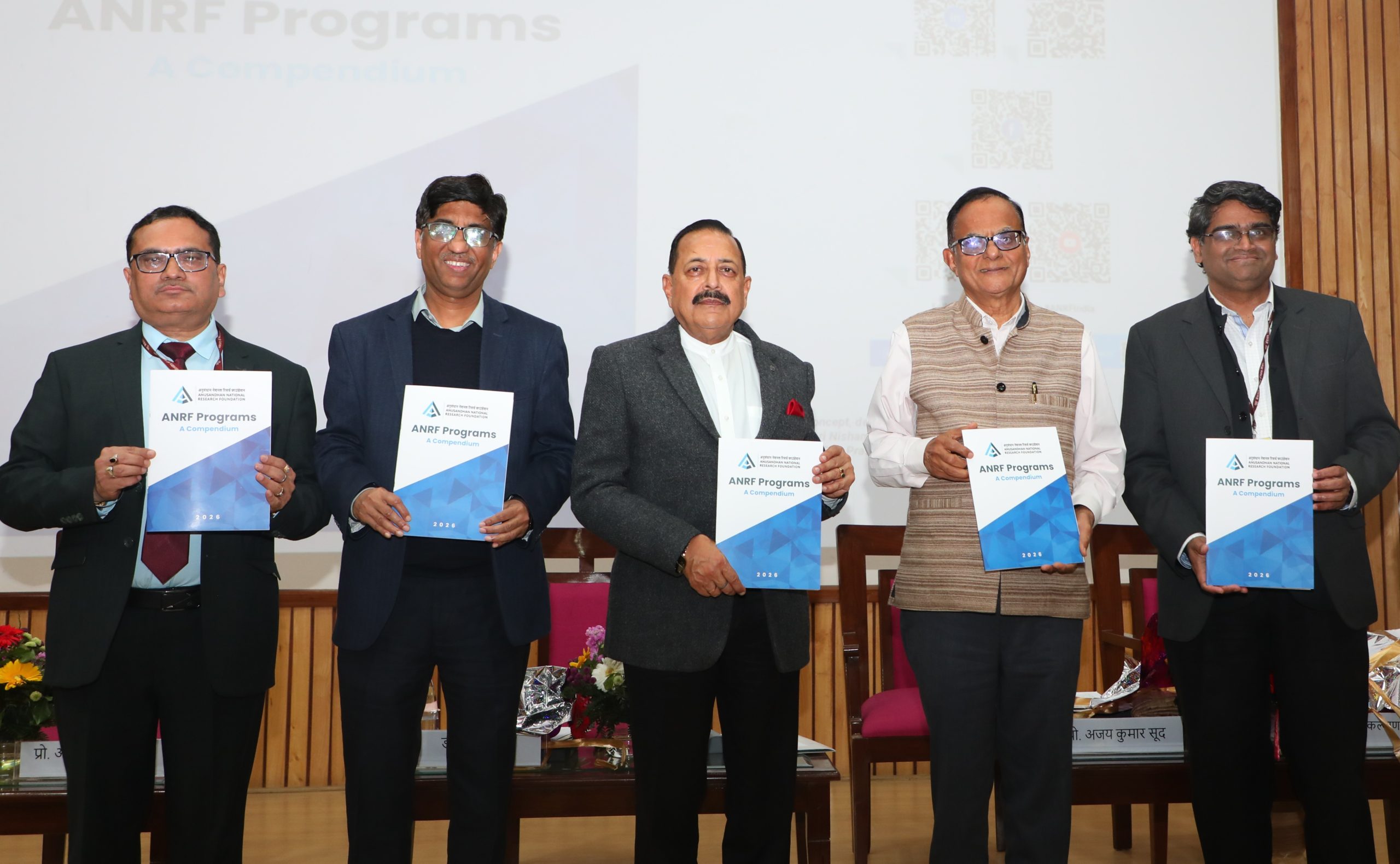
India’s research and innovation ecosystem is entering a transformative phase with the Anusandhan National Research Foundation (ANRF) positioned as a key catalyst for mission-driven, globally aligned and partnership-based research, Union Minister of State (Independent Charge) for Science and Technology, Dr Jitendra Singh, said on Thursday.
Addressing the ANRF Foundation Day event held at Prithvi Bhawan in New Delhi, Singh said the Foundation marks a major institutional reform aimed at strengthening research-led economic growth and positioning India as a global innovation leader by 2047. He said ANRF represents a shift from conventional, silo-based research funding towards a collaborative and outcome-oriented model.
The event was attended by Principal Scientific Adviser to the Government of India Prof. Ajay Kumar Sood, Secretary of the Department of Science and Technology Prof. Abhay Karandikar, ANRF Chief Executive Officer Dr Shivkumar Kalyanaraman, senior officials from science departments, and representatives from academia, industry and research institutions.
Tracing the evolution of ANRF, Singh said the Foundation was conceptualised after extensive consultations and a careful study of global research models, while being tailored to India’s scientific, social and cultural needs. He said ANRF is designed to integrate science, industry, social sciences, humanities and culture within its governance and programme framework, reflecting the interdisciplinary nature of modern research.
Referring to the post-pandemic global environment, the Minister said there has been renewed international focus on life sciences and indigenous knowledge systems. India, he said, is uniquely placed to contribute original research by combining modern scientific approaches with traditional knowledge.
Singh said ANRF is steadily moving towards a funding model where a growing share of research support will come from non-government sources, including industry and philanthropy. He noted that early participation from the private sector in ANRF programmes indicates a gradual cultural shift towards collaborative and results-driven research.
He also highlighted mission-mode initiatives under ANRF in areas such as electric mobility, advanced materials, batteries, power technologies and artificial intelligence for science and engineering. These programmes, he said, signal a transition from ministry-specific projects to coordinated national research efforts involving multiple stakeholders.
Principal Scientific Adviser Prof. Ajay Kumar Sood said ANRF has been envisioned as a bridge between laboratories, universities and industry, with the objective of translating scientific research into societal impact. He said the Foundation places equal emphasis on funding research and fostering a culture of inquiry, particularly at a time when technological capability is critical for national resilience and economic competitiveness.
Prof. Sood added that ANRF’s mission-oriented programmes and private sector participation have the potential to significantly improve the translation of research outcomes into real-world applications.
Concluding his address, Singh said ANRF will play a central role in building a robust research, innovation and technology-translation ecosystem, with science and innovation remaining key pillars of India’s long-term development strategy.