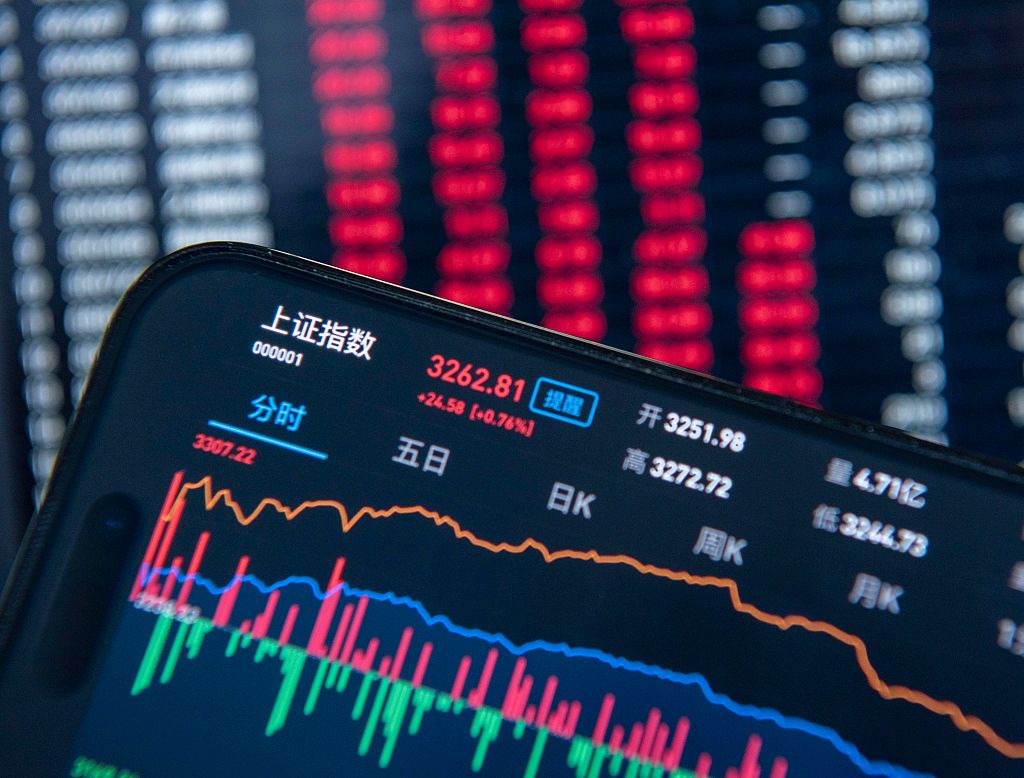
Shares fell in Asia on Wednesday as AI darling Nvidia took a hit from U.S. curbs on chip sales to China, highlighting the damage to come in a tit-for-tat global trade war, while gold hit a record and the dollar stayed under pressure.
Data showed that China’s economy grew 5.4% in the first quarter from a year earlier, beating expectations, although trade tensions with the U.S. have clouded the outlook.
Overnight, President Donald Trump ordered a probe into potential new tariffs on all U.S. critical minerals imports, on top of reviews into pharmaceutical and chip imports. Beijing is continuing to play hardball, having reportedly ordered airlines to suspend deliveries of Boeing aircraft.
Treasury yields were steady ahead of a key speech from Federal Reserve Chair Jerome Powell later in the day. Fed Governor Christopher Waller already sounded dovish and the expectation is Powell will echo the recent messages from his colleagues amid the tariff chaos.
S&P 500 futures fell 0.8% while Nasdaq futures slumped 1.4%. That was due to a 6% plunge in Nvidia shares in after-hours trading, which erased a total of $160 billion in its market cap.
The chip giant is facing $5.5 billion in charges after the U.S. government limited exports of its H20 artificial intelligence chip to China, a key market for one of its most popular chips.
“This disclosure is a clear sign that Nvidia now has massive restrictions and hurdles in selling to China,” said Daniel Ives, analyst at Wedbush Securities.
“The Street will take this news with clear nervousness worried these are the first shots fired in the tech battle between the US and China and Beijing/Xi are not just going to take this news and walk away.”
On Wednesday, MSCI’s broadest index of Asia-Pacific shares outside Japan fell 0.9%, snapping a four-day winning streak. Japan’s Nikkei slipped 0.5%.
Chinese blue chips fell 0.6%, while Hong Kong’s Hang Seng slid 1.6%. Chinese semiconductor shares, however, rallied with Hua Hong Semi up 4% and SMIC 1% higher.
“Both countries seem to believe they have the upper hand, potentially prolonging the current stalemate for months to come,” said analysts at PGIM Fixed Income in a note to clients.
“China appears to have no intention of climbing down from its current stance on tariffs and instead views the current trade dynamics as an opportunity to make inroads with countries that export to the U.S.”
The White House said Trump is open to making a trade deal with China but Beijing should make the first move.
GOLD SHINES
All of the uncertainties left gold in an unstoppable position, with the bullion up 1.2% to hit another record high of $3,266.65 per ounce.
ANZ on Wednesday updated their forecast for gold to hit $3,600 an ounce by the year-end, arguing that the risk-off purchases for the asset are yet to pick up.
U.S. Treasuries found some love after an epic sell-off last week, helped in part by Trump’s tariff reversals.
The benchmark 10-year yield was steady at 4.325%, well off the recent high of 4.592%. The 30-year yield was little changed at 4.777%, also some 25 basis points lower from the high seen last week.
In the currency markets, the dollar was on the back foot again, with the euro up 0.3% to $1.1316 and the yen 0.3% higher at 142.84 per dollar.
Bank of Japan Governor Kazuo Ueda told the Sankei newspaper that the central bank may need to take policy action if U.S. tariffs hurt the Japanese economy, signalling the potential to pause the bank’s rate-hike cycle.
Oil prices were marginally higher. Brent inched up 0.2% at $64.79 a barrel, while U.S. crude also rose 0.2%to $61.42 per barrel.
(Reuters)