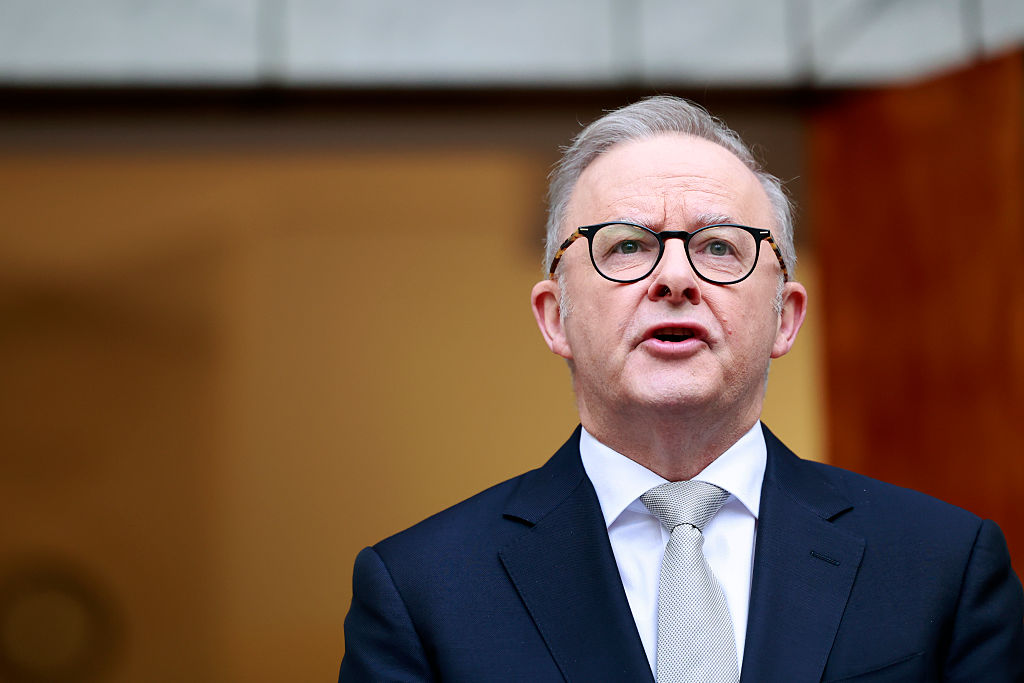
Australia’s Prime Minister Anthony Albanese on Friday called a national election for May 3, launching a five-week campaign that is set to be dominated by cost-of-living pressures.
Albanese’s Labor party won a majority at the last federal election in 2022, but most recent opinion polls show the party neck-and-neck with the opposition Liberal-National coalition when votes from smaller parties are redistributed.
“Our government has chosen to face global challenges the Australian way – helping people under cost-of-living pressure, while building for the future,” he told a press conference. “Because of the strength and resilience that our people have shown, Australia is turning the corner. Now on 3 May, you choose the way forward.”
Albanese earlier in the morning met the country’s Governor-General Sam Mostyn to seek permission to formally call the election, as required by Australia’s constitution. The governor-general represents Australia’s head of state, Britain’s King Charles.
TIGHT CAMPAIGN
Albanese has announced a slew of measures aimed at pleasing families and businesses in recent months, including tax cuts in Tuesday’s budget, with the rising cost of living in the country set to dominate the campaign.
On Friday, Albanese focused his campaign attack on the opposition Liberal and National coalition, saying it would axe government programmes and revoke modest new tax cuts passed by parliament.
A close-run election could mean no single party or coalition of parties will be able to form a government on its own, instead relying on smaller parties and independents to command a majority in the country’s lower house.
Albanese, a long-time Labor lawmaker who grew up in government housing, has suffered from waning popularity as living costs and interest rates rose steeply during his tenure.
Falling inflation and the decision by Australia’s central bank to cut interest rates for the first time in five years at its February meeting have done little to help Albanese’s polling numbers.
After enjoying a healthy lead for much of his term, his personal approval ratings are now close to those of Liberal leader Peter Dutton, a former police officer and the defence minister in the last Liberal-National government.
Dutton has campaigned on a housing crisis that he says is putting home ownership out of reach, and on Friday he said cutting permanent migration by 25% will create more homes.
Reducing energy costs for small businesses and households would be at the centre of his government if elected, Dutton told reporters.
“If energy is unaffordable and unreliable it is a disaster for the economy,” he said, criticising Labor’s transition to renewable energy.
A Liberal and National government would reserve gas that isn’t already under export contract to meet Australian demand, to reduce electricity prices for manufacturers and supermarkets, he said.
“It’s important that we honour our overseas export contracts but equally its important to ensure that we can take care of Australians first,” he said.
Longer term, Dutton plans to adopt nuclear power in the country.
Dutton promised a cut to fuel excise that he said would bring faster relief to households as they fill up the car, compared to Labor’s tax cuts that start next year.
Both leaders have promised an extra A$8.5 billion ($5.42 billion) over four years to shore up the country’s public healthcare system.
Recounting how his invalid pensioner mother was treated in the same public hospital as an Australian billionaire, Albanese on Friday revived a scare campaign that dominated the 2016 election, suggesting the coalition would cut Medicare. Dutton has said he will match Labor’s plan to boost Medicare funding for doctors’ visits.
Another issue in the campaign will be which leader would best handle relations with U.S. President Donald Trump, who imposed steel and aluminium tariffs that affect Australian exports. Trump is expected to announce a further round of tariffs on trade partners next week.
Albanese said his government had been “engaging on a daily basis” with the Trump administration over tariffs, and pointed to his two phone calls with the U.S. president and early meetings between the two countries’ defence and foreign ministers.
Without naming Trump, Albanese sought to cast Dutton as adopting Trump-like policies, such as cutting public servant jobs.
“There are a range of ideas borrowed from others – we need the Australian way,” Albanese said in his press conference.
(Reuters)