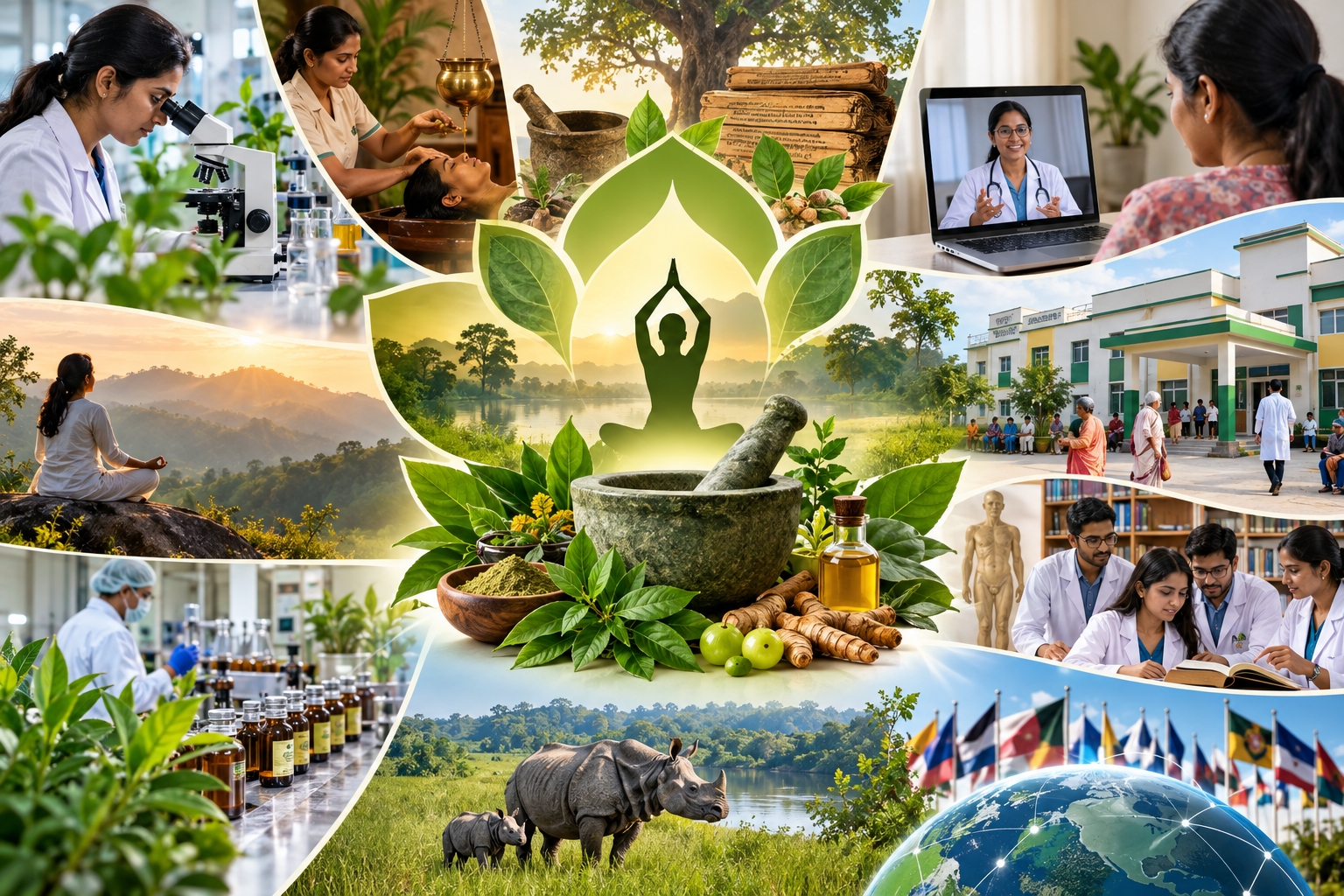
India is marking the 11th Ayurveda Day on September 23 with a focus on expanding Ayurveda’s role in healthcare through infrastructure, scientific research, education, regulation, digital access and international cooperation.
This year’s theme is “Ayurveda for a Healthier Tomorrow”, with the government highlighting efforts to integrate the traditional system of medicine with modern healthcare while strengthening evidence-based research and quality standards.
Expanding Ayurveda in public healthcare
Through the National Ayush Mission (NAM) and the National Health Mission (NHM), the government is expanding Ayush services, including Ayurveda, across public healthcare facilities.
Between 2014-15 and 2025-26, the Central Government released more than Rs 6,406.99 crore through the National Ayush Mission to States and Union Territories for integrating Ayush healthcare with conventional medical systems.
As of September 19, 2026, 12,260 Ayushman Arogya Mandirs (Ayush) were functional, against a target of 12,500.
Ayush services are also being provided alongside standard medical care at 13,249 public health facilities, comprising 6,302 Primary Health Centres, 3,191 Community Health Centres, 475 District Hospitals and 3,281 other local health facilities.
The government is funding salaries for 25,322 Ayush doctors and 5,666 Ayush paramedics across States and Union Territories.
The initiative also includes upgrading existing clinics, establishing integrated hospitals, providing essential medicines and expanding community health and awareness programmes.
Ayurveda enters telemedicine and insurance
Ayurveda services are also becoming accessible through digital healthcare.
The government’s eSanjeevani telemedicine platform, which has served more than 50 crore patients, provides Ayush OPD services, allowing people to consult doctors specialising in Ayurveda and other Ayush systems virtually.
Ayurvedic treatment has also been brought under the health insurance framework. The Insurance Regulatory and Development Authority of India mandated insurers in 2024 to offer products or add-ons covering all systems of medicine, including Ayurveda, under board-approved policies.
In February 2026, the All-India Institute of Ayurveda (AIIA), New Delhi, was empanelled with all 32 general insurance companies under a common agreement for cashless treatment.
International recognition and research
The government release also highlights the inclusion of Ayurveda in the WHO International Classification of Diseases 11th Revision Module.
According to the release, this allows Ayurveda, Siddha and Unani diagnoses to be recorded using standard codes, supporting documentation, research, policymaking and insurance processing.
Research and scientific validation remain a major focus. Under the AYURGYAN scheme, launched in 2021-22, Rs 9.38 crore has been allocated to 17 Ayurveda-specific projects out of a total research funding pool of Rs 17.79 crore across 34 projects.
The release says 11 specific research projects had been approved by early 2026, while Ayurvedic research contributed 33 specific publications between 2014-15 and 2025-26.
The AYUR SWASTHYA Yojana has also supported research, clinical studies, education, public health initiatives and infrastructure development. Of 28 specialised Centres of Excellence established under the initiative, 22 are focused on Ayurveda-centric research and healthcare delivery.
Growth in Ayurveda education
The expansion of healthcare infrastructure is accompanied by an increase in Ayurveda educational institutions.
As of March 13, 2026, India had 593 Ayurveda colleges, with 45,245 undergraduate seats and 5,673 postgraduate seats.
Under the National Ayush Mission, 17 Ayush colleges have been approved for establishment, including 12 focused on Ayurvedic education.
The Central Council for Research in Ayurvedic Sciences is also supporting research capacity through fellowships, training and student programmes. Its SPARK programme benefited 289 Ayurveda colleges between 2022-23 and 2024-25.
Focus on quality and regulation
The government is also strengthening regulatory mechanisms for Ayurvedic medicines.
Ayurvedic medicines are regulated under the Drugs and Cosmetics Act, 1940, and Drugs Rules, 1945. Manufacturers are required to follow Good Manufacturing Practices and meet safety, efficacy and pharmacopoeial standards.
Government drug inspectors conduct sampling and testing, while the e-Aushadhi portal enables paperless processing and tracking of drug manufacturing licence applications.
The FSSAI, in collaboration with the Ministry of Ayush, has also introduced regulations for Ayurveda Aahara, establishing a standardised framework for traditional Ayurvedic dietary products.
Expanding global partnerships
India is also expanding international cooperation in traditional medicine.
The government says India has signed 27 country-to-country MoUs, 16 MoUs for Ayush Academic Chairs and 57 institute-to-institute MoUs covering collaborative research and academics.
There are also 46 Ayush Information Cells across 43 countries and 104 scholarships for foreign nationals under the International Ayush Fellowship/Scholarship Programme.
New Delhi hosted the Second WHO Global Summit on Traditional Medicine in December 2025, which brought together delegates from more than 100 countries and 22 health ministers. Participants adopted the Delhi Declaration on incorporating traditional medicine into primary healthcare through scientifically supported approaches.
Rs 4,408 crore allocation for Ayush
The Union Budget 2026-27 allocated Rs 4,408 crore to the Ministry of Ayush.
Among the key initiatives are the establishment of three new All India Institutes of Ayurveda, upgrading Ayush pharmacies and drug-testing laboratories, and upgrading the WHO Global Traditional Medicine Centre in Jamnagar.
The government’s approach is aimed at creating a wider ecosystem around Ayurveda — spanning public healthcare, education, research, regulation, digital services and international collaboration — while placing greater emphasis on scientific validation and quality standards.