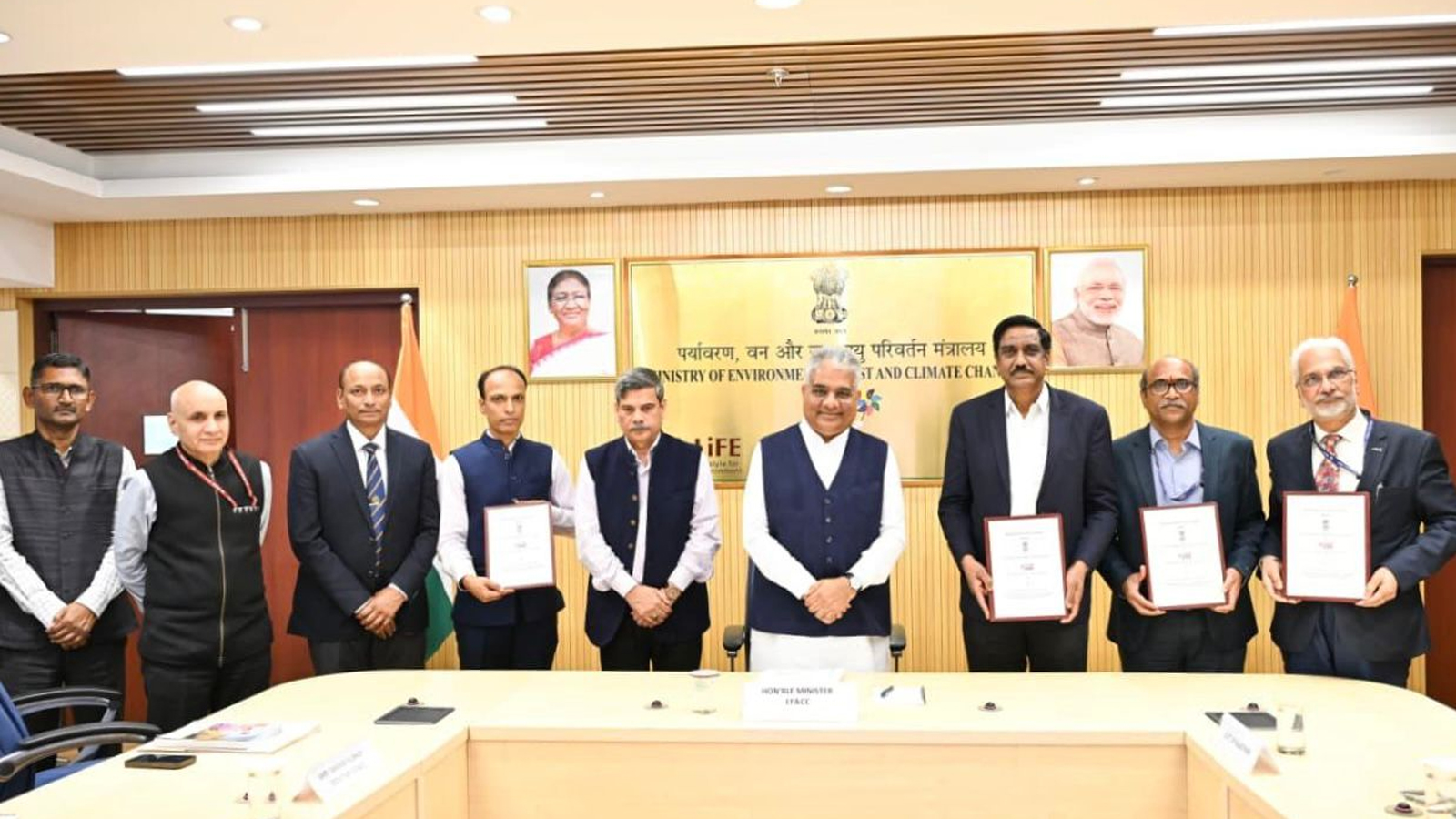
Union Minister for Environment, Forest and Climate Change Bhupender Yadav presided over the signing of four Memoranda of Understanding (MoUs) aimed at implementing a Standard Framework and a Road Asset Management System (RAMS) for sustainable and dust-free urban roads in the National Capital Region (NCR).
The MoUs were signed at Indira Paryavaran Bhawan in the presence of senior officials from NCR states – Delhi, Haryana, Uttar Pradesh and Rajasthan – along with representatives from CSIR-Central Road Research Institute (CSIR-CRRI) and the School of Planning and Architecture, New Delhi (SPA). The agreements operationalise the framework issued by the Commission for Air Quality Management (CAQM) to standardise paving, greening and maintenance of urban roads across NCR.
Calling the MoU signing a “collective commitment” rather than a procedural formality, Yadav emphasised the need for time-bound implementation, scientific mapping of high-traffic and dust-prone corridors, and evaluation of social impact. He also underlined the importance of planting low-water-requirement native species in open areas and along road corridors, stating that around 30 suitable species have already been identified by the Ministry.
The initiative builds upon a tripartite MoU signed earlier between CAQM, CSIR-CRRI and SPA to facilitate implementation of the framework and establish a Project Monitoring Cell for technical oversight.
Key Features of the Framework
The MoUs provide for standardised road cross-sections and right-of-way (RoW) design; structured greening for dust suppression within RoW; development of a Web-GIS-based Road Asset Management System (RAMS); adoption of sustainable and low-emission construction technologies; and scientific road condition assessment using modern tools such as Network Survey Vehicles, Falling Weight Deflectometer and Ground Penetrating Radar.
Under the plan, NCR states will implement road development and greening works in accordance with CAQM guidelines, while CSIR-CRRI and SPA will offer technical advisory and monitoring support.
Approximately 10,099 km of roads in Delhi, 10,133 km in Haryana, 6,891 km in Uttar Pradesh and 1,747 km in Rajasthan have been identified for phased coverage over a three-year period. Each state will designate a nodal agency and establish a dedicated Paving and Greening Cell.
The structured deployment of RAMS is expected to significantly reduce road dust emissions, enhance durability of road infrastructure, strengthen technology-enabled maintenance systems and promote sustainable urban corridor design.
Enforcement Task Force Reviews Compliance
Separately, the 126th meeting of CAQM’s Enforcement Task Force (ETF), held on February 20, reviewed inspection and enforcement activities across NCR between February 4 and 18.
During the period, flying squads conducted 318 inspections covering construction and demolition (C&D) sites, industrial units and diesel generator (DG) sets. A total of 131 violations were reported, including 123 in the industrial sector, four in C&D activities and four related to DG sets. Authorities proposed closure of 39 units, sealing of 10 DG sets, and issued 15 show-cause notices, while 28 cases remain under examination.
Since the inception of the enforcement drive, 26,328 inspections have been carried out across NCR. So far, 1,686 closure directions have been issued for non-compliance, with 1,290 units allowed to resume operations after verification of corrective measures.
The ETF also placed special emphasis on mechanised road sweeping, water sprinkling, maintenance of paved shoulders and strict adherence to dust mitigation measures, particularly along high-traffic corridors and urban hotspots.