In a major scientific breakthrough, researchers have discovered a new form of magnetism in a rare-earth compound – an advance that could pave the way for faster, more energy-efficient quantum and spintronic technologies.
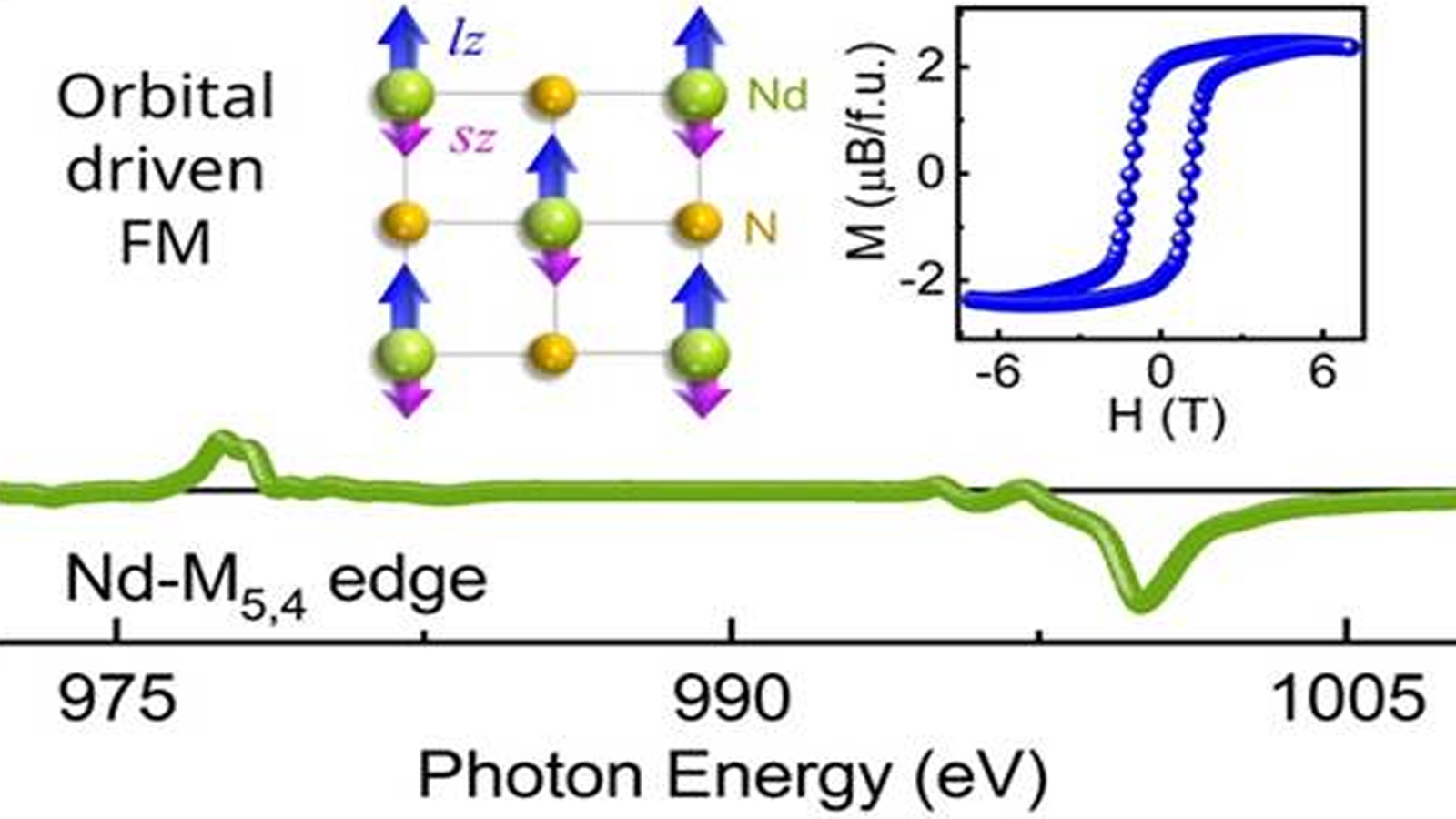
A team from the Jawaharlal Nehru Centre for Advanced Scientific Research (JNCASR) has shown for the first time that single-crystal thin films of neodymium nitride (NdN) exhibit ferromagnetism driven not by electron spin, as seen in conventional magnets, but by the electron’s orbital angular momentum. The findings, published recently in ACS Nano, mark a significant shift in the understanding of magnetic behaviour in rare-earth materials.
Rare-earth elements, especially neodymium, are central to technologies such as electric vehicles, smartphones, wind turbines and defence systems. Neodymium-based permanent magnets are valued for their exceptional strength. Until now, their magnetic properties were believed to be governed primarily by electron spin.
The new study reveals that NdN stabilizes a fundamentally different, orbital-driven magnetism—opening up possibilities in the emerging field of “orbitronics”, which seeks to utilise the orbital motion of electrons in futuristic quantum and magnetic devices.
“This discovery represents a paradigm shift in our understanding of magnetism,” said Prof. Bivas Saha, who led the research team at JNCASR, an autonomous institute under the Department of Science and Technology (DST). “By controlling the orbital degrees of freedom, we can develop materials where both spin and orbital moments can be precisely tuned for more efficient magnetic and quantum technologies.”
The team used state-of-the-art thin-film growth methods and advanced characterization techniques, combined with electronic structure analysis, to understand how crystal symmetry, electron hybridisation and rare-earth orbital states contribute to this unique magnetic behaviour.
The study also details the magnetic anisotropy and electronic band structure of NdN, offering a blueprint for designing materials with strong orbital contributions—a key requirement for next-generation orbitronic devices. Such innovations could help overcome the limitations of existing spin-based information and memory technologies.
The discovery comes at a crucial time as global competition for rare-earth resources intensifies. Neodymium is among the most strategically important minerals for clean-energy and defence applications. With nearly 8% of the world’s rare-earth reserves, India is positioned to play a significant role in future material innovations.
The research was conducted in collaboration with IISER Thiruvananthapuram, the Raja Ramanna Centre for Advanced Technology (Indore), and international partners at DESY (Germany) and ALBA (Spain). Contributors to the study include Renuka Karanje, Anupam Bera, Sourav Rudra, Debmalya Mukhopadhyay, Souvik Banerjee, Manisha Bansal, Kiran Baraik, Sourav Chowdhury, Weibin Li, Manuel Valvidares and Tuhin Maity.