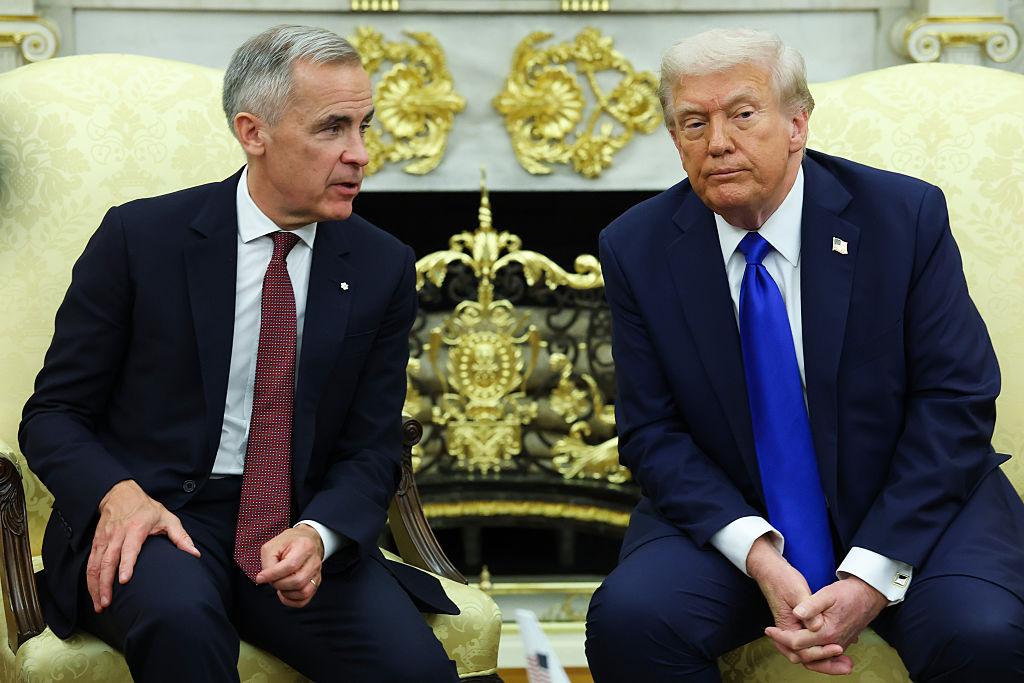
Canada’s Prime Minister Mark Carney made his second visit to the White House in five months on Tuesday under increasing pressure to address U.S. tariffs on steel, autos, and other goods that are hurting Canada’s economy.
Carney and U.S. President Donald Trump, both smiling, shook hands and chatted for a few seconds before entering the building. Their schedule calls for a face-to-face meeting followed by lunch.
“From the beginning, I liked him, and we’ve had a good relationship,” Trump told reporters in the Oval Office, sitting next to Carney.
“We have natural conflict. We also have mutual love … you know we have great love for each other,” he added, saying the two men would discuss tariffs.
In response, Carney called Trump a transformative president.
A Canadian government official and several analysts played down the chances of an imminent trade deal with Trump and said the fact discussions are continuing should be considered a success for Carney.
The prime minister last visited the Oval Office in May, when he bluntly told Trump that Canada would never be for sale in response to Trump’s repeated threat to purchase or annex Canada.
Since then, the prime minister has made numerous concessions to Canada’s biggest trading partner, including dropping some counter-tariffs and scrapping a digital services tax aimed at U.S. tech companies.
Carney’s office has said the working visit will focus on forging a new economic and security relationship with the U.S.
White House spokeswoman Karoline Leavitt said on Monday: “I’m sure trade will be a topic of discussion … and all of the other issues that are facing both Canada and the United States.”
CANADA STEEL, AUTO INDUSTRIES BEAR BRUNT
While the majority of Canada’s exports are entering the United States tariff-free under the U.S.-Canada-Mexico free trade agreement, tariffs have pummeled Canada’s steel, aluminum, and auto sectors and a number of small businesses.
“The reality is that right now, Canadian products have among the lowest tariff rate,” said Jonathan Kalles, a former adviser to Carney’s predecessor, Justin Trudeau. “You don’t want to poke the bear when things could be much worse,” he said, adding that any meeting with Trump is a calculated risk.
“Carney will probably get a better deal through private negotiations, not the pomp and ceremony of going to the White House,” he said.
Carney won an election in April, promising to be tough with Trump and secure a new economic relationship with the United States. Shachi Kurl, president of the Angus Reid Institute, said polls show Canadians have largely been willing to give Carney time to deal with Trump.
“But that amount of time is finite,” Kurl said, noting pressure may build with job losses mounting and economic growth hobbled by U.S. tariffs. The U.S. is the destination for nearly three-quarters of Canadian exports.
Doug Ford, premier of the Canadian industrial province of Ontario, reiterated calls for Carney to be prepared to be tougher with Trump.
“We seem to be weakening our case by continuously pulling off tariffs. I’d take a different approach – try to get a deal. If you can’t, we got to hit him back hard and never stop hitting him back hard, because we can never take a back seat to anyone, especially President Trump,” he told reporters.
“You sure don’t sit back and get beat up by a bully every single day.”
OPPOSITION CRITICIZES PRIME MINISTER’S APPROACH
Canada’s main opposition leader, Pierre Poilievre, has criticised Carney’s approach to Trump, noting the prime minister’s earlier pledge to “negotiate a win” by July 21. He said on Monday it did not look like Carney would accomplish much in the trip.
Dominic LeBlanc, the minister responsible for Canada-U.S. trade, said in response Canada has work to do on sectoral tariffs.
“Was the leader of the opposition suggesting that if the president of the United States invites us to go to Washington for a meeting and a working lunch, we should have just said no and hung the phone up?” LeBlanc said in Parliament.
Asa McKercher, a specialist in Canada-U.S. relations at St. Francis Xavier University, said Carney’s meeting with Trump would be a success if there is any recognition that Canada has moved to address some of Trump’s persistent grievances.
“Carney has just set up this new defense agency and boosted military spending, so it would be great if Trump could reduce some of those sectoral tariffs on autos,” McKercher said, citing Trump’s past complaint that Canada is a “military free-rider.”
(Reuters)