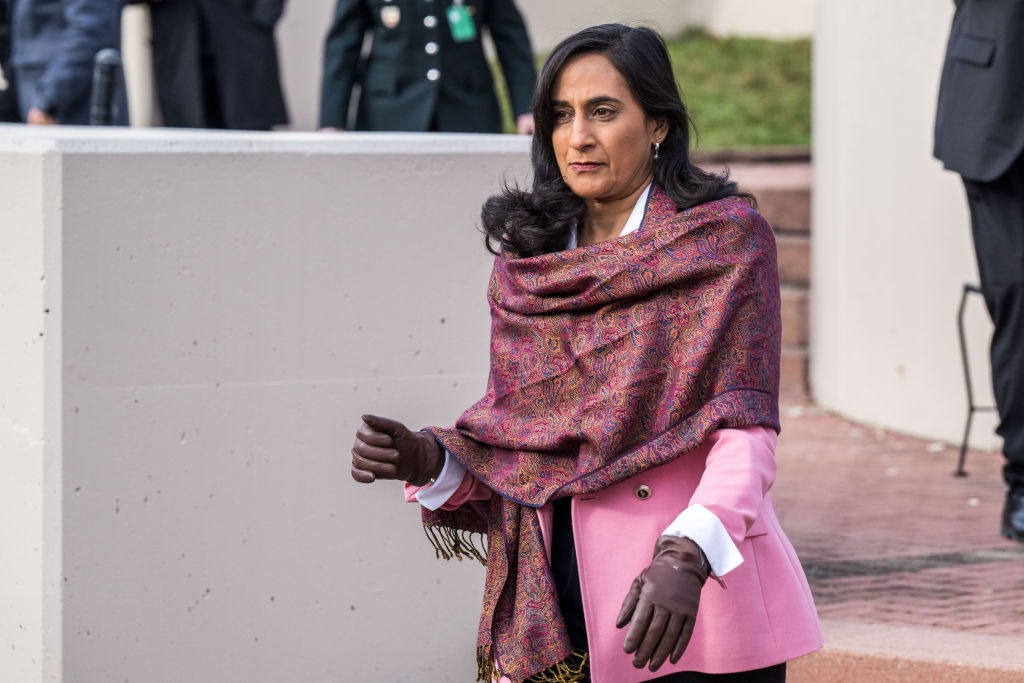
Canadian Foreign Minister Anita Anand on Wednesday called for stronger mechanisms to enforce international law, emphasising the role of institutions such as the International Criminal Court (ICC) and the International Court of Justice (ICJ) in safeguarding territorial integrity, human rights and state sovereignty.
Speaking at a Bloomberg New Economy 2026 discussion titled “Is This the Middle Power Moment?”, Anand highlighted the challenges of enforcing international law and stressed the importance of supporting international judicial institutions.
“Enforcement in the international arena is a very ambiguous, if not vulnerable, concept,” Anand said.
“International law has long suffered from the fact that there is no enforcement mechanism, and that’s why it is so important to support the international adjudicatory institutions like the ICC, like the ICJ, because they give, to the extent that is possible, some enforcement mechanism to the principles of territorial integrity, human rights, state sovereignty, etc,” she added.
Her remarks came amid renewed scrutiny of the ICC following the US Department of State’s announcement of additional sanctions against the court.
Washington said the measures were aimed at protecting American sovereignty and US citizens from what the Trump administration described as a threat posed by the ICC.
“Under President Trump, the United States has acted decisively to defend U.S. sovereignty and U.S. citizens against the threat of the International Criminal Court (ICC),” the State Department said in a fact sheet.
The department said the US had previously imposed sanctions on 17 individuals under an executive order before announcing the latest measures targeting the institution itself.
Under the sanctions, subject to applicable licences and exceptions, the ICC’s property and interests in property located in the United States or held by US persons are blocked and must be reported to the Treasury Department’s Office of Foreign Assets Control (OFAC).
The restrictions also prohibit US persons from engaging in transactions involving the property or interests of designated or otherwise blocked persons, including transactions conducted within or through the United States, unless specifically exempted or authorised.
Against this backdrop, Anand stressed that efforts to strengthen strategic autonomy and economic resilience must be accompanied by a commitment to the fundamental values underpinning international cooperation.
“We are all pragmatic in the sense that we’re speaking about how do we enhance our strategic autonomy and how do we ensure that we are resilient economically in these times. But we can’t forget the role that values play in this conversation,” she said.
“The idea is there are fundamental principles or values that will motivate us as well,” Anand added.
The discussion brought together Anand, External Affairs Minister S. Jaishankar, Asia Society Global President and CEO Kevin Rudd, and former British Prime Minister Rishi Sunak to examine the evolving international order and the role of middle powers amid shifting geopolitical and economic dynamics.
The session explored whether middle powers could deepen cooperation on security guarantees, open markets, reserve-currency arrangements and rules-based international institutions amid concerns over a perceived shift in US engagement with the global order it previously helped sustain.
During the discussion, Jaishankar highlighted the growing significance of economic and financial vulnerabilities in international relations, warning of the potential weaponisation of critical resources, financial systems and sanctions.
The exchange underscored the challenges facing middle powers as they seek to strengthen strategic autonomy, safeguard economic resilience and uphold international institutions amid intensifying geopolitical competition.
(ANI Inputs)