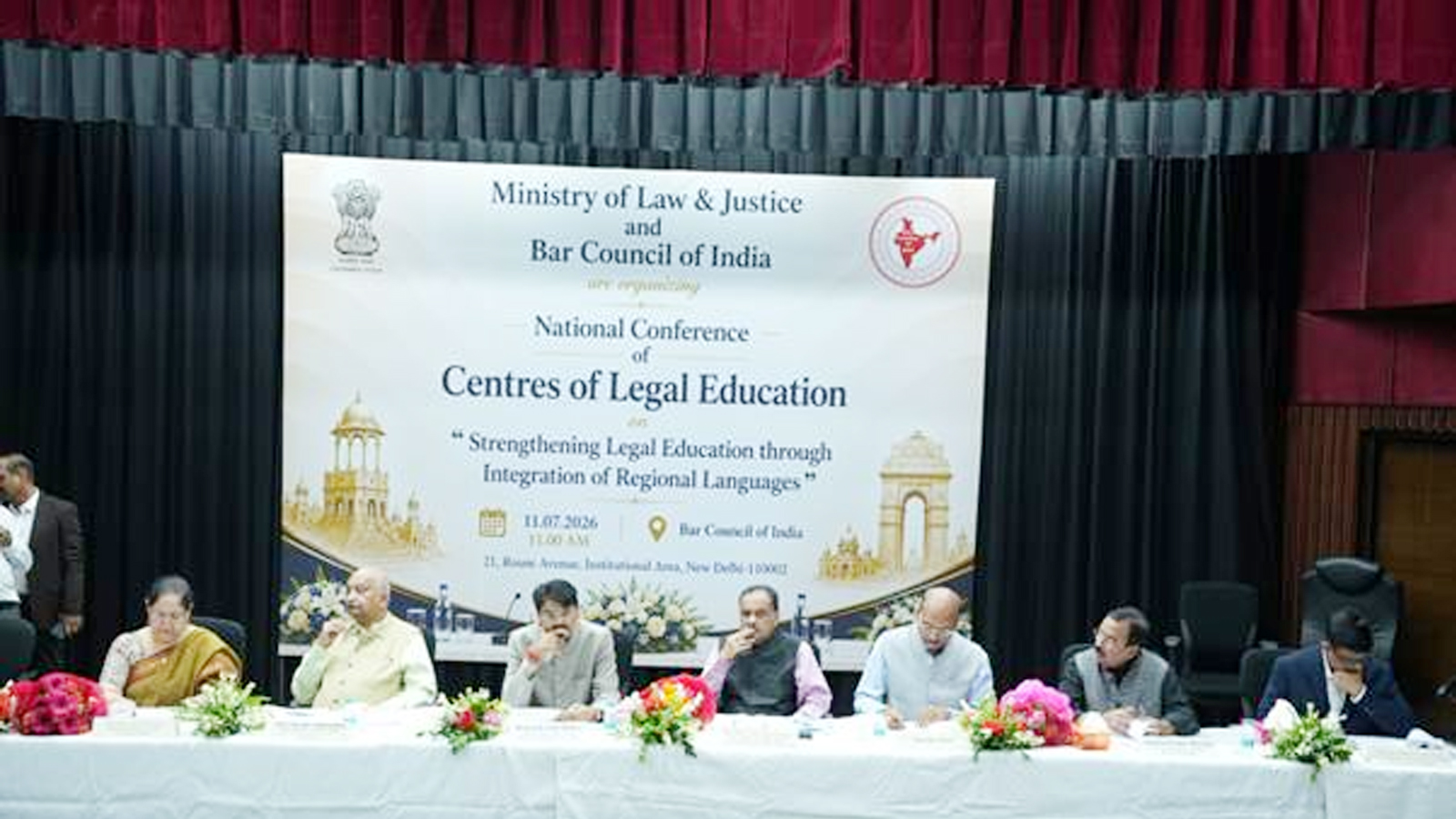
The Department of Legal Affairs under the Ministry of Law and Justice, in collaboration with the Bar Council of India (BCI), on Saturday held a national conference to formulate a long-term roadmap for integrating Hindi and other Indian languages into legal education while preserving English as an important link language.
The conference, titled “Strengthening Legal Education through Integration of Regional Languages,” brought together senior government officials, representatives of the judiciary, legal academicians, members of the Bar, and vice-chancellors of leading law institutions to deliberate on a Ten-Year Perspective Action Plan aimed at making legal education more inclusive and accessible.
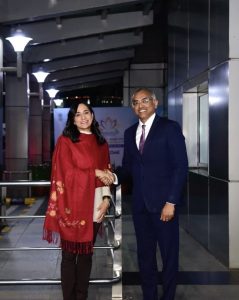
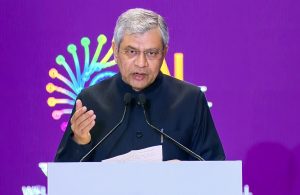
The event was attended by Justice Rajendra Menon, Chairperson of the Armed Forces Tribunal and Co-Chairperson of the Standing Committee on Legal Education of the Bar Council of India; Rajya Sabha MP and Bar Council of India Chairman Manan Kumar Mishra; Secretary, Department of Legal Affairs, Dr. Rajiv Mani; along with several other dignitaries.
The discussions focused on developing a phased, structured and measurable framework for introducing Indian languages into legal education without compromising quality. Participants emphasised that while English would continue to serve as an important national and international language for legal studies and practice, a bilingual and progressively multilingual education model could significantly improve legal comprehension and access to justice.
The proposed framework aims to strengthen legal education by enabling students to study law in Indian languages, particularly those intending to practise before district and subordinate courts. It is also expected to improve legal aid services and clinical legal education by making legal knowledge more accessible to a wider section of society.
Technology emerged as a key theme during the deliberations. Participants highlighted the potential of Artificial Intelligence-powered translation tools, digital legal repositories, standardised legal glossaries and terminology databases in supporting multilingual legal education. However, they stressed that such technological solutions must undergo rigorous validation by legal and linguistic experts to ensure the accuracy and reliability of legal terminology and educational content.
The conference also outlined several measures for the future. Participants agreed to work towards a National Declaration on Indian Languages in Legal Education, finalise the broad framework of the Ten-Year Perspective Action Plan for phased implementation, and establish a National Steering Committee jointly anchored by the Department of Legal Affairs and the Bar Council of India. The committee will be responsible for guiding, monitoring and overseeing the implementation of the proposed reforms.
The conference reaffirmed the shared commitment of the Government of India, the Bar Council of India and other stakeholders to promote inclusive, accessible and high-quality legal education by integrating Indian languages in a calibrated manner. The initiative is expected to contribute to greater access to justice while supporting the broader vision of Viksit Bharat by 2047.