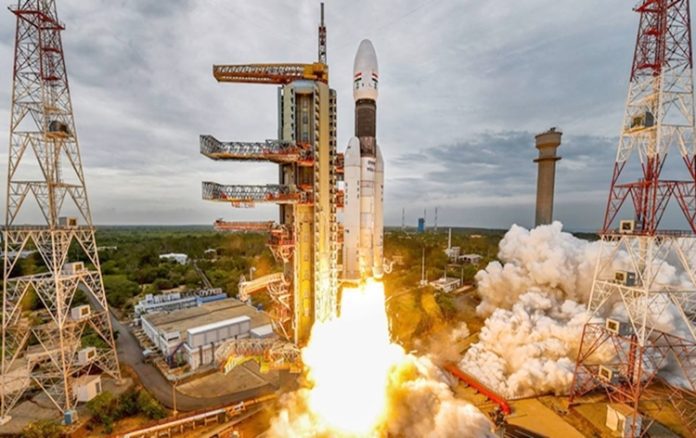
The Indian Space Research Organisation (ISRO)'s Vikram lander successfully soft-landed on Moon’s south pole at 6.04pm on August 23. This mission is seen as crucial to lunar exploration and India's standing as a space power. Prime Minister Narendra Modi waved the Indian flag as he watched the landing from South Africa, where he is attending the BRICS summit.
Scientists and officials clapped, cheered and hugged each-other as the spacecraft landed and as the government now looks to spur investment in private space launches and related satellite-based businesses. This was India's second attempt to land a spacecraft on the moon and comes less than a week after Russia's Luna-25 mission failed.
India scripted history by becoming the first country to land the ISRO's Chandrayaan-3 spacecraft on the Moon's south pole. The solar-powered rover Pragyan will explore the surface and transmit data to Earth over its two-week lifespan
The lunar south pole is a region whose shadowed craters are thought to contain water ice that could support a future moon settlement. On top of demonstrating its space technology capabilities, India's latest attempt for the moon landing following a failure in 2019, is sure to boost its space industry. Meanwhile, on the streets of New Delhi and elsewhere in the country, excitement was palpable among people.
The Chandrayaan-3 is aimed at the lunar south pole, a region with water ice, or frozen water, that could be a source of oxygen, fuel and water for future moon missions or a more permanent moon colony.
The Chandrayaan-3 is expected to remain functional for two weeks, running a series of experiments including a spectrometer analysis of the mineral composition of the lunar surface.
The Chandrayaan-3 lander stands about 2 meters tall and has a mass of just over 1,700 kg (3,747.86 lb), roughly on par with an SUV. It's designed to deploy a smaller, 26-kg lunar rover.
NASA administrator Bill Nelson said in a statement that the U.S. space agency was “looking forward” to what would be learned from the Indian mission.