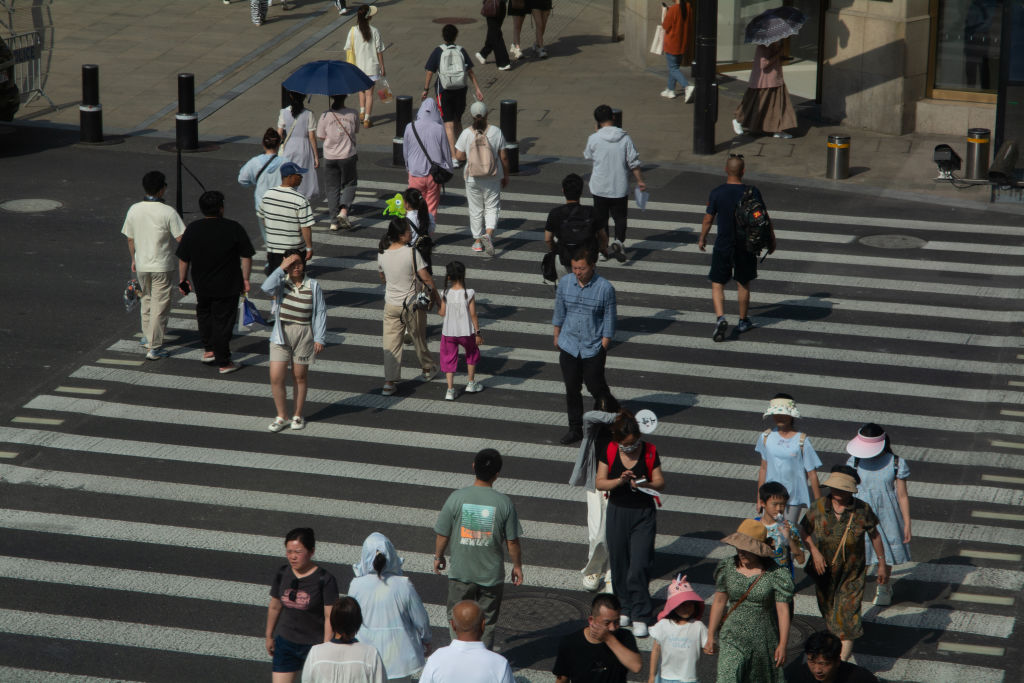
China is facing hotter and longer heatwaves and more frequent and unpredictable heavy rain as a result of climate change, the weather bureau warned on Thursday, as the world’s second-biggest economy braces for another scorching summer.
In its annual climate “Blue Book”, the China Meteorological Administration (CMA) warned that maximum temperatures across the country could rise by 1.7-2.8 degrees Celsius within 30 years, with eastern China and the northwestern region of Xinjiang set to suffer the most.
Last year, average national temperatures hit a new high, leading to record levels of glacial retreat and melting permafrost in the northwest, the Blue Book said.
China describes itself as one of the world’s most climate-vulnerable countries, and it is coming under increasing pressure to adapt to rapidly changing weather patterns and sea levels that are rising faster than the global average.
“China is a region that is sensitive to global climate change, a region where the impact will be significant,” said Yuan Jiashuang, vice-director of the CMA’s National Climate Centre, at a briefing.
She warned that if emissions remained high, extreme heat events expected to occur once every fifty years in China could happen every other year by the end of the century, and rainfall could double and become more unpredictable.
The weather bureau said on Thursday that it expects temperatures in most areas across China to be relatively high over the next few months, signalling a second consecutive summer of extreme heat.
“The weather is going to be different from previous years and there is more extreme weather now,” said Chen Yuhan, a resident of China’s commercial hub Shanghai, which saw above-38 Celsius (100.4 Fahrenheit) temperatures on Thursday.
“It surprises me every time I go out.”
Torrential rains and floods are already battering the south and temperatures have broken records in several parts of north and central China, threatening crops and putting pressure on electricity grids.
Average temperatures from March to May hit their highest since records began in 1961, according to official data.
Record-breaking temperatures last month broiled key grain producing provinces in the northwest and east, forcing corn farmers to delay planting, while torrential rain in other regions flooded soybean and rice fields.
“It is necessary to guard against the risk of yield reduction of cotton, early rice and late rice caused by high temperature and heat damage,” Jia Xiaolong, CMA’s deputy director, said at the briefing.
Summer temperatures in regions including Zhejiang, Jiangxi, Hunan, Fujian, Guangdong, Guangxi, Gansu and Ningxia are expected to be 1 to 2 degrees Celsius above normal, CMA said.
The weather bureau also said that two typhoons could make landfall in mainland China in July. The typhoons are expected to move in a westward or northwestward direction, authorities said.
Last year, two powerful typhoons – Doksuri and Haikui – made landfall, causing massive rains that broke records in some areas, unleashed flooding and prompted widespread evacuations.
(Reuters)