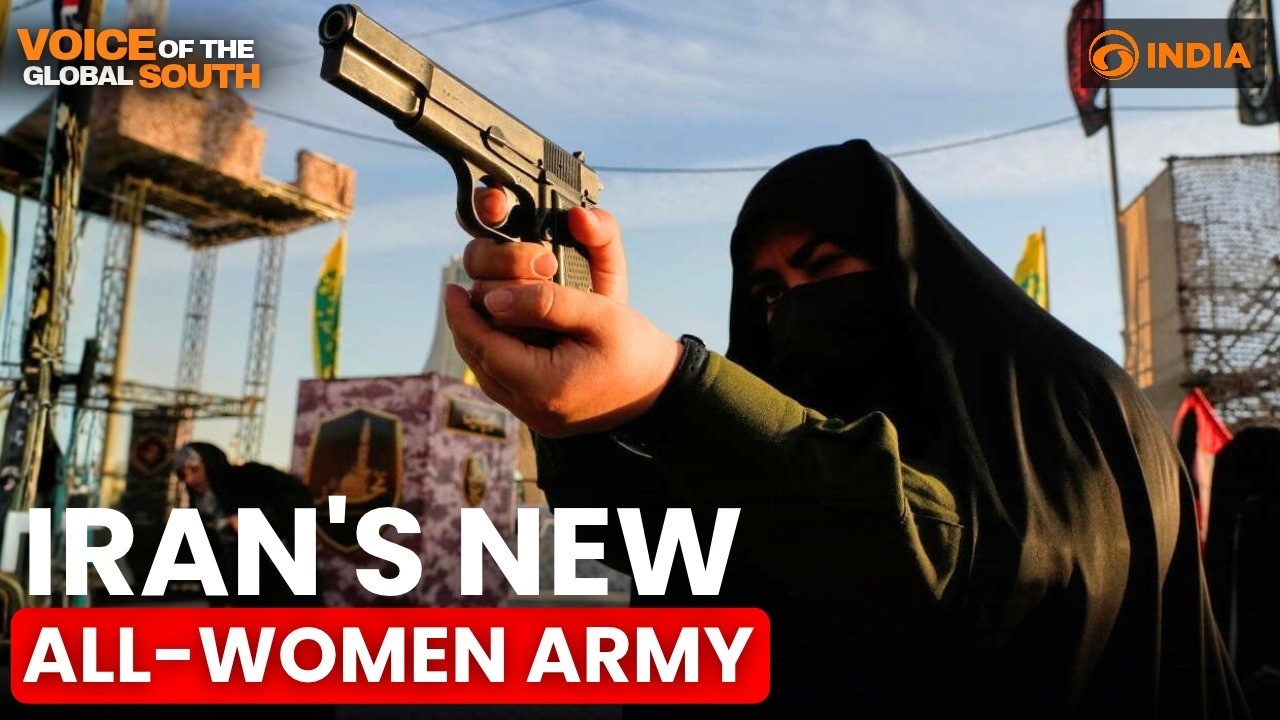
Dressed head-to-toe in traditional black chadors, dozens of Iranian women are scaling walls, flying down tactical ziplines and assembling assault rifles. Striking new images emerging from Tehran show female recruits undergoing intensive commando-style training — raising major questions about why the Islamic Republic is suddenly mobilising an all-female force at the very Square where women once protested for their freedom.
https://www.youtube.com/watch?v=oDx_WGbrdDI&feature=youtu.be
The training is taking place at Iran’s first-ever all-women military camp, which officially opened in the heart of Tehran on 10th November. According to State media, volunteers are learning everything from locking onto targets and close-quarters combat to battlefield first-aid. The camp is part of a broader mobilisation campaign called “Janfada” (meaning “Sacrifice for the Homeland”), which was first launched in March amid heightened military tensions with the U.S. and Israel.
While the military drills themselves are eye-catching, the location carries deep political symbolism. The training ground sits in Tehran’s iconic Azadi Square — a Persian name that literally translates to “Freedom.” For decades, strict hijab laws have tightly dictated how Iranian women dress and live in public. Back in 2022, following the death of Mahsa Amini in morality police custody, thousands of women marched through these very streets chanting “Woman, Life, Freedom,” only to be met with a brutal State crackdown. Now, with fears of a renewed U.S. or Israeli ground attack hanging over the region, the regime is suddenly banking on women to become its “first line of defence.”
Unlike men, women in Iran are not subject to mandatory military conscription. While Iranian women served as nurses and support staff during the Iran-Iraq War in the 1980s, openly training them with combat weaponry marks a significant shift. The move follows a massive state-organised rally in April titled “Daughters Devoted to Iran,” where women paraded alongside missile launchers and pink-painted military jeeps.
Islamic Revolutionary Guard Corps officials claim that the response has been overwhelming, asserting that half a million women signed up in just 100 minutes — a massive figure that cannot be independently verified. Alireza Salarkia, Deputy Coordinator for the Tehran I.R.G.C. base, framed the turnout as the regime’s ultimate deterrent: “Women account for nearly 50 per cent of the 33 million people who signed up in support of this system and revolution and declared that they were ready to sacrifice their lives for the revolution. We do not need a nuclear bomb. Our martyred leader declared that our nuclear bomb is the presence of these dear people… Countries around the world are now astonished, wondering what has happened that these people have been standing in the streets and squares for eight months, defending this system and revolution.”
Military analysts say that there are two ways to read the viral imagery coming out of Tehran. On the one hand, training civilians in urban combat and first aid signals that Tehran is digging in for a long, drawn-out conflict and preparing its population for worst-case scenarios. On the other hand, the carefully-staged photographs are designed to project an image of total national unity to both adversaries in Washington and a restless public at home.
As researchers at the Australian Institute of International Affairs point out, handing women assault-rifles does not mean handing them freedom in their everyday lives. Ultimately, Tehran’s message is clear: Strict social rules at home remain locked in place but when it comes to defending the regime, everyone is expected to fight.