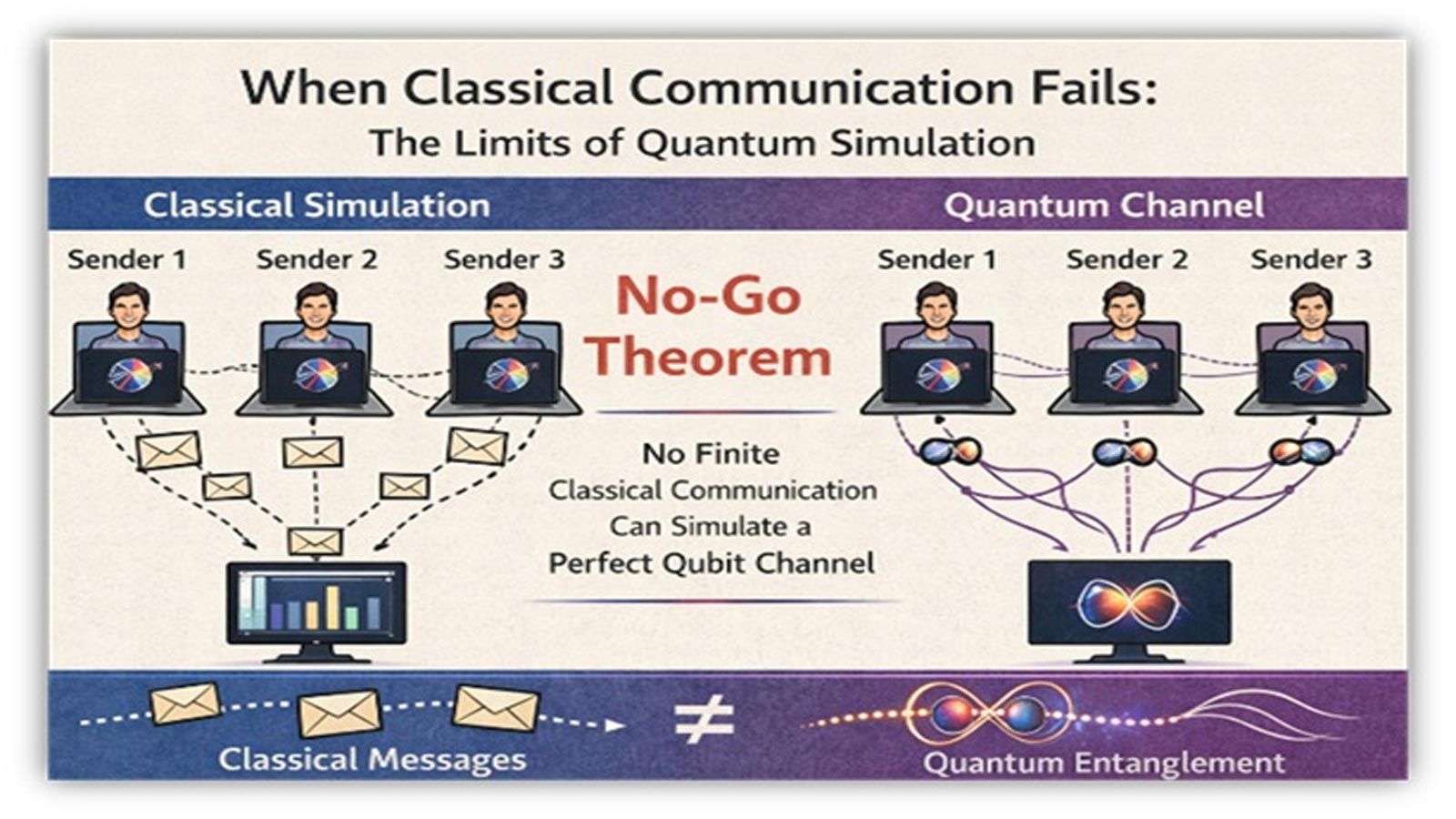
A recent international study has established a fundamental limitation of classical communication, concluding that no finite amount of classical messaging can accurately simulate a quantum communication channel. The findings mark a significant advance in understanding the boundary between classical and quantum physics, with important implications for future quantum technologies.
The research builds on a long-standing question first posed by Richard P. Feynman: whether quantum processes can be faithfully reproduced using only classical resources. This question lies at the core of quantum information science and the concept of “quantum advantage.”
The study was conducted by researchers including Sahil Gopalkrishna Naik and Manik Banik from the S. N. Bose National Centre for Basic Sciences, in collaboration with international scientists. Their findings were published in the journal Proceedings of the Royal Society A.
The researchers examined scenarios in which multiple distant parties attempt to replicate quantum measurement outcomes at a central node using only classical communication. While earlier work showed that such simulations are possible in simple two-party systems, the new study reveals that this breaks down in more complex network settings.
The team demonstrated that when multiple senders are involved, no finite classical communication can perfectly reproduce the behavior of a quantum channel. This limitation arises due to the role of entangled measurements – a uniquely quantum phenomenon that cannot be replicated through classical means.
The findings establish a “no-go theorem,” proving that even the most advanced classical communication strategies – allowing multiple rounds and bidirectional exchanges – cannot simulate a perfect qubit channel.
Beyond its technical significance, the study also has implications for the interpretation of quantum mechanics. It challenges the idea that quantum states are merely representations of knowledge, instead supporting the view that they reflect an underlying physical reality.
The research reinforces the concept of quantum advantage, highlighting that quantum systems are fundamentally more powerful than classical ones in certain information-processing tasks. It also underscores that quantum channels, particularly in networked systems, possess an irreducible quantum nature that cannot be mimicked by classical communication alone.