







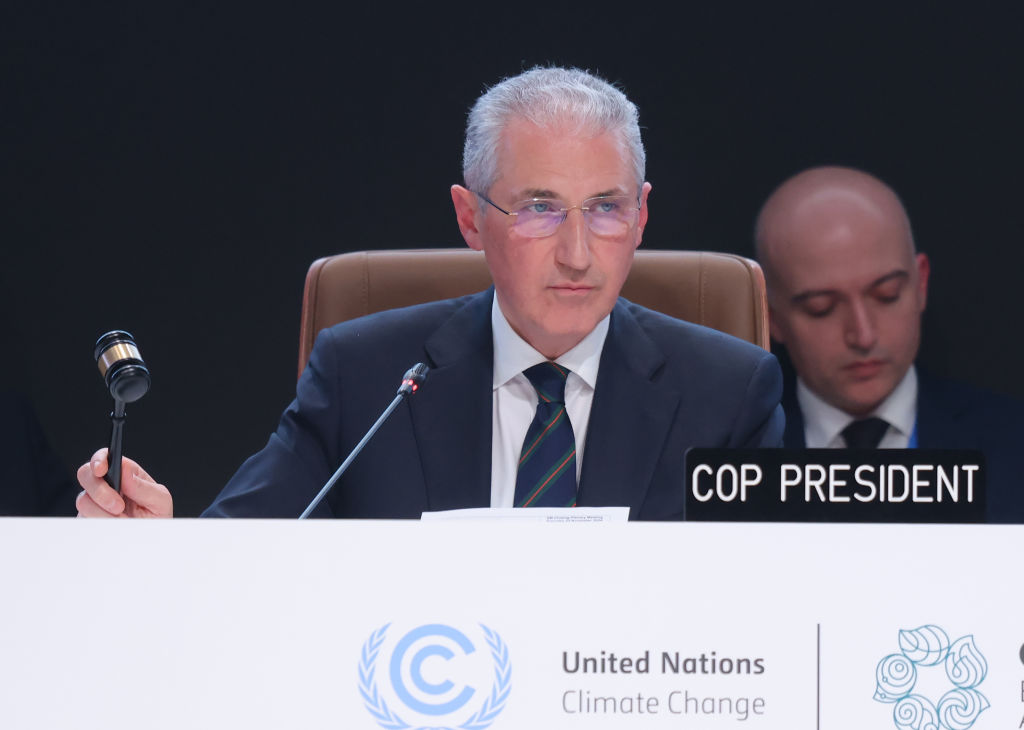
When COP29 President Mukhtar Babayev stepped to the podium at the closing meeting of the Baku climate summit on Sunday morning, hoping to clinch a hard-fought agreement on global climate finance, he carried with him two speeches.
One was crafted around a hoped-for deal being struck, while the other for the possibility of a summit-collapsing impasse, according to two sources familiar with the matter who spoke to Reuters on condition of anonymity.
“Yes, we had prepared different variations of the speech for various scenarios, but as we stepped onto the stage, we were confident in our success,” said one of the sources, an official in the COP29 presidency.
In the end, Babayev managed to gavel through the $300 billion finance plan to help developing nations cope with the soaring costs of global warming over the next decade before critics had time to object, allowing him to read the more positive speech.
He praised the agreement as a breakthrough and shamed the deal’s doubters as “wrong”, even as many of the climate deal’s intended recipients slammed it as woefully inadequate.
Babayev’s preparation for different outcomes at the divisive summit in the Caspian Sea nation of Azerbaijan reflected what many in the audience had already known before it began: the Baku climate talks were never going to go smoothly.
Expectations for a deal were depressed by worries of a looming U.S. withdrawal from global climate cooperation, geopolitical turmoil, and a rise of isolationist politics that had shunted climate change off much of the world’s top priorities list.
Those obstacles loomed large in Baku and will continue to overshadow global climate efforts in the months ahead as Brazil prepares for next year’s much broader conference in the Amazon rainforest city of Belem – where the world will plot a years-long course for steeper emissions cuts and building resilience in the fight against climate change.
“Multilateralism as a whole is under threat,” said Eliot Whittington, chief systems change officer at the Cambridge Institute for Sustainability Leadership.
“Indeed, the UNFCCC is probably the bright spot – proving that even in the face of incredibly hostile geopolitics and on fundamentally difficult questions, a deal can be made,” he said, referring to the U.N. body sponsoring the annual climate summit.
But the slow pace of progress, with global emissions still rising, has raised tensions and calls for reform.
“This is something that needs to be looked at, when just a handful of countries, based on their own economic interests, can almost wreck the entire process,” Sierra Leone Environment Minister Jiwoh Abdulai told Reuters.
(Reuters)