









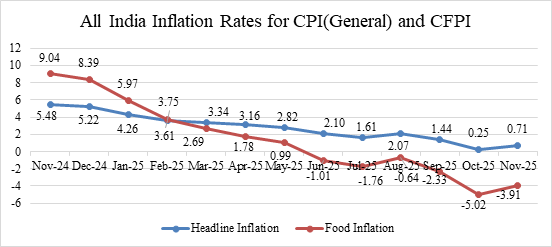
India’s headline inflation, as measured by the all-India Consumer Price Index (CPI), continued at low levels in November 2025 but rose compared with October, official provisional data released by the Ministry of Statistics & Programme Implementation shows. The all-India CPI inflation stood at 0.71 per cent year-on-year, up by 46 basis points from the previous month, reflecting a gradual uptick in price pressures across the economy.
Food inflation, captured through the Consumer Food Price Index (CFPI), remained in negative territory at -3.91 per cent on a year-on-year basis, though it narrowed significantly compared with October’s larger decline. The moderation in food deflation came as prices of vegetables, eggs, meat and fish, spices, and fuel and light showed firmness, according to the provisional figures for November.
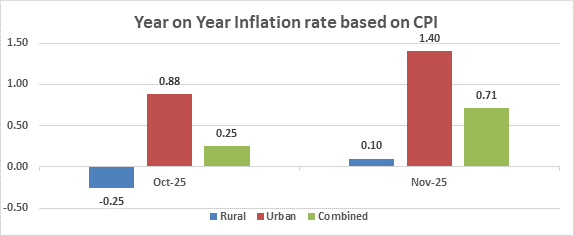
The provisional estimates point to a modest increase in rural inflation, which shifted from negative in October to 0.10 per cent in November, while urban inflation rose more sharply to 1.40 per cent, up from 0.88 per cent the previous month. This contrast underscores a balancing act between weaker food prices and rising costs in other segments of household expenditure.
Category-wise trends reveal a mixed picture. Housing costs, compiled for the urban sector, recorded a 2.95 per cent rise compared with the same period last year, largely steady with October. Education and health costs continued to trend higher, although at slightly lower rates than the previous month. Transport and communication saw moderate inflation, and fuel and light costs moved up further, signaling sustained pressure in energy-related components of the CPI.
Behind these headline numbers is an expansive data collection exercise undertaken by the National Statistical Office, with price data gathered from a wide network of rural and urban markets across all states and union territories. For November, field staff reported high coverage of selected markets, ensuring the robustness of the provisional estimates.
Economists and policymakers will be watching these trends closely as they integrate into broader assessments of economic activity, consumer demand and monetary policy. The next set of CPI data, covering December 2025, is scheduled for release on January 12, 2026, or the next working day should there be a holiday.
The provisional data suggest a slow shift from deeply subdued price pressures toward a more balanced inflation environment, with food prices stabilizing and costs in other sectors nudging up. This nuanced landscape reflects ongoing adjustments in supply chains and demand patterns as the Indian economy evolves.