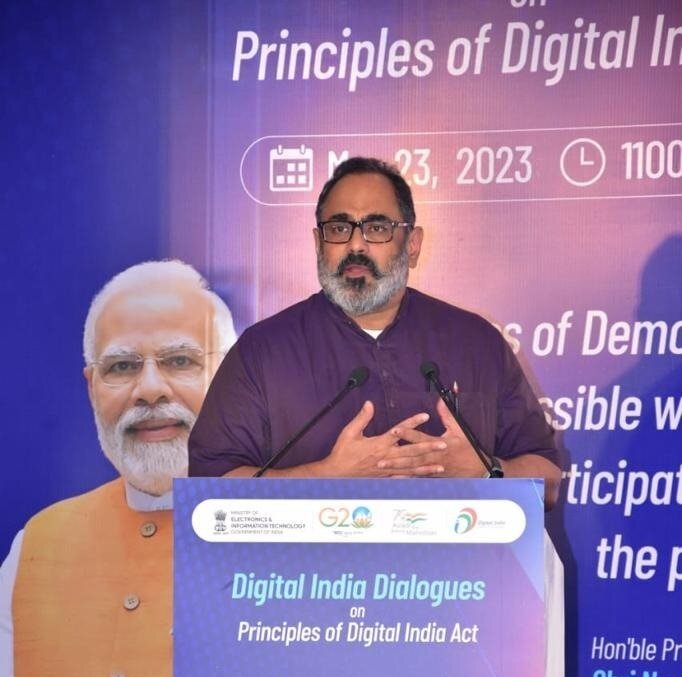
Union Minister Rajeev Chandrasekhar held a Digital India Dialogues’ session on Tuesday (May 22) in Mumbai on the Digital India Act. The session was attended by various stakeholders in the tech industry, including members of the startup community and legal professionals, among others.
In a statement, the Ministry of Electronics and IT informed that the consultation was in line with Prime Minister Narendra Modi’s initiative to develop a consultative approach to law and policy making.
Terming the act as ‘future-ready legislation’, the government says that it aims to catalyse India’s ambition of being in the leading pack of nations that will shape future technologies. Further, it is the first time the consultations are taking place at the pre-draft stage of the bill.
What is the Digital India Act?
The act aims to replace the existing IT Act and provide a strong legal framework to support India’s techade goals. The Digital Personal Data Protection Bill, the National Data Governance Framework policy, the recent amendments to the IT Rules, and the CERT-In guidelines form the important elements of this legal framework.
Earlier, in a similar programme held in Bengaluru, Union Minister Rajeev Chandrasekhar said that the proposed Digital India Act aims to help develop India as a globally competitive innovation and entrepreneurial ecosystem while at the same time protecting the rights of its citizens.
Given the present scenario of the internet and how it has become vulnerable to various types of complex user harms like catfishing, cyber stalking, cyber trolling and phishing, among others, there is an urgent need for a specialised and dedicated adjudicatory mechanism for online civil and criminal offences. Moreover, according to the Ministry, the act consists of global standard cyber laws.
“The act provides a strong legal framework for protecting the rights of 'Digital Nagriks' while ensuring an enabling environment for innovation and growth,” said Union Minister Rajeev Chandrasekhar.
World’s largest digitally connected democracy
India is often regarded as the world's largest digitally connected democracy due to its vast population and its increasing adoption of digital technologies. The country has witnessed remarkable growth in internet penetration, mobile phone usage, and the development of various digital platforms.
The Ministry informs that the country has around 830 million internet users and the internet is largely governed by the 23-year-old IT Act, which is lacking in provisions on user rights, trust, and safety, among other challenges. In addition, the Ministry observes that the present IT Act is not well-equipped to deal with evolving, sophisticated forms of cybercrimes like doxxing, cyberstalking, online trolling, etc.