











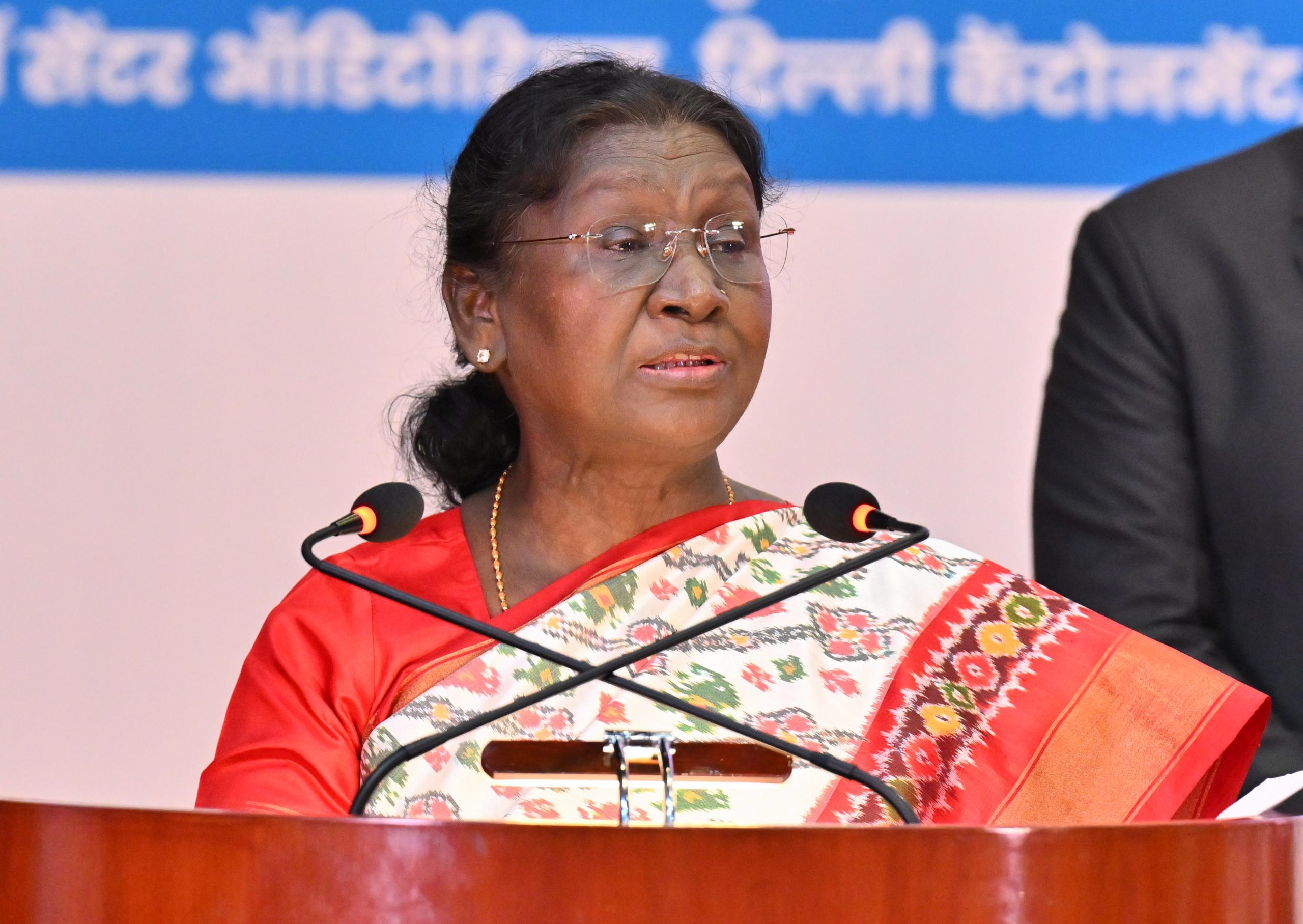


President Droupadi Murmu on Sunday said India must ensure equal participation of women in all spheres of life to achieve development in the true sense, noting that women constitute nearly half of the country’s population.
The President made the remarks while addressing a national-level event organised by the Ministry of Women and Child Development in New Delhi to mark International Women’s Day.
Highlighting the growing role of women in India’s progress, Murmu said women are taking the lead across sectors including education, administration, judiciary, the armed forces, science, technology, medicine, arts and entrepreneurship. She noted that women in rural areas are becoming financially self-reliant through Self-Help Groups (SHGs) and are contributing to grassroots governance through their leadership in panchayats.
“Given the right opportunities and support, women can achieve excellence in every field,” the President said.
Murmu said India is steadily moving towards women-led development, adding that significant progress has been made over the past decade in removing barriers that limit women’s participation in society.
She noted that India has achieved gender parity in school education, while the Gross Enrolment Ratio of female students in higher education has also seen notable growth. Participation of women in Science, Technology, Engineering and Mathematics (STEM) education is also rising steadily.
Referring to the Union Budget 2026–27, the President said the proposal to establish a women’s hostel in every district will help female STEM students continue their education and prepare for leadership roles in the knowledge economy.
Murmu also highlighted the growing presence of women in entrepreneurship. She said more than half of the start-ups supported under the Start-up India initiative have at least one woman director, while over two lakh women-owned MSMEs are currently active on the Government e-Marketplace (GeM).
She further mentioned the SHE-Mart initiative, announced in the Union Budget 2026–27, which aims to provide better market access for products made by self-help groups and rural women.
The President added that the labour codes implemented last year seek to create a more inclusive and safe working environment for women.
At the same time, she said several challenges remain in the journey towards women’s empowerment, including discrimination, unequal pay and domestic violence. Addressing these issues, she said, requires not only legal measures but also a change in societal mindset.
Murmu said that as India moves towards the goal of becoming a developed nation by 2047, empowering women and ensuring their equal participation will be essential for the country’s progress.
Calling for collective action, the President urged citizens to pledge to provide education and equal opportunities to every girl, prioritise the dignity and safety of women, and work towards eliminating discrimination in society.
She said such efforts would help present India’s model of women’s empowerment to the world.







