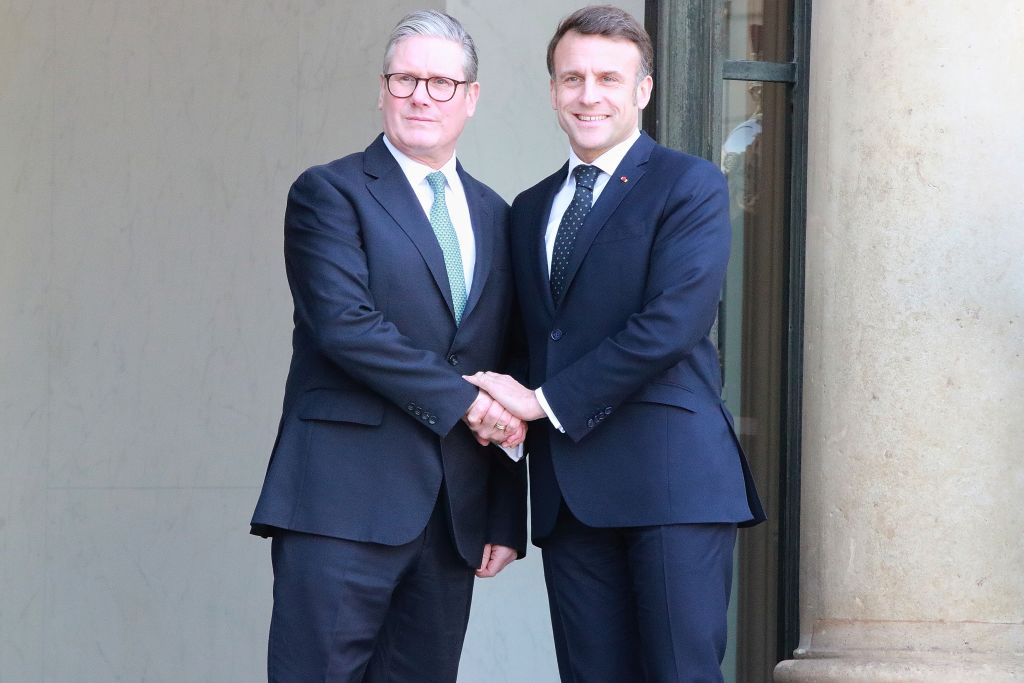
European leaders meeting in Paris for emergency talks on Monday called for higher spending to ramp up the continent’s defence capabilities but remained split on the idea of deploying peacekeepers to Ukraine to back up any peace deal.
The leaders also agreed it would be dangerous to conclude a Ukraine ceasefire without a peace agreement at the same time, and that they were ready to provide security guarantees to Ukraine “depending on the level of American support,” a European official said.
“We agree with President Trump on a “peace through strength” approach,” the official said, speaking on condition of anonymity.
The Paris meeting was called by French President Emmanuel Macron after U.S. President Donald Trump arranged bilateral peace talks with Russia, excluding European allies and Ukraine from negotiations to end the war that are scheduled to begin in Saudi Arabia on Tuesday.
Macron spoke with Trump ahead of the meetings, officials from both countries said on Monday. A White House official called it “a friendly call” in which they talked about the Paris meeting and the talks in Saudi Arabia.
Ukrainian President Volodymyr Zelenskiy also said he had a “long” call with Macron on security guarantees.
“We share a common vision: security guarantees must be robust and reliable,” Zelenskiy said on X, adding: “Any other decision without such guarantees — such as a fragile ceasefire — would only serve as another deception by Russia and a prelude to a new Russian war against Ukraine or other European nations.”
Trump stunned Ukraine and European allies last week when he announced he had called Russian President Vladimir Putin, long ostracised by the West, to discuss ending the war without consulting them, and they must now confront the reality of a future with less U.S. protection.
The U.S. decision has sparked a realisation among European nations that they will have to do more to ensure Ukraine’s security.
British Prime Minister Keir Starmer, who before the meeting said he was willing to send peacekeeping troops to Ukraine, said on Monday there must be a U.S. security commitment for European countries to put boots on the ground. He said it was too early to say how many British troops he would be willing to deploy.
A peacekeeping force would not only raise the risk of a direct confrontation with Russia, which launched its full-scale invasion of Ukraine in 2022, but also stretch European armies, whose arsenals have been depleted by supplying Ukraine and decades of relative peace.
There are also difficult questions about how some European nations, whose public finances are groaning, will pay for such expanded military commitments.
Keith Kellogg, Trump’s Ukraine envoy, said he would visit Ukraine from Wednesday and was asked if the U.S. would provide a security guarantee for any European peacekeepers.
“I’ve been with President Trump, and the policy has always been: You take no options off the table,” he said.
DEFENCE SPENDING
Starmer’s push for peacekeepers appeared to draw a dividing line between participants in Paris, who included German Chancellor Olaf Scholz, and Giorgia Meloni, Donald Tusk and Pedro Sanchez, the prime ministers of Italy, Poland and Spain.
Scholz said there could be no peace deal without Ukraine’s consent, but said talk of a German peacekeeping mission in Ukraine was “highly inappropriate” without a peace deal in hand.
Both he and Tusk though said stringent EU fiscal rules should be loosened to allow more spending on defence without countries falling foul of the EU’s deficit rules.
Meloni also questioned the peacekeeping plan, according to sources in her office.
“It was useful to discuss today the various hypotheses on the table. The one that foresees the deployment of European soldiers in Ukraine seems to me to be the most complex and perhaps the least effective, and on this too I voiced Italy’s doubts,” she said, according to the sources.
Danish Prime Minister Mette Frederiksen said she was open to discussing troop deployments and that Europe must boost its support for Ukraine while ramping up domestic defence spending.
“Russia is threatening all of Europe now, unfortunately,” he told reporters.
(Reuters)