








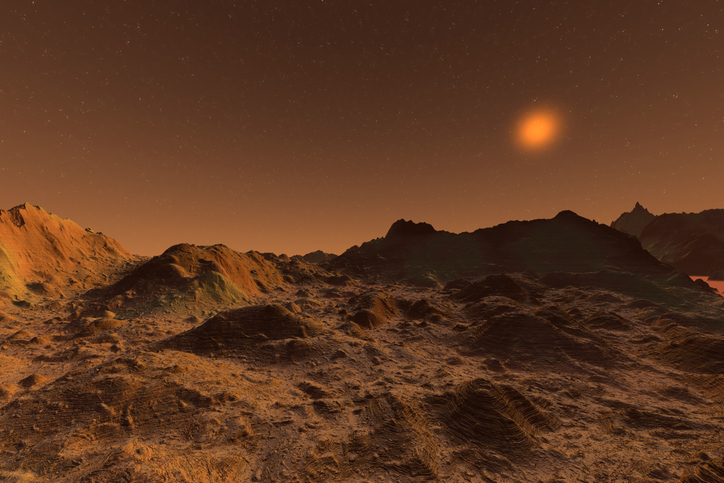
Ground-penetrating radar data obtained by China’s Zhurong rover has revealed buried beneath the Martian surface evidence of what look like sandy beaches from the shoreline of a large ocean that may have existed long ago on the northern plains of Mars.
The findings are the latest evidence indicating the existence of this hypothesized ocean, called Deuteronilus, roughly 3.5 to 4 billion years ago, a time when Mars – now cold and desolate – possessed a thicker atmosphere and warmer climate. An ocean of liquid water on the Martian surface, according to scientists, potentially could have harbored living organisms, much like the primordial seas of early Earth.
The rover, which operated from May 2021 to May 2022, journeyed about 1.2 miles (1.9 km) in an area that exhibits surface features suggestive of an ancient shoreline. Its ground-penetrating radar, which transmitted high-frequency radio waves into the ground that reflected off subsurface features, probed up to 80 meters (260 feet) beneath the surface.
The radar images detected some 33-115 feet (10-35 meters) underground thick layers of material with properties similar to sand, all sloped in the same direction and at an angle similar to that of beaches on Earth just below the water where the sea meets the land. The researchers mapped these structures spanning three quarters of a mile (1.2 km) along the rover’s path.
“The Martian surface has changed dramatically over 3.5 billion years, but by using ground-penetrating radar we found direct evidence of coastal deposits that weren’t visible from the surface,” said Guangzhou University planetary scientist Hai Liu, a member of the science team for China’s Tianwen-1 mission that included the rover.
On Earth, beach deposits of this size would have needed millions of years to form, the researchers said, suggesting that on Mars there was a large and long-lived body of water with wave action that distributed sediments carried into it by rivers flowing from nearby highlands.
“The beaches would have been formed by similar processes to those on Earth – waves and tides,” said Liu, one of the leaders of the study published on Monday in the journal Proceedings of the National Academy of Sciences. “Such oceans would have profoundly influenced Mars’ climate, shaped its landscape and created environments potentially suitable for life to emerge and thrive.”
“Shorelines are great locations to look for evidence of past life,” said planetary scientist and study co-author Michael Manga of the University of California, Berkeley. “It’s thought that the earliest life on Earth began at locations like this, near the interface of air and shallow water.”
The rover explored in the southern part of Utopia Planitia, a large plain in the Martian northern hemisphere.
The researchers ruled out other possible explanations for the structures Zhurong detected.
“A primary part of this work was testing these other hypotheses. Wind-blown dunes were considered, but there were a few issues. First, dunes tend to come in groups, and these groups produce characteristic patterns not present in these deposits,” Penn State geoscientist and study co-author Benjamin Cardenas said.
“We also considered ancient rivers, which exist in some nearby locations on Mars, but we rejected that hypothesis for similar reasons based on the patterns we saw in the deposits. And you don’t typically get structures like this in lava flows, either. Beaches simply fit the observations the best,” Cardenas said.
Earth, Mars and the solar system’s other planets formed roughly 4.5 billion years ago. That means Deuteronilus would have disappeared approximately a billion years into Martian history, when the planet’s climate changed dramatically. Scientists said some of the water may have been lost to space while large amounts may remain trapped underground.
A study published last year based on seismic data obtained by NASA’s robotic InSight lander found that an immense reservoir of liquid water may reside deep under the Martian surface within fractured igneous rocks.
For decades, scientists have used satellite images to trace Martian surface features resembling a shoreline. But any such evidence on the surface could have been erased or distorted by billions of years of wind erosion or other geological processes.
That is not the case with the newly found structures, which were entombed over time under material deposited by dust storms, meteorite strikes or volcanism.
“These are beautifully preserved because they are still buried in the Martian subsurface,” Cardenas said.
(Reuters)