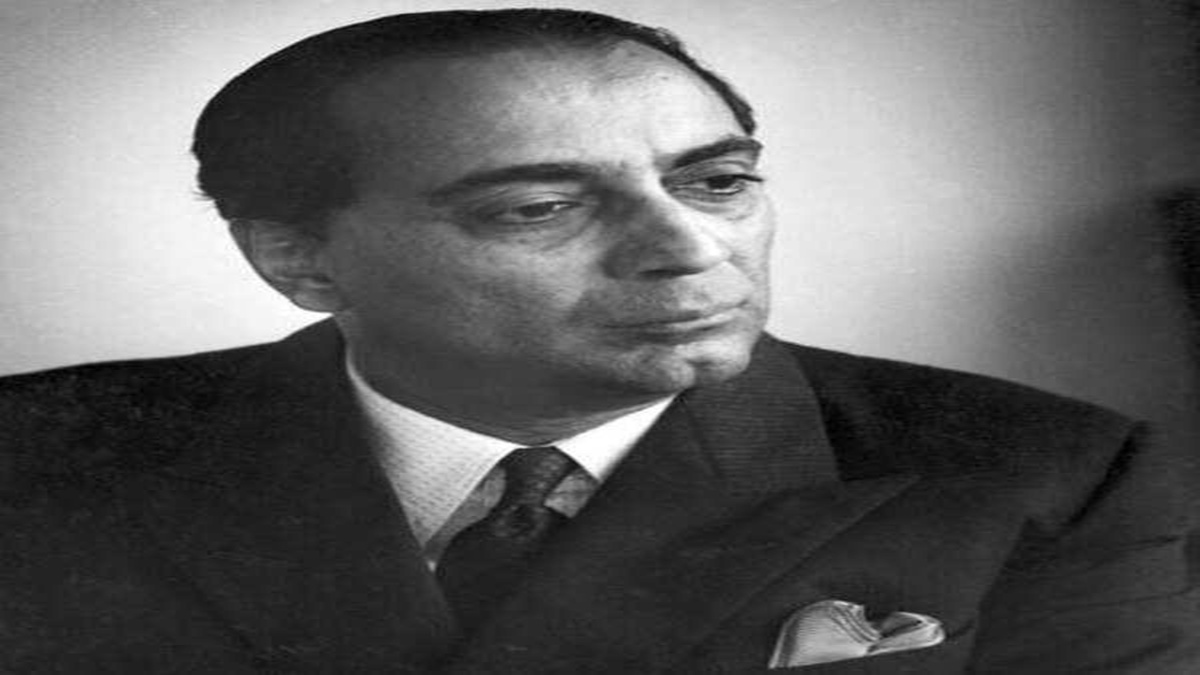
Dr Homi Jehangir Bhabha envisioned an India that could develop its own scientific expertise and harness nuclear energy for national development. A pioneering physicist and institution-builder, he helped create the research facilities and administrative framework that shaped the country’s atomic energy programme.
Born on October 30, 1909, Bhabha is remembered as the father of India’s nuclear programme. His contribution extended beyond scientific research: he recognised that technological self-reliance required trained scientists, well-equipped laboratories and sustained institutional support.
Who was Homi Jehangir Bhabha?
Bhabha was born to Jehangir H. Bhabha and Meherbai Framji Panday at Kenilworth House in Bombay, now Mumbai. The house on Peddar Road, now Dr Deshmukh Marg, belonged to his aunt Cooverbai Panday.
He grew up in an environment that encouraged intellectual and cultural interests. His family’s connections with the Tatas exposed him to discussions about Indian industry and the country’s future. His paternal aunt Meherbai was married to Dorabji Tata, and visits to the family’s Esplanade House brought him into contact with the ideas of industrialists and nationalist leaders.
At the Cathedral and John Connon School, Bhabha developed interests in science, languages, poetry, painting and Western classical music. These pursuits remained part of his life even as physics became his principal vocation.
How did he choose a career in physics?
Before travelling to Cambridge, Bhabha studied at Elphinstone College and the Royal Institute of Science. During this period, a lecture by American physicist Arthur Compton introduced him to cosmic rays, which later became an important area of his research.
Although he initially enrolled in engineering at Cambridge, Bhabha wanted to pursue physics. In a letter to his father, he explained that his ambitions lay in scientific research rather than business or an engineering career.
“Physics is my line,” he wrote. “I am burning with a desire to do physics.”
He earned his doctorate in 1935 under R. H. Fowler at the Cavendish Laboratory. Studentships enabled him to travel and interact with leading physicists, including Enrico Fermi in Rome, while developing his research career.
Why were his years in Bangalore important?
Bhabha’s work at the Indian Institute of Science in Bangalore helped connect his scientific interests with the practical needs of research in India.
With support from the Sir Dorabji Tata Trust, he established a cosmic ray research unit. His experience also highlighted the difficulties of conducting advanced research without adequate facilities and institutional backing.
He began advocating a world-class institution for original work in nuclear physics, cosmic ray physics, high-energy physics and other emerging fields. This became a crucial step towards building a domestic scientific community capable of supporting India’s future technological needs.
How did the Tata Institute of Fundamental Research take shape?
On the advice of J. R. D. Tata, Bhabha submitted a proposal to the Sir Dorabji Tata Trust for a dedicated research institution.
His argument was forward-looking: India needed to train scientists before nuclear energy became widely available for electricity generation.
“When nuclear energy has been successfully applied for power production in, say, a couple of decades from now, India will not have to look abroad for its experts but will find them ready at hand,” he wrote to Sir Sorab Saklatvala.
The Tata Institute of Fundamental Research was established in 1945. Its early Bombay premises were at Kenilworth House, where Bhabha had been born. The room of his birth became his office.
TIFR provided a base for fundamental research and helped nurture the scientific expertise required for India’s emerging nuclear programme.
Why is Bhabha called the father of India’s nuclear programme?
The description reflects his role in connecting scientific research, institution-building and government policy.
Bhabha understood that a nuclear programme required more than equipment. It needed scientists, technical skills, research institutions, funding and an organisational structure capable of sustaining work over decades.
After Independence, he worked closely with Prime Minister Jawaharlal Nehru, who shared his belief in science as a foundation for national development.
The Atomic Energy Act and the establishment of the Atomic Energy Commission in 1948 provided a framework for organised nuclear research. Bhabha played a central role in shaping this effort and developing the institutions needed to carry it forward.
What was the significance of Trombay and the Department of Atomic Energy?
As the programme expanded, India needed facilities dedicated to atomic energy research and development.
In 1954, the Atomic Energy Commission decided to establish an atomic energy centre at Trombay. The Atomic Energy Establishment, Trombay, became a major focus of the country’s nuclear activities.
The Department of Atomic Energy was created in August 1954 under the direct charge of the Prime Minister, with Bhabha appointed its secretary. Its location in Bombay enabled him to oversee work at Trombay.
Together, these developments gave the programme a stronger scientific and administrative foundation. Bhabha received the Padma Bhushan in 1954 in recognition of his contributions.
What role did he play internationally?
Bhabha was a prominent advocate of international scientific cooperation in the peaceful uses of atomic energy.
He presided over the first United Nations Conference on the Peaceful Uses of Atomic Energy, which brought together scientists from the Soviet bloc and Western countries during the Cold War.
He also contributed to the work of the International Atomic Energy Agency through its Scientific Advisory Committee and represented India in the agency’s General Assembly.
His international engagement complemented his domestic mission: building Indian expertise while participating in the wider exchange of scientific knowledge.
Was his work limited to science?
Bhabha maintained a deep interest in painting, music and theatre. At Cambridge, he sketched, designed stage sets and explored musical composition.
His combination of artistic and scientific interests impressed C. V. Raman, who described him as “the modern equivalent of Leonardo da Vinci”.
These interests formed part of a broader intellectual outlook that accompanied his work as a researcher and institution-builder.
What is his lasting legacy?
Bhabha died in a plane crash in 1966 while travelling to Vienna. His death cut short a career that had helped establish the foundations of India’s atomic energy capabilities.
His legacy survives in the institutions he helped build and in his emphasis on developing expertise within the country. Former Atomic Energy Commission chairman Homi Sethna remembered him as a visionary who sought a self-reliant India through progress in nuclear power.
Bhabha’s central insight was that scientific independence had to be prepared for in advance. By investing in research, people and institutions, he helped give India the capacity to pursue its own technological ambitions.