







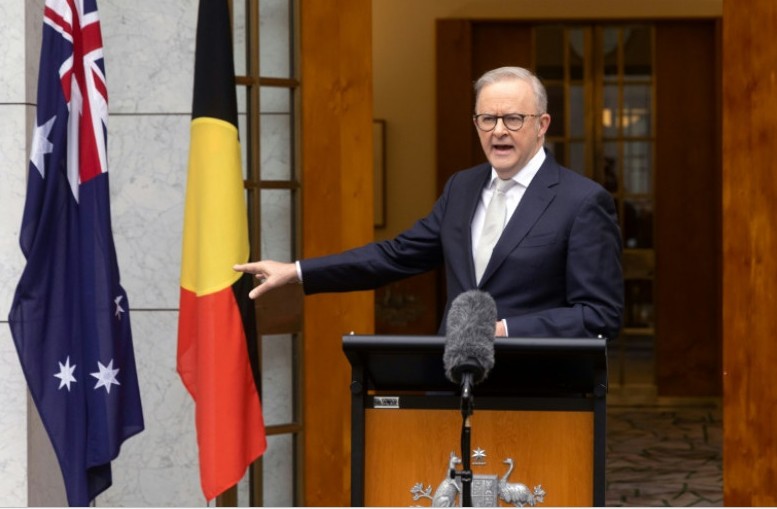
Australia will hold a general election on Saturday, May 3.
Opinion polls indicate Prime Minister Anthony Albanese’s ruling centre-left Labor party is ahead of the conservative Liberal-National coalition led by Peter Dutton, as global uncertainty fuelled by U.S. President Donald Trump makes some voters more risk-averse.
A large number of independent and minor parties are also seeking reelection and could become king-makers if either major bloc falls short of a majority government.
Labor returned to power in 2022 after nine years of Liberal-National coalition rule.
Here are some facts on how elections work in Australia:
HOW DOES IT WORK?
Australia is one of the few countries in the world with compulsory voting for all citizens aged 18 years and older. Around 4.8 million of 18 million eligible voters had cast a ballot at early voting centres by Thursday.
Counting of ballots will start from 6 p.m. Australian Eastern Time (0800 GMT) on Saturday after polling closes. Election tallies are progessively published on the Australian Electoral Commission website.
The commission never officially declares the results of a federal election on election night. Whether analysts or political parties declare a result on Saturday evening will depend on how close the race is.
Most postal votes will be counted after the election day.
AUSTRALIA’S PARLIAMENT
There are two houses of parliament, with the government formed by the party or coalition holding a majority in the lower chamber, the House of Representatives. The prime minister is chosen by the governing party from the House.
The upper house, the Senate, has 76 members – 12 from each of the six states and two from each of Australia’s two less-populous territories.
Half of the Senate seats will be contested at this election.
WHAT’S THE STATE OF PLAY NOW?
Labor holds 77 House of Representatives seats, the Liberal-National coalition holds 53 seats, the Greens hold 4, and 15 are held by micro parties and independents.
A loose grouping of seven “Teal” independents are women who won Liberal seats by focusing on climate change and government accountability.
To form majority government in the 2025 election, a party or coalition needs 76 seats out of 150.
If neither Labor nor the Liberal-National coalition has a majority of seats in the House of Representatives after polling day, a minority government can be formed with an agreement of support from independent members or minor parties.
Such an agreement is not legally binding, and is only a political pledge of support which can be changed at any time, because a member of parliament cannot contract their vote, according to constitutional law experts.
HOW DO AUSTRALIANS VOTE?
Australia has a preferential voting system for the House of Representatives. Voters rank local candidates in order of preference on their ballot papers.
A candidate who gets more than 50% of the first-preference votes wins the seat. If no candidate reaches that threshold, the one with the fewest votes is excluded, and their votes are distributed to the person each of those voters nominated as their second preference. This continues until one candidate passes the 50% threshold.
–Reuters