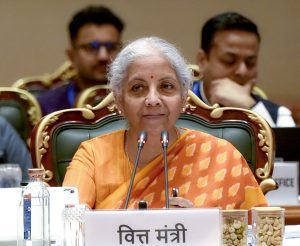
Union Finance Minister Nirmala Sitharaman on Monday introduced a revised version of the Income Tax Bill, 2025 in the Lok Sabha, incorporating most of the recommendations made by the Parliamentary Select Committee headed by BJP leader Baijayant Panda. The introduction took place amid Opposition uproar.
Tabling the bill, Sitharaman said that the changes were necessary to convey the correct legislative meaning.
“There are corrections in the nature of drafting, alignment of phrases, consequential changes and cross-referencing,” she said, adding that the earlier bill was withdrawn to avoid confusion.
The Finance Minister said the updated bill is designed to improve fairness and clarity while aligning the law with existing provisions. Lawmakers will now have a single, updated version that reflects all suggested changes.
The revised draft incorporates 285 recommendations from the Parliamentary Select Committee. It seeks to simplify tax processes, address earlier shortcomings, and potentially reshape the country’s income tax framework.
Last week, the government formally withdrew the Income Tax Bill, 2025, which was initially introduced in the Lok Sabha on February 13 to replace the existing Income Tax Act, 1961.
According to Panda, the new legislation will simplify India’s decades-old tax structure, reduce legal confusion, and help individual taxpayers and MSMEs avoid unnecessary litigation.
The current Income Tax Act, enacted in 1961, has undergone more than 4,000 amendments and now contains over five lakh words, making it highly complex. Panda noted that the new bill simplifies the law by nearly 50 per cent, making it far easier for ordinary taxpayers to read and understand. The committee had flagged multiple drafting errors and suggested amendments to reduce ambiguity.
In the revised bill, slabs and rates have been adjusted across the board to benefit all taxpayers. The government said the new structure will substantially reduce taxes for the middle class, leaving more disposable income in their hands and boosting consumption, savings, and investment.