For Ranjana Ramchandra Kadam in Maharashtra’s Sindhudurg district, a coir unit became a route to entrepreneurship. With assistance under the Prime Minister’s Employment Generation Programme (PMEGP) and guidance from the Coir Board, she built a shed, acquired machinery and began manufacturing ropes, pillows and doormats. Her factory now provides full-time employment to six people.
In Andhra Pradesh’s East Godavari district, Allam Gowthamy’s enterprise has grown into both a business and a source of skills for other women. Adigo Coir Products employs six women, records an annual turnover of approximately ₹35 lakh and earns an annual profit of around ₹10 lakh. Nearly 120 women have also received training through programmes she conducts with institutional support.
These enterprises illustrate how one of India’s oldest traditional industries is finding new opportunities through training, technology and access to markets.
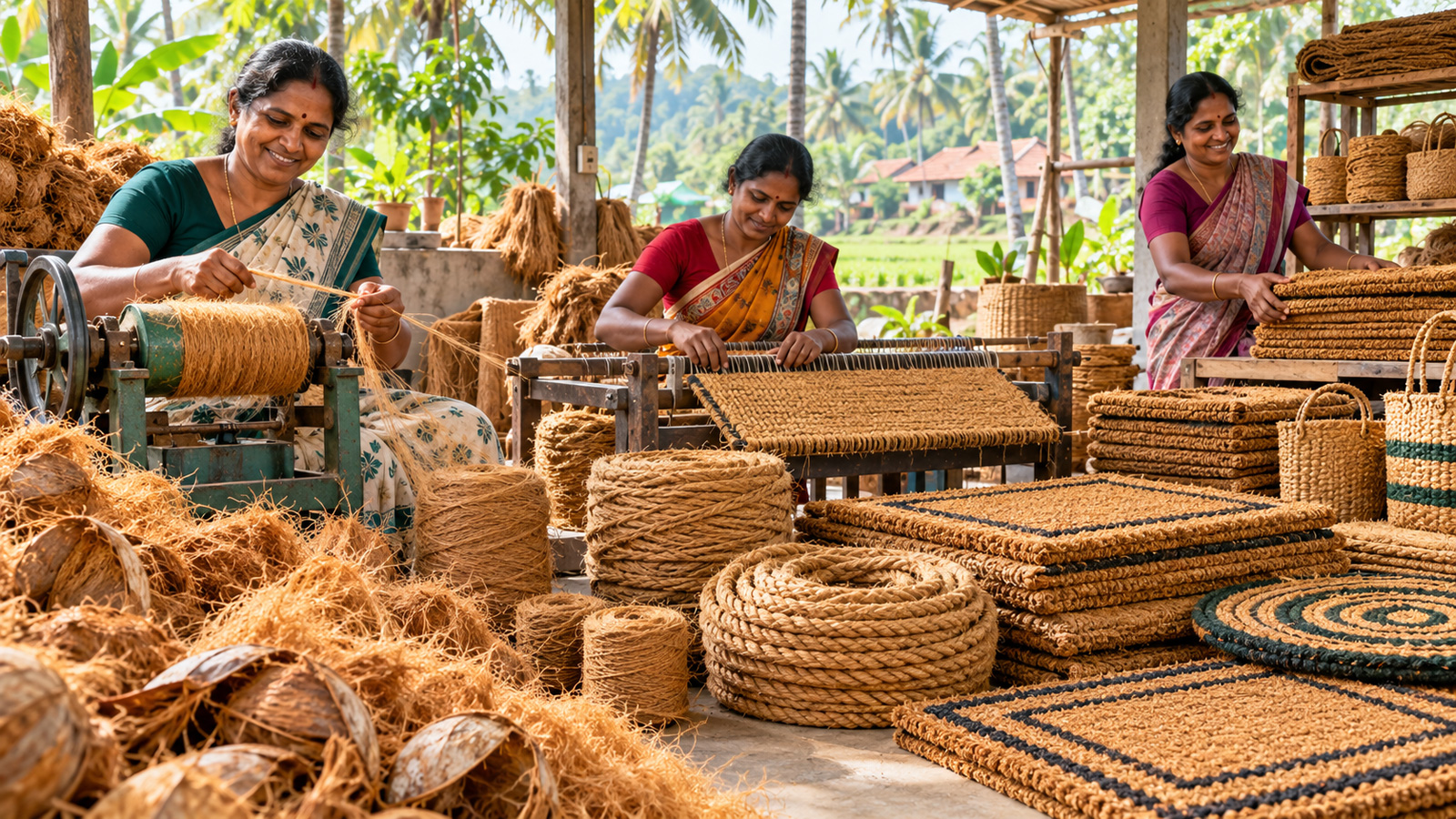
Coir is the natural fibre extracted from the tough outer husk of coconuts. Processing transforms it into mats, mattresses, ropes, brushes and other utility products, giving commercial value to coconut husks while supporting livelihoods in rural communities.
India is the world’s largest producer and exporter of coir and coir products, accounting for about two-thirds of global production. The industry has an estimated turnover of ₹16,000 crore, according to the government release.
The wider sector provides direct and indirect employment to more than seven lakh workers, about 80% of whom are women from rural households. More than 21,000 units registered on the Udyam portal employ 2.3 lakh people, placing these businesses within the formal MSME policy ecosystem.
International demand has helped expand the sector’s reach. Coir exports increased from ₹1,630.33 crore in 2014-15 to ₹6,614.40 crore in 2025-26 – a rise of 305.70%, taking export earnings to more than four times their earlier level.
The United States, China, the Netherlands, Spain and the United Kingdom were major export destinations in 2025–26. Coir pith, fibre, yarn and tufted mats were among the principal products shipped abroad.
Supporting this growth is the Ministry of MSME’s Coir Vikas Yojana, a central sector scheme designed to promote sustainable development and assist artisans and businesses.
The scheme supports new technologies, machinery and products, skill training, promotional programmes and sales in domestic and international markets. It also provides financial assistance for sales promotion, facilitates participation in overseas exhibitions and supports the compilation and publication of industry statistics.
Since 2014–15, more than 68,000 people have received training under various programmes, with women accounting for over 80% of participants. The release also lists more than 150 innovative machines, technologies and value-added products among the sector’s achievements.
More than 1,000 exporters have been supported to participate in international exhibitions. Financial assistance exceeding ₹20 crore has been provided to over 850 entrepreneurs under Export Market Promotion. Within India, more than 1,400 promotional programmes have been organised, alongside participation in over 950 exhibitions.
For individual businesses, this support has taken different forms.
Kadam’s Sindhudurg unit used PMEGP assistance and Coir Board guidance to establish production infrastructure. The resulting business connects household products with regular local employment.
In Kozhikode, Kerala, Surendran P.’s Sampoorna Plus Agro Fertilizer Enterprises demonstrates another application of coir: the production of coir pith bio-fertiliser.
Surendran attended hands-on training, demonstrations and awareness sessions supported by the Coir Board’s Kannur sub-regional office and the Central Coir Research Institute at Kalavoor. These programmes covered production and effective utilisation of the bio-fertiliser.
Within a year, the enterprise built a customer base of more than 500 and sold over 20 tonnes of the product. It now employs five workers, including two women.
Gowthamy’s journey began with training at a Coir Board centre five years ago. Encouraged by the technical guidance, she established Adigo Coir Products with financial assistance under PMEGP.
Beyond the enterprise’s turnover, profits and employment, her work has extended into community training. With support from the Coir Board’s Rajahmundry regional office and Mandal Parishat authorities, she conducts programmes in coir mat weaving, rope making and handicraft production.
In Alappuzha, Kerala, G. Sabu started a coir spinning unit in 2024 under PMEGP with support from the Coir Board’s Kalavoor regional office.
Within two years, the unit developed steady production of yarn and rope supplied to local coir societies and manufacturers. It created direct employment for eight to 10 workers, predominantly women from nearby villages. Growing monthly turnover has provided a stable income for Sabu and regular wages for employees.
Across these examples, the sector’s development links traditional materials with practical business support. Training builds skills, machinery enables production, and market connections help enterprises sustain sales.
The coir industry’s contribution is therefore visible both in rising exports and in smaller workplaces where rural residents earn regular incomes. Its emphasis on productive resource use, value addition and women’s participation offers a pathway for traditional manufacturing to contribute to inclusive growth and the vision of Viksit Bharat by 2047.