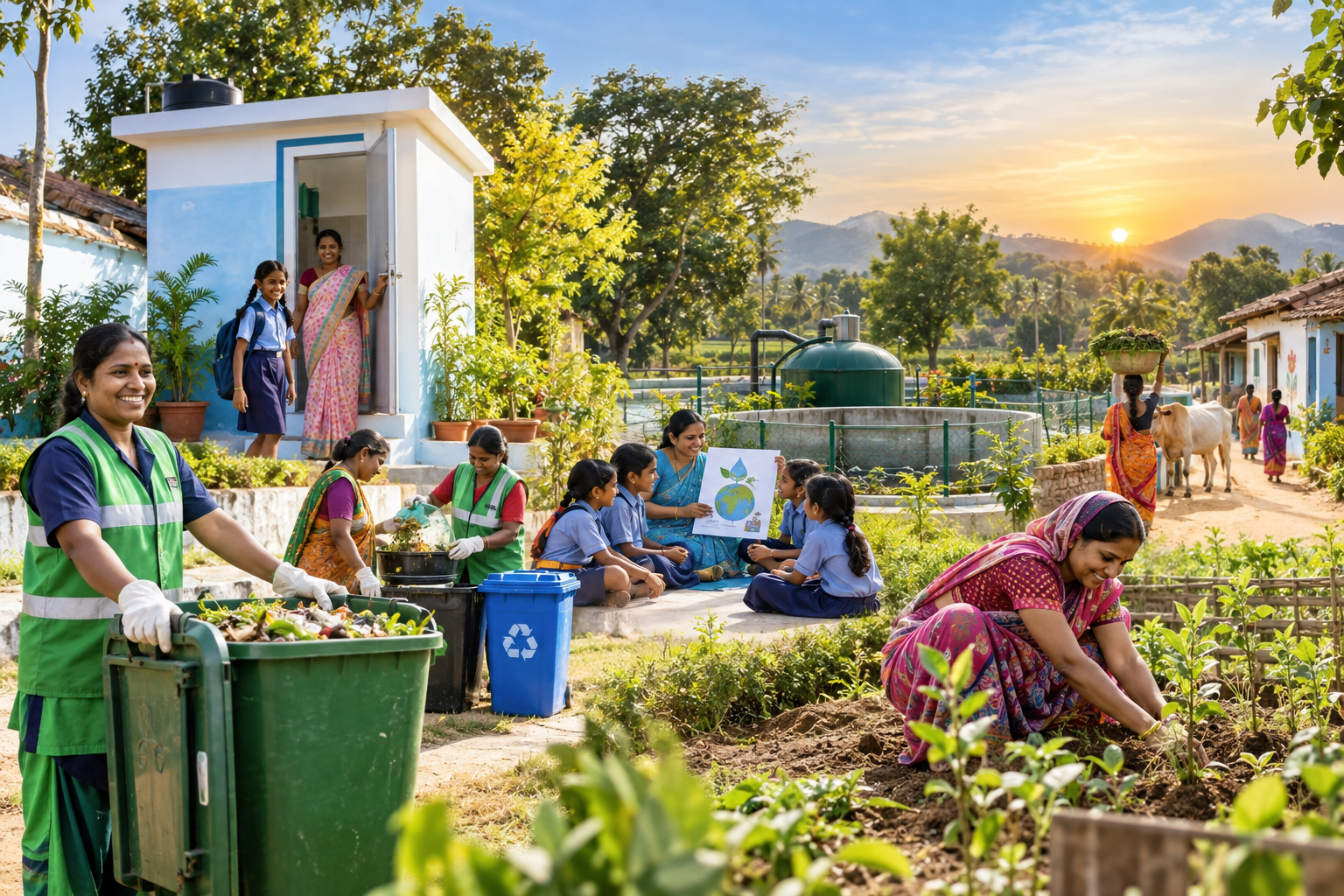
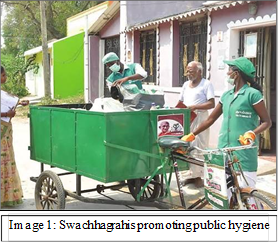
India’s rural sanitation programme has moved beyond the construction of household toilets to a broader focus on sustaining sanitation practices, managing waste and encouraging communities to take ownership of cleanliness.
When the Swachh Bharat Mission (SBM) began in 2014, rural sanitation coverage stood at 39 per cent. By 2019, the government said rural India had achieved 100 per cent sanitation coverage, with more than 10.28 crore toilets constructed between 2014 and 2019. Rural India was subsequently declared Open Defecation Free (ODF) in 2019.
What changed after India became ODF?
Once access to toilets expanded, the challenge shifted from simply providing infrastructure to ensuring that sanitation facilities were regularly used and maintained and that villages could manage the waste generated within them.
This is the focus of Swachh Bharat Mission-Gramin (SBM-G) Phase II. The programme focuses on sustaining ODF status and strengthening solid and liquid waste management systems at the village level.
The next stage is represented by ODF Plus villages. These villages are expected to maintain their ODF status while also managing solid and liquid waste and maintaining visual cleanliness.
What is an ODF Plus village?
ODF Plus villages are classified into three stages:
Aspiring: Manages either solid or liquid waste.
Rising: Manages both solid and liquid waste.
Model: Manages both waste streams, maintains visual cleanliness and displays ODF Plus messaging.
As of September 17, 2026, India had 5.69 lakh ODF Plus villages, including 5.25 lakh villages classified as ODF Plus Model.
The government also reported that 5.38 lakh villages had established solid waste management arrangements and 5.65 lakh had liquid waste management systems. In addition, 1,314 GOBARdhan biogas plants were operational across 582 districts.
Why is behaviour change important?
Building a toilet does not by itself guarantee sustained sanitation. The programme therefore places Behaviour Change Communication (BCC) at the centre of the next phase.
The approach includes encouraging households to use and maintain toilets, adopt safe waste-disposal practices, manage wet waste through compost pits or biogas plants, wash hands, store water safely and avoid littering and spitting in public spaces.
In other words, the focus has shifted from creating sanitation infrastructure to creating everyday sanitation habits.
How are women contributing?
Women have been positioned as active participants in sanitation activities through the Swachhagrahi network and Self-Help Groups under the DAY-NRLM framework.
Swachhagrahis undertake activities such as household outreach, awareness campaigns and cleanliness verification.
The release cites examples of women-led sanitation initiatives. In Howrah, West Bengal, Self-Help Groups supported a plastic-removal programme across 18 Ganga-adjacent gram panchayats, collecting 9.32 tonnes of plastic waste in 18 days.
In Gorakhpur, Uttar Pradesh, SHG women operate a Resource Recovery Centre where household waste is segregated. Wet waste is converted into vermicompost, while dry waste is channelled for sale.
Why are schools part of the sanitation strategy?
The programme also treats schools as important centres for developing sanitation habits.
Schools can provide children with practical lessons in hygiene, waste segregation and sanitation, which can then influence behaviour at home.
For instance, a school in Chandil, Jharkhand, banned single-use plastic and constructed a soak pit for managing greywater. Teachers also engage students on personal hygiene and puberty-related issues.
The 2026 Swachhata Hi Seva campaign further places students and youth at the centre of behavioural change through activities including Swachhata Gyan Yatras, school Samvads and demonstrations on source segregation.
What role do Gram Panchayats play?
Sustaining sanitation requires systems beyond individual households. Gram Panchayats are therefore responsible for planning and implementing village-level sanitation activities.
Their responsibilities include community mobilisation, hygiene promotion, information and education activities and capacity building.
Village Water and Sanitation Committees also support planning, implementation, supervision and behaviour change.
The release cites Gadli Gram Panchayat in Haryana, where community-led sanitation measures included separate and community toilets, drainage infrastructure, greywater treatment through five ponds and GOBARdhan biogas plants.
Can sanitation create livelihoods?
The sanitation programme is also creating local economic opportunities.
In Betul, Madhya Pradesh, Babita Dhurve became the district’s first woman e-rickshaw waste collector after approaching her Gram Panchayat for a waste-collection opportunity. The release says around 100 Gram Panchayats in Betul are now using waste-collection vehicles.
In Nadia, West Bengal, demand for trained workers for toilet construction led to the establishment of two masonry training institutes. Around 2,400 men and women were trained in toilet construction.
This illustrates how sanitation systems can create work not only in construction but also in waste collection, transportation, processing and maintenance.
What is GOBARdhan?
GOBARdhan — Galvanizing Organic Bio-Agro Resources Dhan — is an umbrella initiative under SBM-G Phase II that seeks to convert cattle dung, crop residue and other organic waste into biogas, compressed biogas and organic manure/bio-slurry.
The objective is to treat organic waste as a resource rather than simply something that needs to be discarded.
How does waste management support the environment?
The release gives the example of Vedancha in Gujarat, where a greywater treatment system was designed according to local land and water-flow conditions.
The system treats around 200 kilolitres of greywater every day, with treated water being used for irrigation and groundwater recharge. The panchayat earns around ₹2.5 lakh annually through compost and treated-water reuse, according to the release.
What is the broader goal?
The sanitation strategy described in the release represents a progression from access to usage and from usage to sustainability.
The government’s approach is to combine household behaviour, community participation and institutional support. Gram Panchayats, Self-Help Groups, schools, youth groups and other local institutions are expected to sustain sanitation practices, while government funding, technical support and convergence with programmes such as DAY-NRLM and Jal Jeevan Mission provide institutional backing.
The central idea is that sanitation cannot be sustained through infrastructure alone. It requires regular participation by households and communities, supported by local institutions and systems for managing waste.
The release describes this as a shift from building sanitation infrastructure to making cleanliness an everyday practice sustained by people and communities.