











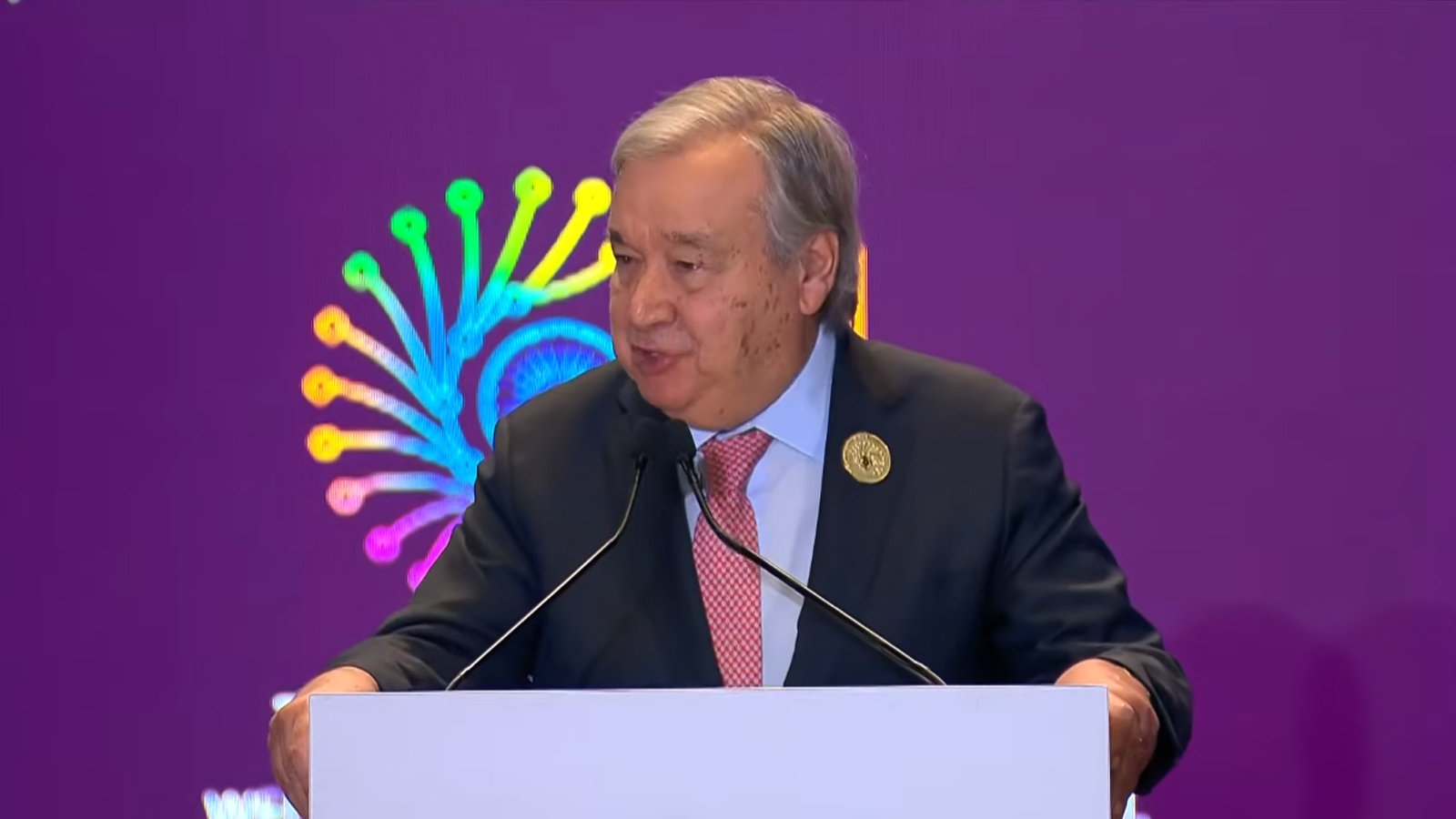
United Nations Secretary-General Antonio Guterres on Thursday said that hosting the India AI Impact Summit 2026 in the Global South carries “special meaning,” stressing that the future of artificial intelligence must not be shaped by a handful of countries or controlled by a few billionaires.
Addressing global leaders, technology executives and policymakers at Bharat Mandapam in New Delhi, Guterres thanked Prime Minister Narendra Modi for the invitation and congratulated India for organising what he described as the first AI summit in the Global South.
“Meeting in India has special meaning. It brings this conversation closer to the realities shaping much of the world,” Guterres said. “The future of AI cannot be decided by a handful of countries or left to the whims of a few billionaires.”
AI Must Belong to Everyone
Emphasising inclusivity, the UN chief said artificial intelligence is transforming economies, societies and governance structures at an unprecedented pace, and that its governance must be globally representative.
“AI must belong to everyone,” he asserted, warning that without adequate investment many countries risk being “logged out of the AI age.”
Guterres reiterated his call for the creation of a Global Fund on AI, proposing a target of 3 billion US dollars to build basic capacity worldwide, including skills, data infrastructure, affordable computing power and inclusive innovation ecosystems. He noted that the proposed fund amounts to less than one per cent of the annual revenue of a single major technology company, calling it “a small price for AI diffusion that benefits all.”
Augment, Not Replace, Human Potential
Addressing concerns about job losses and automation, Guterres said AI must strengthen, not substitute, human capabilities. “We must invest in workers so AI augments human potential – not replaces it,” he said.
He cautioned that, if mismanaged, AI could deepen inequality, amplify bias and fuel harm. However, when guided responsibly, it holds immense promise to accelerate progress on the UN’s Sustainable Development Goals (SDGs), advance medical breakthroughs, strengthen food security, bolster climate action and disaster preparedness, and expand access to essential public services and education.
“Real impact means technology that improves lives and protects the planet,” he said. “Let’s build AI for everyone – with dignity as the default setting.”
Call for Safety, Sustainability and Child Protection
The Secretary-General underlined that AI systems must be safe and rights-based, protecting people from exploitation, manipulation and abuse. He also stressed that “no child should be a test subject for unregulated AI,” calling for stronger safeguards in digital spaces.
Raising environmental concerns, Guterres noted that the soaring energy and water demands of AI-driven data centres must not come at the cost of vulnerable communities. “Data centres and supply chains must switch to clean power – not shift costs to vulnerable communities,” he said.
French President Emmanuel Macron echoed the concern, stating that child protection against AI and digital abuse would be a priority during France’s presidency of the G7.
Global Dialogue on AI Governance
Guterres said deliberations at the New Delhi summit would feed into the UN’s upcoming Global Dialogue on AI Governance in Geneva in July, convened by the General Assembly. The dialogue aims to ensure that every country has a voice in shaping guardrails that preserve human agency, oversight and accountability.
He also highlighted the establishment of an Independent International Scientific Panel on AI under the General Assembly, comprising 40 global experts, and urged member states, industry and civil society to contribute to its work.
(With agency inputs)












