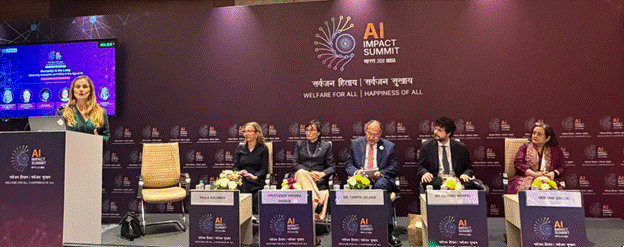
Global leaders from parliaments, multilateral institutions, public policy and industry on Thursday emphasised that trust in artificial intelligence must be embedded by design rather than assumed as an outcome, during the session “Humanity in the Loop – Balancing Innovation and Ethics in the Age of AI” at the India AI Impact Summit 2026.
Speakers positioned ethics and innovation as mutually reinforcing, arguing that ethical reflection, human oversight and risk-based regulation must be built into AI systems from the outset to enable democratic scaling and societal value.
Brando Benifei, Member of the European Parliament, highlighted the risks of delayed regulation seen in earlier technology cycles and advocated a calibrated, risk-based approach for AI. He stressed stronger oversight in high-impact areas such as healthcare, workforce deployment and administrative decision-making, noting that transparency, data quality, cybersecurity and clear governance are essential because “without trust, democratic adoption of AI is impossible.”
Dr. Tawfik Jelassi, Assistant Director-General for Communication and Information at UNESCO, said ethical reflection must be integrated at the design stage rather than applied retrospectively after harm occurs. He noted that systems built as “ethical by design” gain greater trust, wider use and higher impact, adding that human-centric innovation must be contextual and guided by overarching frameworks rather than one-size-fits-all rules.
Debjani Ghosh, framed the challenge as a civilisational choice about technology’s use. She said the real task is not choosing between innovation and ethics but ensuring oversight is embedded “from design to commercialisation so that ethics becomes by design, not an afterthought,” with accountability resting with human institutions and developers.
Paula Goldman, EVP and Chief Ethical and Humane Use Officer at Salesforce, brought an enterprise view, stressing that organisations scale AI successfully only when people can see, question and control how systems operate. She highlighted the need for built-in observability, human escalation pathways and user choice, noting that companies thrive when they “put people at the centre, giving them a voice in where AI actually helps.”
The session positioned ethics as the core operating system of the AI era rather than a compliance add-on. From global governance to product-level choices, speakers agreed that AI’s future depends on whether people can trust it in critical moments.