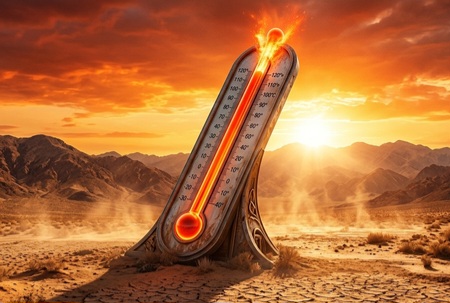
Global average temperatures are likely to remain at or near record levels over the next five years, according to a report released by the World Meteorological Organization (WMO) and produced by the UK’s Met Office on Thursday. The report added that Arctic temperature anomalies are expected to continue to remain higher than the global average.
The report stated that although the average temperature over the next five years is likely to exceed 1.5 degrees Celsius above pre-industrial levels, this does not constitute a breach of the Paris Agreement, which refers to long-term warming measured over a period of around 20 years.
Annual global mean near-surface temperatures during 2026–2030 are predicted to range between 1.3 and 1.9 degrees Celsius above the 1850–1900 average.
According to the report, there is an 86 per cent chance that at least one year between 2026 and 2030 will surpass 2024 as the warmest year on record.
The findings also showed a 91 per cent chance that the global mean near-surface temperature will temporarily exceed 1.5 degrees Celsius above the 1850–1900 average for at least one year between 2026 and 2030.
This threshold was also temporarily exceeded in 2024, when the global average surface temperature was around 1.55 degrees Celsius above the pre-industrial baseline.
“There is an El Nino predicted for the end of 2026, which increases the chances of 2027 becoming the next record-breaking year,” said Dr Leon Hermanson, lead author of the report.
The five-year predicted average temperature in the central tropical Pacific (Nino 3.4 region) indicates a tendency towards El Nino conditions, particularly in 2027 and 2028.
Under the Paris Agreement, countries agreed to keep the rise in long-term global average surface temperature well below 2 degrees Celsius above pre-industrial levels, while pursuing efforts to limit the increase to 1.5 degrees Celsius.
The scientific community has repeatedly warned that warming beyond 1.5 degrees Celsius could trigger increasingly severe climate impacts and extreme weather events, while also reducing adaptation options.
–IANS