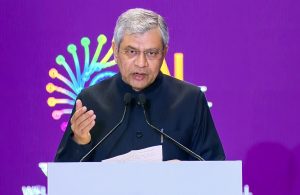
The Government on Wednesday outlined a series of legal, regulatory and institutional measures aimed at ensuring an open, safe, trusted and accountable internet for all users, including children. The information was shared by Minister of State for Electronics and Information Technology Jitin Prasada in the Lok Sabha.
With the rapid expansion of internet access across the country, the Government said it is increasingly focused on addressing risks related to harmful, addictive, or age-inappropriate content and ensuring stronger accountability from social media platforms.
The Government noted that the Information Technology Act, 2000, along with the Information Technology (Intermediary Guidelines and Digital Media Ethics Code) Rules, 2021, provides a robust framework to counter unlawful and harmful online content.
The IT Act defines penalties for cyber offences, including identity theft, impersonation, privacy violations, and publishing obscene or sexually explicit material. It also empowers law enforcement agencies to investigate offences and take action against violators.
Under the IT Rules, 2021, social media intermediaries are required to exercise due diligence, prohibit uploading of unlawful content, ensure transparency, and take timely action on user grievances. Platforms must inform users of prohibited content, remove unlawful material upon government or court orders, and appoint grievance officers to address complaints.
Content affecting privacy, impersonation or involving nudity must be removed within 24 hours of receiving a complaint. Users also have the option to appeal unresolved complaints before the Grievance Appellate Committees through the portal www.gac.gov.in.
Significant social media intermediaries—platforms with over 50 lakh users – have additional compliance requirements. These include supporting law enforcement in tracing the origin of serious content, deploying automated tools to detect unlawful posts, publishing compliance reports, appointing India-based officers, and offering voluntary verification to users.
Failure to comply with the IT Rules results in loss of the safe-harbour protection under Section 79 of the IT Act, making platforms liable for third-party content.
The Digital Personal Data Protection (DPDP) Act, 2023, restricts the processing of children’s personal data, mandating verifiable parental consent and prohibiting tracking, targeted advertising, or any processing harmful to children.
Provisions in the Bharatiya Nyaya Sanhita (BNS), 2023, target cyber-enabled crimes, including obscenity and misinformation. Section 353 penalises spreading false or misleading statements that cause public fear or mischief.
The POCSO Act, 2012, further strengthens safeguards for children by criminalising the use of minors in sexual content and prescribing strict punishments for possession or distribution of child sexual material.
The National Commission for Protection of Child Rights (NCPCR) has issued several guidelines to promote cyber safety among children, parents and schools, including resources on safe online behaviour, cyberbullying prevention and digital security.
NCERT has also published a handbook titled Safe Online Learning in Times of COVID-19 to support safe digital practices for students.
India has established several mechanisms to strengthen cyber safety and content regulation. These include Grievance Appellate Committees (GACs) for appeals on content moderation decisions; Indian Cyber Crime Coordination Centre (I4C) for nationwide coordination on cybercrime; SAHYOG Portal for automated notifications to platforms for content removal; National Cyber Crime Reporting Portal (https://cybercrime.gov.in; helpline 1930) for reporting cyber offences; CERT-In for issuing cybersecurity advisories; and National awareness campaigns such as Cyber Security Awareness Month, Safer Internet Day, and Cyber Jagrookta Diwas
The Information Security Education & Awareness (ISEA) programme also provides resources on safe internet use at https://www.infosecawareness.in.
The Ministry of Electronics & IT said that these combined legal, technical and awareness measures form a comprehensive framework to ensure a secure online environment for citizens while promoting accountability across digital platforms.