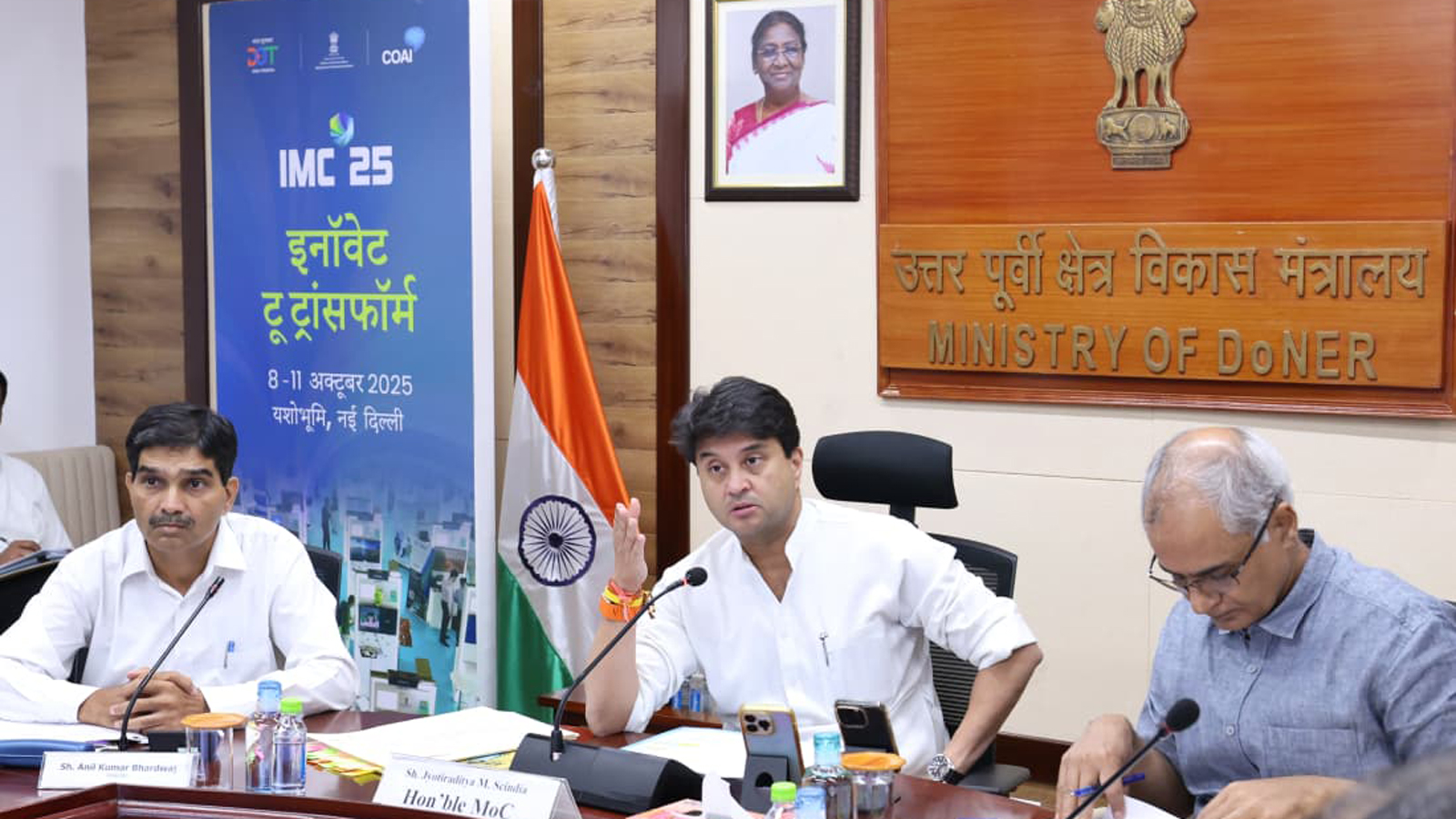
Union Minister for Communications and Development of North Eastern Region Jyotiraditya Scindia, along with Telecom Secretary Dr. Neeraj Mittal, chaired a meeting on Thursday with representatives from Telecom Service Providers (TSPs) and the Original Equipment Manufacturers (OEMs) Advisory Committee to review key telecom initiatives and policy matters.
The meeting covered three major agendas – preparations for India Mobile Congress (IMC) 2025, resolution of pending issues flagged by TSPs and OEMs, and assessment of the progress of the Telecom Manufacturing Zone (TMZ) at Gwalior and the Telecom Innovation, Research and Training Centre at Jabalpur.
During the discussions, the Union Minister acknowledged that most pending issues raised earlier by TSPs had been resolved, including those related to cyber security, spam control, technology standards, and interoperability. However, three critical concerns – bridging the digital divide, spectrum authorization, and the business viability of fixed-line services – remain under consideration. Stakeholders have been asked to submit their responses to draft rules by October 6, 2025. Issues such as telemarketer regulations, license fee reforms, and power requirements are also being addressed as part of the upcoming Telecom Policy.
On the OEM side, the Minister confirmed the resolution of concerns around indigenous manufacturing, certification timelines, and ease of doing business measures. Four key issues are still pending, including achieving cost structure parity with global peers, creating a domestic manufacturing ecosystem to reduce imports, boosting design-led manufacturing, and overcoming single-source procurement challenges. Policy inputs on these are also expected by October 6.
“The Government remains committed to bridging the digital divide, fostering innovation, and strengthening indigenous telecom manufacturing,” Scindia said, urging TSPs and OEMs to work closely with the Department of Telecommunications (DoT) to submit actionable feedback on time.
He stressed that initiatives like IMC 2025, the Gwalior TMZ, and the Jabalpur Innovation Centre would be instrumental in transforming India into a global telecom hub for technology, services, and manufacturing.
Stakeholder Advisory Committees (SACs), constituted under the Communications Ministry, continue to serve as a structured platform for collaboration between government, industry, and innovators, ensuring inclusive policy-making and a future-ready telecom ecosystem.