The devastating earthquake that struck Gujarat on January 26, 2001, posed an unprecedented challenge to the state’s administration, testing its disaster response, institutional capacity and leadership. However, a combination of swift government action, community participation and long-term planning helped drive the rehabilitation and reconstruction of the earthquake-hit region.
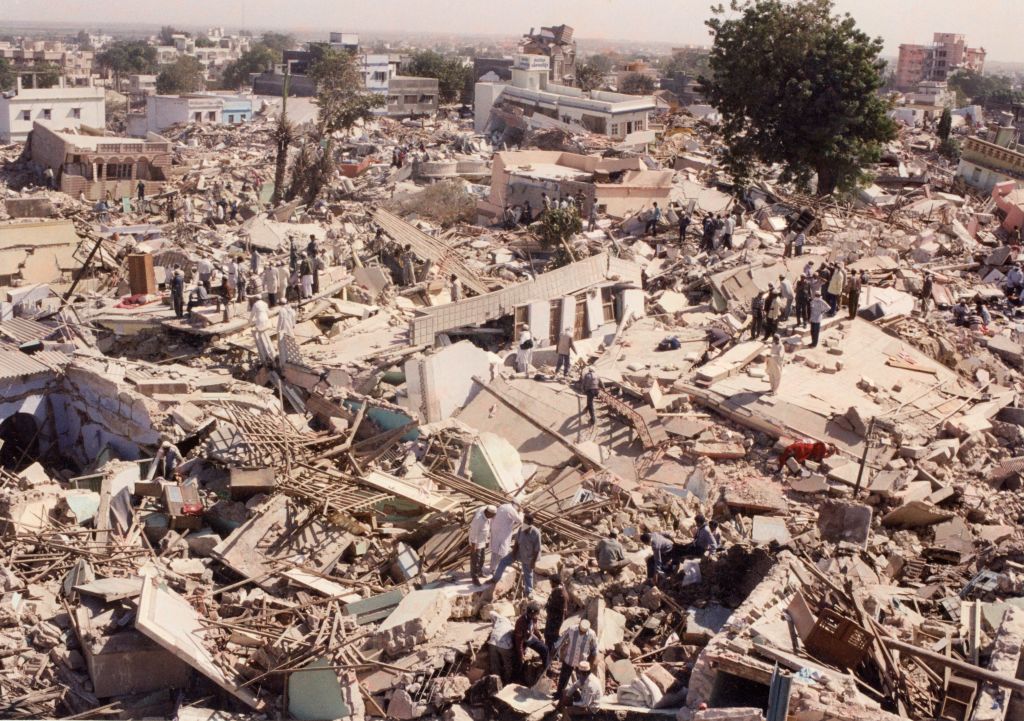
The earthquake, measuring 6.9 on the Richter scale, struck at 8.46 am, with its epicentre in Kutch. It affected around 7,633 villages across 181 talukas, impacting nearly one crore people. A total of 13,805 people lost their lives, including 12,221 in Kutch, while around 1.67 lakh people were injured.
The disaster destroyed more than two lakh houses and damaged nearly nine lakh others. It also severely affected livelihoods, forcing over 10,000 small and medium industrial units to suspend operations and leaving around 50,000 artisans without work.
At the time, Gujarat had emergency preparedness plans for cyclones and floods but lacked a dedicated framework for earthquakes.
Swift response and immediate relief
The state administration began coordinating relief operations on the day of the disaster. The Director of Relief reached the State Control Room in Gandhinagar on January 26 to oversee the response.
Communication networks in the capital region failed within an hour, making coordination difficult. Satellite phones and police wireless networks became the primary means of communication.
In Bhuj, the Superintendent of Police led search and rescue operations, while the District Collector coordinated relief and supplies. A medical camp was established on open ground within approximately two hours. An Army platoon was also deployed following a request to the Brigadier, while police families organised a community kitchen.
The National Crisis Management Committee met under the Prime Minister on the same day, and the Centre sanctioned Rs. 500 crore for immediate relief. The armed forces and paramilitary personnel joined rescue operations, while relief materials were airlifted to the affected region.
Establishment of disaster management authority
As relief operations progressed, the state government shifted its focus towards rehabilitation and long-term reconstruction.
On February 8, 2001, the Gujarat government established the Gujarat State Disaster Management Authority (GSDMA) through a government resolution to oversee reconstruction and rehabilitation.
The initiative drew on the experience of the Orissa State Disaster Management Authority, which had been established following the 1999 super cyclone. The Centre had recommended a similar institutional framework for Gujarat.
Initially registered as a society under the Societies Registration Act, the GSDMA later received statutory status under the Gujarat State Disaster Management Act, 2003.
The authority’s Governing Body was chaired by the Chief Minister and included senior ministers and government officials. On February 10, 2001, it adopted an initial framework emphasising public participation in reconstruction decisions.
Village committees and Gram Sabhas were given a role in deciding whether severely damaged villages should be relocated. At the national level, the Centre constituted a National Committee on Disaster Management on February 13, 2001, following an all-party meeting convened by the Prime Minister.
Funding and reconstruction strategy
The scale of reconstruction required substantial financial resources. Joint assessments by the World Bank and the Asian Development Bank estimated the damage at Rs. 9,909 crore and reconstruction costs at approximately Rs. 10,575 crore.
The Gujarat government subsequently estimated the reconstruction cost at around Rs. 8,496 crore.
The two international lending institutions initially sanctioned loans of USD 1 billion and USD 500 million, respectively. Following a review, the sanctions were revised to USD 703 million and USD 350 million.
The state government contributed approximately Rs. 2,603 crore, accounting for around 30 per cent of the reconstruction expenditure.
Owner-driven housing reconstruction
The government announced four housing assistance packages on February 23, 2001, with financial support determined by the extent of damage, seismic risk and settlement category.
A fifth package was announced on April 24, 2001, for the four worst-affected towns of Kutch — Bhuj, Bhachau, Anjar and Rapar.
The reconstruction programme adopted an owner-driven approach, allowing families to rebuild their homes rather than relying entirely on contractors. Beneficiaries received financial assistance, technical guidance and earthquake-resistant building designs.
Non-governmental organisations and private partners also participated through a public-private partnership programme, under which they helped construct houses in adopted villages. Financial assistance was released in stages as construction progressed.
The programme followed a ‘reconstruction plus’ approach, aimed at building back better rather than merely restoring damaged structures.
Monitoring, transparency and grievance redressal
Damage assessments were classified into five categories, from G1, indicating minor damage, to G5, representing complete destruction or damage beyond repair.
A total of 2,051 survey teams comprising 4,592 personnel, including 1,794 revenue officials, conducted assessments. Communities were involved in the process, and families were allowed to request re-surveys.
A multi-level grievance redressal mechanism was established through village committees, district committees and District Judges appointed as ombudsmen.
The ombudsmen could directly receive public complaints and instruct the administration to take appropriate action. By October 2003, they had received 47,156 petitions, of which approximately 99 per cent had been addressed.
A four-tier administrative structure operated at the state, district, taluka and village levels. Additional Collectors were posted in the worst-affected talukas.
At the village level, Gram Navrachna Samitis supervised reconstruction activities. Their membership included the Sarpanch, a woman representative, members of backward castes and minority communities, the primary school headmaster and a representative of a non-governmental organisation.
Government departments executed reconstruction projects, while the GSDMA, headed by Chief Executive Officer Dr P.K. Mishra, coordinated and monitored their implementation. District Collectors served as Joint Chief Executive Officers, and an operational manual was introduced to expedite project approvals.
Financial assistance was released in instalments after engineers certified construction progress. A network of 1,082 material banks supplied cement and other building materials, while nearly 30,000 masons and 6,200 engineers received training.
Around 2.6 lakh houses underwent independent inspections. Reconstructed houses were registered jointly in the names of husbands and wives, and new buildings incorporated earthquake-resistant and cyclone-resistant features.
Administrative review and renewed momentum
By October 2001, progress reviews highlighted several outstanding challenges. Many families were still living in tents, while some government offices and schools continued to operate from temporary structures.
Urban reconstruction was slower than rural rehabilitation because of the need for plot surveys, road widening and land reallocation. Some newly developed villages also faced water shortages and site-related difficulties.
Action was taken over delays in debris clearance, with disciplinary proceedings initiated against 276 government employees and cases against 738 individuals associated with local bodies.
Narendra Modi assumed office as Chief Minister in October 2001 and initiated a fresh review of reconstruction work. Following the assessment, 11 senior Secretaries were assigned to the worst-affected talukas to accelerate rehabilitation.
Each Secretary was required to spend three days every weekend in the allotted area until the end of January 2002 and report progress directly to the Chief Minister at weekly review meetings held every Monday.
The administration aimed to demonstrate visible progress by the first anniversary of the earthquake on January 26, 2002. Field visits and regular reviews helped identify and resolve policy and operational bottlenecks, accelerating reconstruction in the subsequent months.
Reconstruction achievements by 2004
The housing rehabilitation programme recorded significant progress in the years following the earthquake.
By January 2002, approximately 7.7 lakh houses had been repaired and nearly 60,000 reconstructed. The number of reconstructed houses increased to around 1.43 lakh by January 2003 and 1.87 lakh by January 2004, achieving 87 per cent of the target of approximately 2.15 lakh houses.
In the education sector, all 42,678 primary schoolrooms identified for repairs had been restored by January 2004. Of the 8,212 destroyed schoolrooms, 7,469 had been reconstructed, representing 91 per cent of the total.
The District Civil Hospital in Bhuj was rebuilt with assistance from the Prime Minister’s National Relief Fund at a cost of approximately Rs. 114 crore. The hospital incorporated base-isolation technology, designed to improve its ability to withstand earthquakes, and was inaugurated on January 14, 2004.
Healthcare infrastructure was also expanded with the construction of six community health centres, 24 primary health centres, 184 sub-centres and 183 anganwadi centres.
Urban development and industrial recovery
Area Development Authorities were established for Bhuj, Anjar, Bhachau and Rapar to oversee town planning and infrastructure development.
Consulting firms were engaged to prepare development plans, issue building permissions and identify relocation sites. Town plans were prepared for three of the four towns, involving surveys of thousands of plots and the resolution of land-related disputes.
Urban infrastructure projects included approximately 403 km of roads, 546 km of water pipelines and 504 km of sewerage networks. Work also covered 134 municipal buildings, around 40 per cent of which had been completed by January 2004.
To revive industrial activity, the Centre and the Gujarat government announced tax incentives for new industrial units in Kutch. These included exemptions from excise duty, sales tax and octroi.
By March 2004, 151 new industrial projects with proposed investments of approximately Rs. 4,785 crore had been established or located in the region.
Institutional reforms and disaster preparedness
The earthquake also prompted long-term changes in Gujarat’s disaster management framework.
The state adopted its Disaster Management Policy in September 2002, followed by the enactment of the Gujarat State Disaster Management Act in 2003.
The Gujarat Institute of Disaster Management was established to strengthen training and capacity-building among government officials and community members.
Village-level preparedness teams, known as Afat Sajjat Senas, were formed in 484 villages. In 2002, the state government also took steps to activate Gram Sabhas and make disaster preparedness a permanent agenda item.
These initiatives received international recognition. Gujarat was conferred the United Nations Sasakawa Award for disaster reduction in 2003 and the Gold Award of the Commonwealth Association for Public Administration and Management in 2004 for innovation in governance.
The state’s experience also preceded the enactment of the Disaster Management Act, 2005, which established a national framework for disaster management across India.
Six key lessons from the Kutch earthquake recovery
The reconstruction experience highlighted six important lessons: the need for immediate action during emergencies, the importance of dedicated institutions, community participation in rehabilitation, transparent grievance redressal, regular monitoring and course correction, and investment in long-term disaster preparedness.
The Kutch experience demonstrated how coordinated administration, public participation and institutional reforms could help a disaster-hit region move beyond immediate relief towards sustainable reconstruction and resilience.
-PIB