







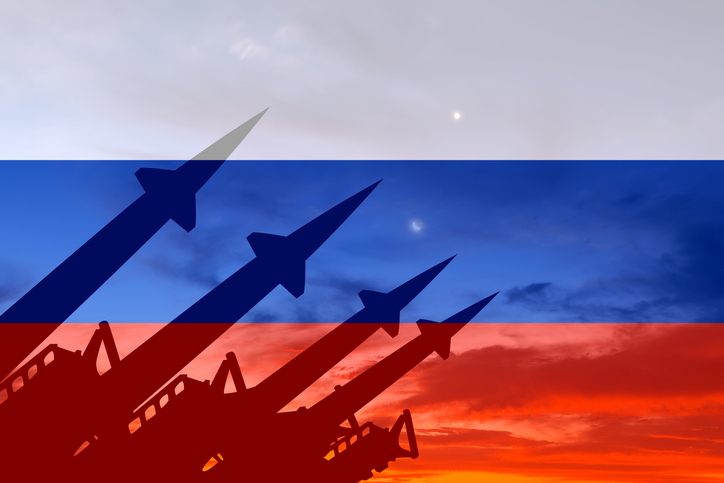
Russia appears to have suffered a “catastrophic failure” in a test of its Sarmat missile, a key weapon in the modernisation of its nuclear arsenal, according to arms experts who have analysed satellite images of the launch site.
The images captured by Maxar on Sept. 21 show a crater about 60 metres (200 feet) wide at the launch silo at the Plesetsk Cosmodrome in northern Russia. They reveal extensive damage that was not visible in pictures taken earlier in the month.
The RS-28 Sarmat intercontinental ballistic missile is designed to deliver nuclear warheads to strike targets thousands of miles away in the United States or Europe, but its development has been dogged by delays and testing setbacks.
“By all indications, it was a failed test. It’s a big hole in the ground,” said Pavel Podvig, an analyst based in Geneva, who runs the Russian Nuclear Forces project. “There was a serious incident with the missile and the silo.”
Timothy Wright, research associate at the International Institute for Strategic Studies (IISS) in London, said the destruction of the area immediately surrounding the missile silo was suggestive of a failure soon after ignition.
“One possible cause is that the first stage (booster) either failed to ignite properly or suffered from a catastrophic mechanical failure, causing the missile to fall back into or land closely adjacent to the silo and explode,” he told Reuters.
James Acton, nuclear specialist at the Carnegie Endowment for International Peace, posted on X that the before-and-after satellite images were “very persuasive that there was a big explosion” and said he was convinced that a Sarmat test had failed.
The Kremlin referred questions on Sarmat to the defence ministry. The ministry did not respond to a Reuters request for comment and has made no announcements about planned Sarmat tests in recent days.
The U.S. and its allies are closely watching Russia’s development of its nuclear arsenal at a time when the war in Ukraine has pushed tensions between Moscow and the West to the most dangerous point for more than 60 years.
Since the start of the conflict, President Vladimir Putin has said repeatedly that Russia has the biggest and most advanced nuclear arsenal in the world, and warned the West not to cross a threshold that could lead to nuclear war.
REPEATED SETBACKS
The 35-metre-long RS-28 Sarmat, known in the West as Satan II, has a range of 18,000 km (11,000 miles) and a launch weight of over 208 tonnes. Russian media say it can carry up to 16 independently targetable nuclear warheads as well as Avangard hypersonic glide vehicles, a new system that Putin has said is unmatched by Russia’s enemies.
Russia had at one point said the Sarmat would be ready by 2018, replacing the Soviet-era SS-18, but the date for deployment has been repeatedly pushed back.
Putin said in October 2023 that Russia had almost completed work on the missile. His defence minister at the time, Sergei Shoigu, said it was set to form “the basis of Russia’s ground-based strategic nuclear forces”.
IISS analyst Wright said a test failure did not necessarily mean that the Sarmat programme was in jeopardy.
“However, this is the fourth successive test failure of Sarmat which at the very least will push back its already delayed introduction into service even further and at most might raise questions about the programme’s viability,” he said.
Wright said the damage at Plesetsk – a test site surrounded by forest in the Arkhangelsk region, some 800 km (500 miles) north of Moscow – would also impact the Sarmat programme.
The delays would put pressure on the serviceability and readiness of the ageing SS-18s the Sarmat is meant to replace, as they will have to remain in service for longer than expected, Wright said.
Nikolai Sokov, a former Russian and Soviet arms control official, said he expected Moscow to persist with the Sarmat, a product of the Makeyev Rocket Design Bureau.
He said the Russian military had shown itself keen to preserve competition between rival designers and would therefore be reluctant to depend on Makeyev’s rival, the Moscow Institute of Thermal Technology, as the single source of all missiles.
(Reuters)