







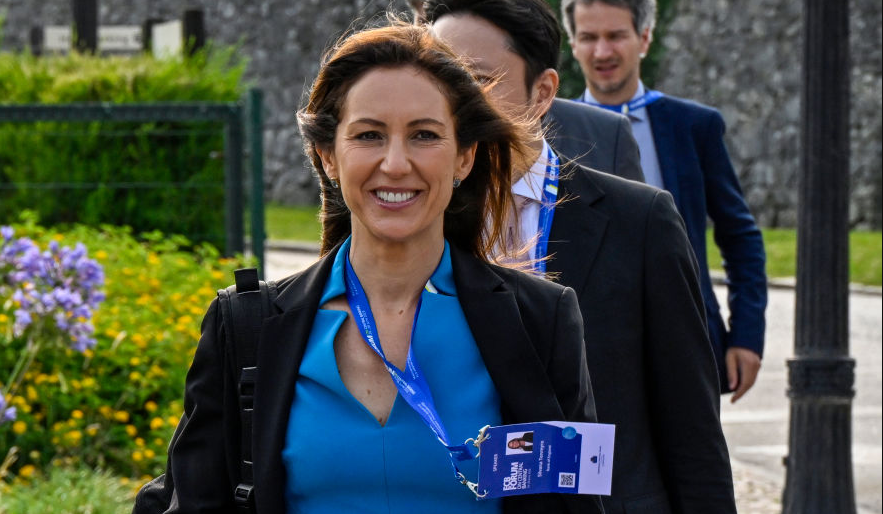
The International Monetary Fund on Tuesday named Silvana Tenreyro as its next chief economist, replacing Pierre-Olivier Gourinchas, who has returned to academia, IMF Managing Director Kristalina Georgieva said in a statement.
Tenreyro, a citizen of Argentina, Italy and Britain and longtime professor of economics at the London School of Economics, will take over as the IMF‘s economic counselor and director of the research department on August 10, the IMF said.
Widely published, Tenreyro also served as an external member of the Bank of England’s Monetary Policy Committee from 2017 to 2023. Earlier in her career, she worked as an economist at the Federal Reserve Bank of Boston and was a member of the Monetary Policy Committee of the Bank of Mauritius.
She is currently part of Georgieva’s external advisory group and counsels leading public and private institutions on economic and financial issues, the IMF said.
“At a time of profound transformation and heightened uncertainty in the global economy, Silvana’s mix of intellectual leadership and policy experience will help ensure that the Fund’s analytical work and multilateral surveillance and policy advice will remain at the cutting edge in support of our membership,” Georgieva said.
The IMF chief economist oversees the preparation of the IMF‘s regular economic updates, and serves as one of the fund’s principal voices on the global economic outlook, a job that has been complicated in recent years by challenges such as the COVID pandemic, U.S. tariff changes and the war in the Middle East.
Tenreyro earned her Ph.D. and Master of Arts in economics from Harvard University after earning an undergraduate degree in Argentina. She is married to economist Francesco Caselli, who heads the academic board at the London School of Economics.
Moritz Schularick, president of the Kiel Institute, praised Tenreyro for her pioneering work on economic volatility, monetary policy transmission and currency unions when she won the institute’s Bernhard Harms Prize last year.
“Her work has considerably advanced our understanding of how diversification and the nature of shocks shape growth and welfare in both emerging and advanced economies,” Schularick said.
-Reuters