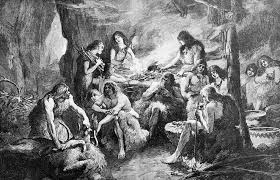
When Homo sapiens trekked out of Africa, our species encountered Neanderthal populations already inhabiting the vast expanses of Europe, Asia and the Middle East. As the presence of Neanderthal DNA in most present-day people shows, interbreeding occurred, though the circumstances have remained unclear.
New research focusing on the X chromosome, one of the two sex chromosomes, in present-day people and, as revealed by ancient genomes, in Neanderthals is providing insight into who participated in these prehistoric pairings. The genetic analysis backs the conclusion that this phenomenon primarily was driven by sex between Neanderthal men and Homo sapiens women.
The researchers said it is unknown why this occurred, whether by peaceful mating preference, by force or some other scenario.
“The preferences of either or both parties could produce these kinds of patterns, with or without the consent of the other,” said geneticist Alexander Platt of the University of Pennsylvania’s Perelman School of Medicine, co-lead author of the research published on Thursday in the journal Science.
Chromosomes are threadlike structures that carry genetic information from cell to cell. In people, females carry two X chromosomes – one inherited from each parent. Males carry one X chromosome inherited from their mother and one Y chromosome from their father. For the other chromosomes, everyone has two copies – one from each parent, equally distributed across the sexes.
Most people, with the exception of certain sub-Saharan African populations, carry small amounts – often 1% to 4% – of Neanderthal DNA across much of their genome but have little to none on their X chromosomes. Africans are the exception because their ancestors, having stayed on the continent, never mixed with Neanderthals.
The genomes of three Neanderthals showed an excess of Homo sapiens DNA on X chromosomes, a pattern opposite from present-day people and suggestive of male Neanderthal-female Homo sapiens mating.
The researchers also examined genetic data from present-day Africans lacking Neanderthal ancestry to better track gene flow between Homo sapiens and Neanderthals who interbred starting as early as 250,000 years ago. A more recent Homo sapiens migration resulted in additional interbreeding peaking around 47,000 years ago.
Scientists had long assumed the absence of Neanderthal contribution to modern X chromosomes was because some Neanderthal genes were biologically incompatible with Homo sapiens, causing serious health problems, and were purged because offspring failed to reproduce – Darwinian “survival of the fittest.”
But the abundance of Homo sapiens DNA in Neanderthal X chromosomes contradicted that notion. Instead, the genetic data, the researchers said, is best explained by Neanderthal men and Homo sapiens women mating, with mathematical modeling confirming this mating bias could reproduce the observed genetic patterns.
SIMILARITIES BEYOND THE ANATOMICAL
Homo sapiens and Neanderthals had a common ancestor until approximately 600,000 years ago. The lineage then split, with Neanderthals evolving in Europe and Homo sapiens in Africa.
Neanderthals, who disappeared roughly 40,000 years ago, and Homo sapiens had similarities beyond the anatomical. Neanderthals, more robustly built and with larger brows, were intelligent, creating art and using complex group-hunting methods, symbolic objects and perhaps spoken language.
The nature of the interaction is difficult to ascertain based on archaeological and genetic evidence, including whether, for example, there were hostilities such as raiding parties by Neanderthal men to abduct Homo sapiens women.
“We have no way of knowing if this was a conflict scenario,” University of Pennsylvania geneticist and study senior author Sarah Tishkoff said, noting the interaction could have been peaceful.
“But we also don’t know why this pattern happened of more modern human (Homo sapiens) females mating with Neanderthals – whether it was due to choice or they were forced. This is what makes it so fascinating, and hopefully someday perhaps there will be archaeological and fossil data that will shed further light on the interactions between Neanderthals and modern humans.”
At some point after spreading through Eurasia, our species greatly outnumbered the Neanderthals.
“If you consider that there may have been 10 to 20 times as many Homo sapiens in the area as Neanderthals, the observation that we had as much as 5% Neanderthal ancestry 30,000 to 40,000 years ago suggests it’s entirely reasonable to guess that there was simply so much interbreeding that we swamped the gene pool – that Neanderthals didn’t actually disappear at all, they just became some of us,” Platt said.
“It’s kind of fun to think that there are currently some six billion people walking around with about 2% Neanderthal genomes,” Platt said. “To the extent that that’s equivalent to 120 million Neanderthals’ worth of genomes, they’re doing better than ever.”
(REUTERS)