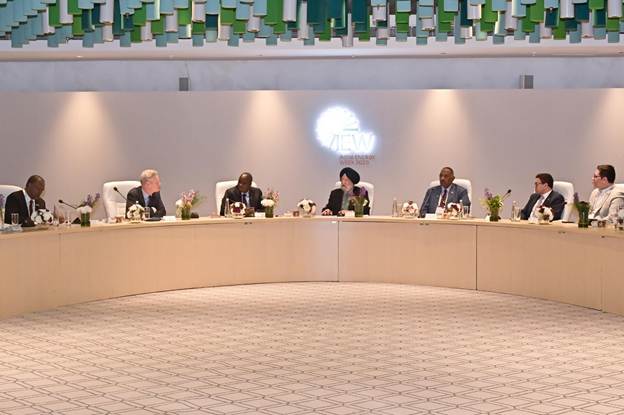
Union Minister of Petroleum and Natural Gas Hardeep Singh Puri chaired a Ministerial Roundtable on Clean Cooking during the second day of India Energy Week 2025, showcasing India’s success in ensuring universal access to clean cooking gas. Puri emphasised that India’s model, driven by targeted subsidies, digitised distribution networks, and cultural shifts, offers a replicable solution for other Global South nations facing similar energy challenges.
The session brought together representatives from countries like Brazil, Tanzania, Malawi, Sudan, and Nepal, along with industry leaders such as the International Energy Agency (IEA), Total Energy, and Boston Consulting Group (BCG). Puri highlighted India’s Pradhan Mantri Ujjwala Yojana (PMUY), which provides LPG access at highly affordable rates—7 cents per day for beneficiaries and 15 cents per day for other consumers—making clean cooking fuel accessible to millions.
During the roundtable, international representatives shared their experiences and challenges in expanding clean cooking solutions. Tanzania’s Deputy Prime Minister and Minister of Energy, Hon. Dkt. Doto Mashaka Biteko, outlined efforts to enable 80% of households to transition to clean cooking by 2030, while Sudan’s Energy Minister, H.E. Dr. Mohieldien Naiem Mohamed Saied, emphasised the need for private sector engagement to address LPG supply gaps.
Mary Burce Warlick, Deputy Executive Director of IEA, praised India’s model for its affordability, access, and infrastructure solutions, highlighting the importance of public-private partnerships and concessional financing for global expansion. Representatives from Rwanda and Nepal shared their countries’ efforts to reduce firewood dependency through electric stoves and biogas.
Rahool Panandiker of BCG credited India’s transformation in clean cooking to its strong political commitment, effective subsidies, and public awareness campaigns. He stressed the need to refine the LPG refill model for sustained usage and economic sustainability.
Puri also discussed the potential of solar cookers, highlighting IOCL’s advanced solar models priced at $500 per unit. While acknowledging cost challenges, he pointed to carbon financing and private sector collaborations as solutions to drive adoption across the Global South.
In his closing remarks, Puri reaffirmed India’s commitment to supporting global energy access initiatives, calling the Indian model a scalable solution for other developing nations. He emphasized that achieving universal clean cooking access is not just an economic goal but a moral obligation due to the health and environmental impacts of traditional biomass cooking.