





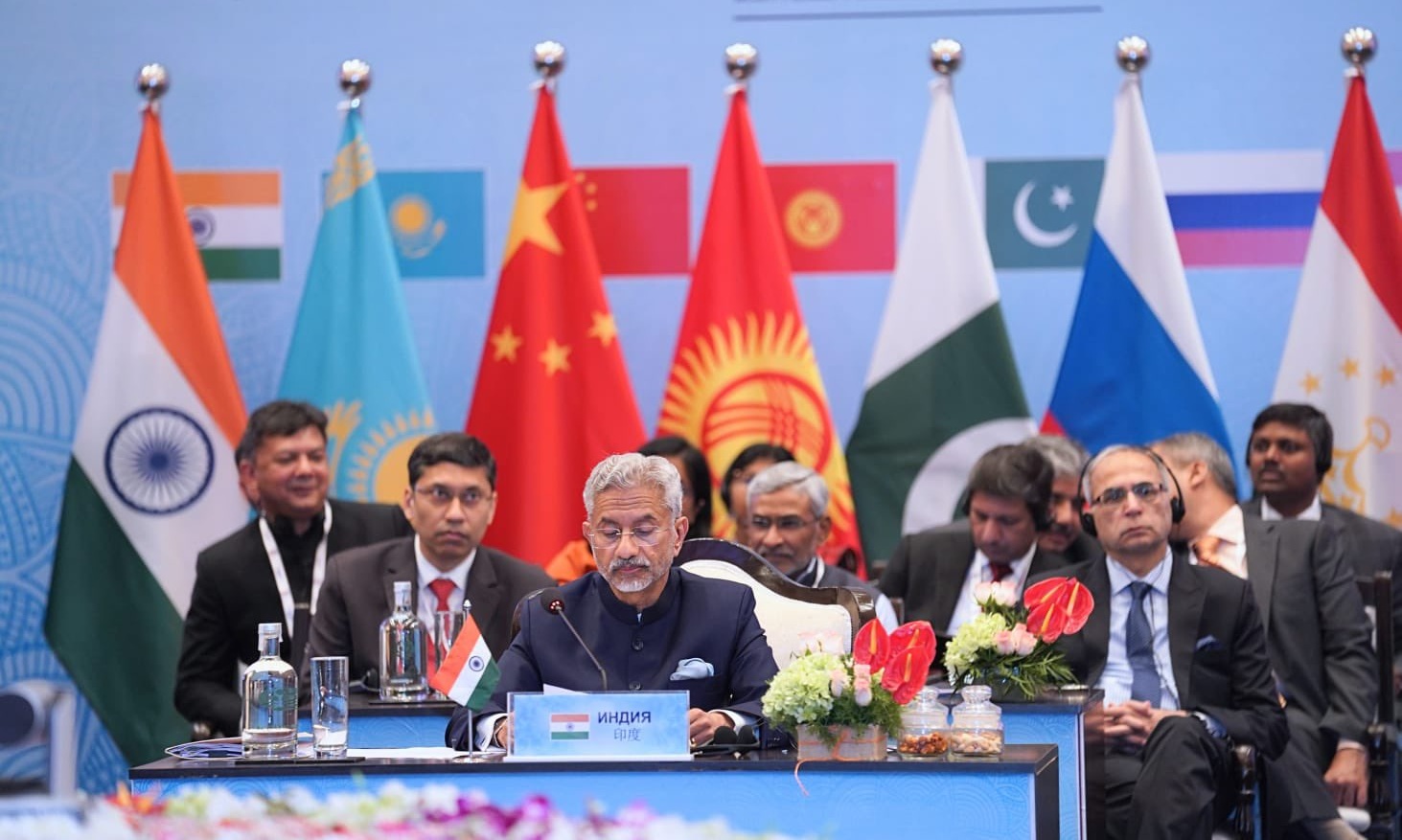
A day ahead of the Shanghai Cooperation Organisation (SCO) Council of Foreign Ministers’ Meeting (CFM) in Tianjin, External Affairs Minister (EAM) S. Jaishankar on Monday stated that the “primary mandate” of the grouping is to “combat terrorism, separatism and extremism”.
“Tomorrow, we will be meeting in the format of the SCO, whose primary mandate is to combat terrorism, separatism and extremism. This is a shared concern and India hopes that zero tolerance for terrorism will be strongly upheld,” the EAM said in his opening remarks during a meeting with Chinese Foreign Minister Wang Yi on Monday.
Last month, the SCO Defence Ministers’ Meeting held at Qingdao could not adopt a Joint Statement after India’s concerns on terrorism did not reflect in the document.
Defence Minister Rajnath Singh, who had attended the meeting, had laid down the broad contours of India’s transitional shift in its policy against terrorism and had also called upon the member countries to unite in eliminating the menace for collective safety and security.
“I understand that they could not adopt a Joint Statement. I also understand that member countries could not reach consensus on certain issues and hence the document could not be finalised. On our side, India wanted concerns on terrorism reflected in the document, which was not acceptable to one particular country, and therefore the statement was not adopted,” the Ministry of External Affairs (MEA) spokesperson Randhir Jaiswal had said during a regular media briefing held in New Delhi on June 26.
On June 24, while spotlighting the barbaric Pahalgam terror attack and India’s subsequent Operation Sindoor to dismantle terror infrastructure across the border, National Security Advisor Ajit Doval had also called for the urgent need to shun double standards in the fight against terrorism and take decisive actions against UN-proscribed terrorists and entities.
Addressing the 20th meeting of the Security Council Secretaries of the SCO Member States in Beijing, NSA Doval had said that India is deeply concerned about continued threat from terror groups designated by United Nations Security Council (UNSC), including Lashkar-e-Taiba (LeT), Jaish-e-Mohammed (JeM) — two of the most dangerous and state-supported terror outfits operating out of Pakistan – besides Al Qaeda, ISIS and its affiliates.
In his intervention, he highlighted the need to shun double standards in the fight against terrorism and take decisive actions against UN-proscribed terrorists and entities like LeT, JeM and their proxies and dismantle their terror eco-systems.
Reiterating that any act of terror including cross border terrorism is a crime against humanity, India had called on SCO members to hold accountable the perpetrators, organisers, financiers and sponsors of acts of cross border terror and to help bring them to justice.
During his visit, NSA Doval had also held discussions with Chinese Foreign Minister Wang Yi who is also a Member of the Political Bureau of the Central Committee of the Communist Party of China (CPC).
–IANS