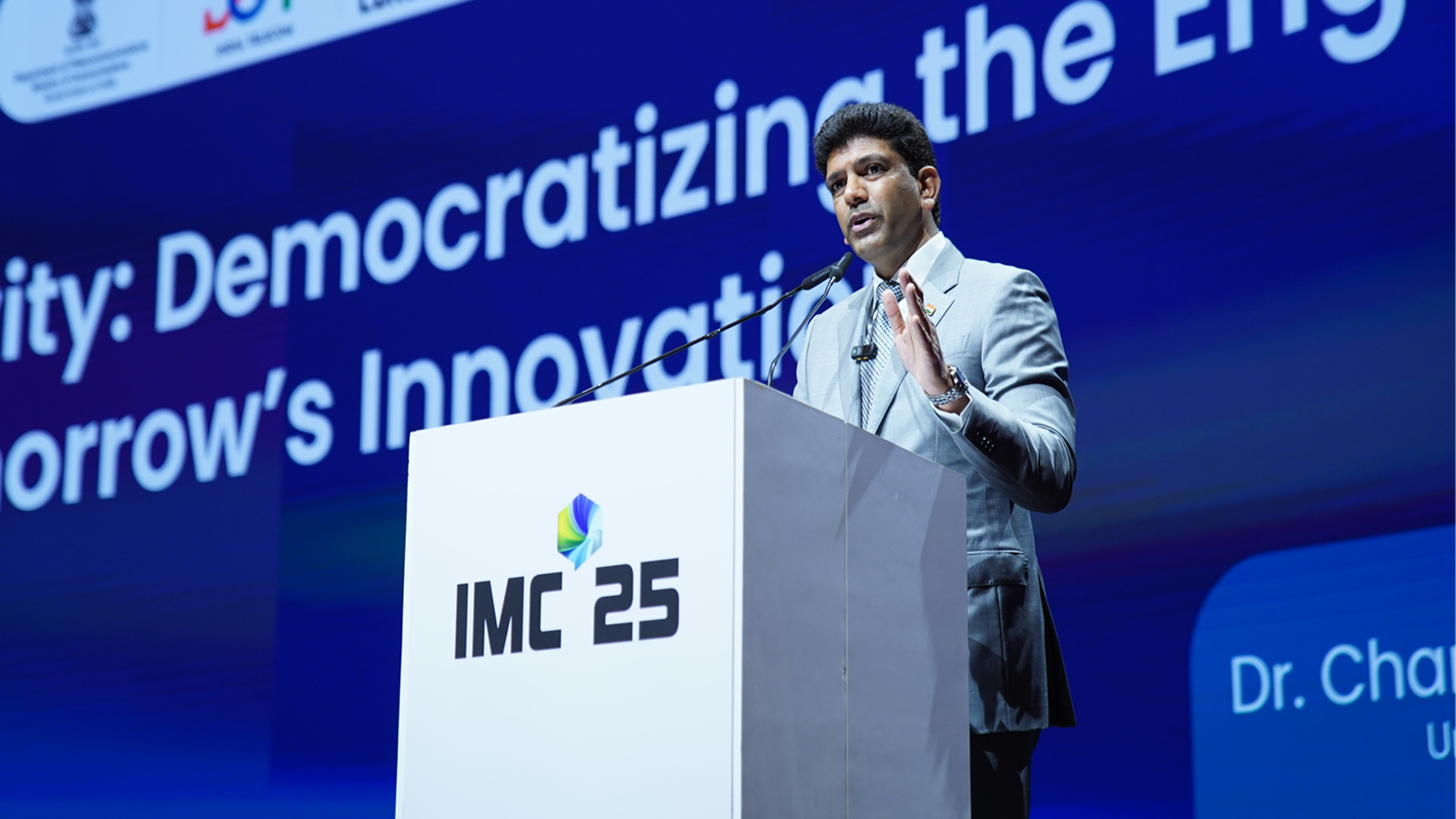
India is turning innovation into a people’s movement by making it accessible to every citizen, said Union Minister of State for Communications and Rural Development, Dr. Pemmasani Chandra Sekhar, while addressing a session titled “Beyond Connectivity: Democratising the Engines of Tomorrow’s Innovation” on the sidelines of India Mobile Congress 2025 at Yashobhoomi in New Delhi on Wednesday.
Chandra Sekhar emphasised that under the visionary leadership of Prime Minister Narendra Modi, India is building an inclusive and globally competitive innovation ecosystem. “We are democratising the engines of tomorrow’s innovation – making them work for every Indian,” he said.
Highlighting the shift in India’s mindset, the Minister said that initiatives such as Atal Innovation Mission, Startup India, Digital India and Atmanirbhar Bharat have played a crucial role in making innovation accessible. “Innovation is in our DNA, and we are awakening it for a new century,” he added, recalling India’s historic contributions such as zero and chess.
Chandra Sekhar noted that India’s innovation journey has entered a decisive phase – moving from connectivity to creativity. The country now boasts the world’s third-largest startup ecosystem with over 1.9 lakh startups. Patent filings have doubled in the last decade, rising from 40,000 in 2014 to more than 80,000 in 2025.
“Innovation is no longer a privilege – it is becoming a national habit. Code is being written in tier-3 towns, and startups are being born in college dorms,” he said, underlining the expanding innovation landscape.
The Minister also highlighted that a decade of digital inclusion through the Jan-Dhan-Aadhaar-Mobile (JAM) trinity, affordable internet reaching 900 million users, and UPI’s 10+ billion monthly transactions has laid a strong foundation for innovation. He pointed to milestones such as Chandrayaan-3, indigenous 4G/5G technology, the Made-in-India MRI, and a 30-fold rise in defence exports as symbols of India’s growing technological strength and self-reliance.
Further, he underlined key economic reforms like GST, the Insolvency and Bankruptcy Code, labour law simplification, and the abolition of retrospective taxation, which have created a transparent and investor-friendly environment. “India has shifted from a license raj to a trust-first model, celebrating entrepreneurs as nation-builders,” he said.
The session was attended by Hiroshi Mikitani, Chairman and CEO of Rakuten Group; Ankur Kapoor, Chief Network Officer at T-Mobile; and Gopal Vittal, Chairman of GSMA.