India and Japan on Thursday unveiled a comprehensive roadmap to deepen cooperation in artificial intelligence (AI), committing to jointly develop a safe, secure, trustworthy and human-centric AI ecosystem while expanding collaboration in governance, research, digital infrastructure, talent development and innovation.
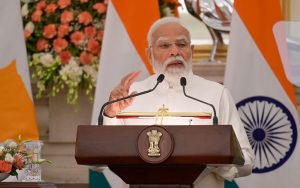
In a joint statement issued after talks between Prime Minister Narendra Modi and Japanese Prime Minister Sanae Takaichi, the two leaders described AI as an era-defining general-purpose technology that is reshaping economies, industries, governance, science, security and societies. They said the decisions taken today on AI development and governance would have long-term implications for innovation, economic security and the global order, and agreed to strengthen bilateral cooperation to enhance the resilience and competitiveness of both countries.
The two leaders also agreed to align AI cooperation with India’s MAHASAGAR vision and Japan’s updated Free and Open Indo-Pacific (FOIP) strategy to build resilient and growth-oriented economic ecosystems. They pledged to work with like-minded countries and partners to promote inclusive AI development across the Indo-Pacific and the Global South.
Recognising the need to balance innovation with responsible regulation, India and Japan reaffirmed their commitment to promoting safe, secure, trustworthy and inclusive AI while mitigating risks and ensuring resilient AI supply chains. They welcomed the outcomes of the New Delhi AI Impact Summit and agreed to continue regular India-Japan AI Strategic Dialogues following the inaugural meeting held in April 2026 under the Japan-India AI Cooperation Initiative (JAI).
On global AI governance, the two countries committed to strengthening coordination in international forums, including the G20, OECD, Global Partnership on AI (GPAI) and the United Nations. They reaffirmed support for the Hiroshima AI Process, including its guiding principles and code of conduct for advanced AI systems, and agreed to deepen cooperation through the Hiroshima AI Process Friends Group while promoting greater participation from the Global South and private sector.
The joint statement also underscored the importance of cooperation on AI model evaluation, capability assessment, benchmarks and safety tools through initiatives such as the Trusted AI Commons. India and Japan further agreed to enhance collaboration on AI-enabled cybersecurity, the security of AI systems and protection of critical infrastructure, while stressing the need for safeguards to ensure children’s safety in the development and deployment of AI.
In the area of technology and infrastructure, both countries elevated their partnership to become strategic research and development partners in AI. They agreed to strengthen cooperation on secure digital infrastructure, including data centres, GPU and other computing resources, semiconductors and resilient AI supply chains. The two sides also committed to advancing the FOIP Digital Corridor Initiative to improve digital connectivity across the region.
The leaders pledged to jointly promote resilient, efficient and energy-conscious AI by supporting work on efficient models, optimised inference, green computing and secure data infrastructure. They also agreed to deepen collaboration among governments, industry and academia on multilingual, open-source and domain-specific AI models, particularly for native languages and public-interest applications.
As part of the initiative, several agreements were welcomed, including an MoU between IIT Bombay, BharatGen Technology Foundation and Japan’s National Institute of Informatics for joint research on large language models (LLMs), an agreement between Sarvam and Preferred Networks covering the AI technology stack, and a Memorandum of Cooperation between India AI and Japan’s Ministry of Economy, Trade and Industry (METI) to support AI companies from both countries.
The two nations also committed to expanding cooperation in AI-enabled scientific research through the Network of AI for Science (AI4S) Institutions and increasing joint research, researcher exchanges and industry-academia collaboration across the AI value chain.
Recognising India’s growing AI talent pool, the leaders encouraged Japanese companies to expand AI-related research, innovation and industrial partnerships in India while creating greater opportunities for Indian professionals through internships, research collaborations and employment in Japan. They reaffirmed the target announced during the India-Japan Foreign Ministers’ Strategic Dialogue in January 2026 to bring 500 highly skilled Indian AI professionals to Japan by 2030.
The joint statement also highlighted the importance of AI skilling and reskilling and called for greater public-private collaboration to develop scalable AI solutions addressing strategic, economic and societal challenges. Governments, startups, corporations, research institutions and investors from both countries were encouraged to jointly identify real-world problems and develop AI-based solutions, drawing upon the Global AI Impact Commons.
Reaffirming the vision of “AI for All” outlined in the New Delhi Declaration adopted at the India AI Impact Summit, both countries pledged to work together with like-minded partners to promote AI capacity building, technical assistance, knowledge sharing and replication of successful AI applications for inclusive and sustainable development.
Prime Minister Modi also welcomed Japanese Prime Minister Sanae Takaichi’s announcement that Japan will host the next AI Summit at the earliest opportunity, underscoring the growing strategic partnership between the two countries in shaping the future of artificial intelligence.