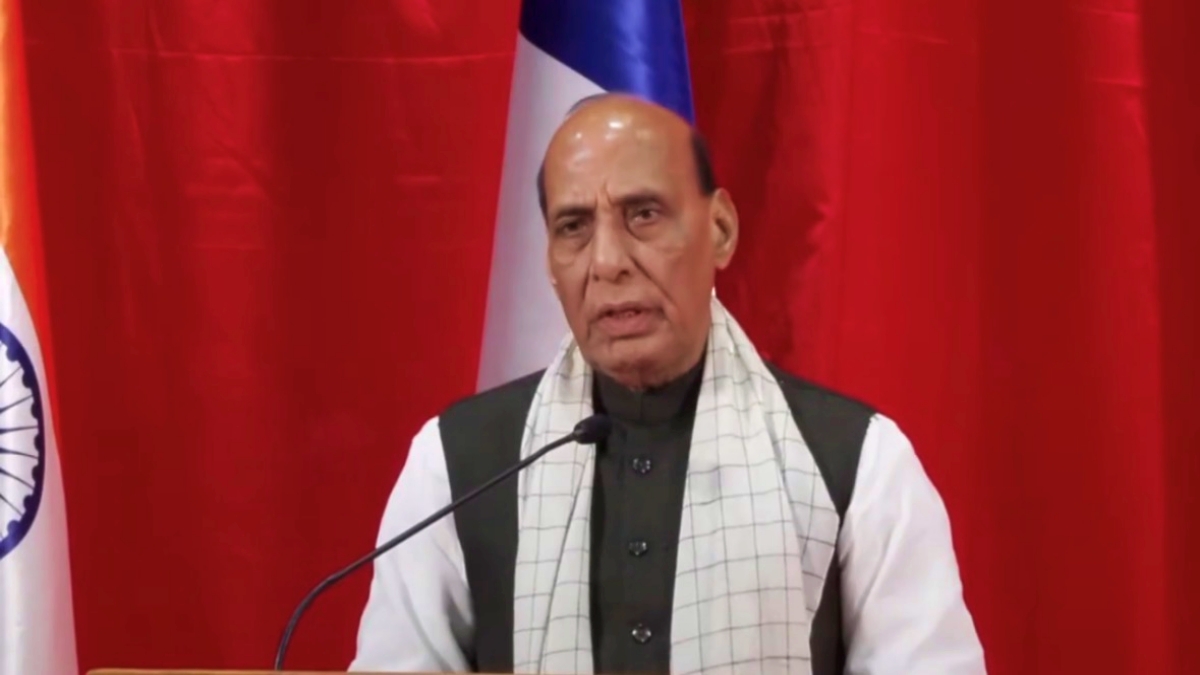
Defence Minister Rajnath Singh on Friday emphasised that self-reliance is essential for India to remain prepared in an increasingly uncertain global environment, highlighting the government’s push to strengthen indigenous defence production and shipbuilding capabilities.
Speaking at “Sagar Sankalp – Reclaiming India’s Maritime Glory,” a defence and maritime dialogue organised by Garden Reach Shipbuilders & Engineers Limited (GRSE) in Kolkata, the Defence Minister said global supply chain disruptions and geopolitical tensions are reshaping the international order.
“The old global order and perceptions are changing rapidly. The situation in regions such as the Middle East and vital energy routes like the Strait of Hormuz directly impact global trade and energy security,” Singh said, adding that such uncertainties are increasingly becoming the “new normal”.
He stressed that technological advancements are rapidly transforming the defence sector, making it necessary for India to achieve self-reliance in critical defence technologies to stay prepared for future challenges.
Highlighting progress in domestic defence production, Singh said India’s defence manufacturing has grown significantly due to structural and policy reforms introduced by the government.
Domestic defence production crossed ₹1.5 lakh crore in the financial year 2024-25, while defence exports reached an all-time high of about ₹24,000 crore, he said. Singh said that exports are expected to touch around ₹29,000 crore by April 2026, with the government targeting ₹50,000 crore in defence exports by FY 2029-30.
He also noted that the private sector currently contributes around 25 per cent of defence platforms and equipment produced in the country, a share that is expected to rise to about 50 per cent in the coming years.
The Defence Minister said India has made significant strides toward building a “Builder’s Navy”, pointing out that all warships and submarines currently on order for the Indian Navy are being constructed in domestic shipyards.
He added that the government aims to transform shipyards into advanced technology hubs, with modern infrastructure, digital ship design tools, modular construction techniques and integrated supply chains.
“Our aim is to develop ships into technology hubs and bring them up to global standards through infrastructure modernisation,” Singh said.
The government has also taken steps to support private participation in the defence sector, including improving import-export processes, providing industry access to research facilities of the Defence Research and Development Organisation (DRDO), and establishing defence industrial corridors.
Singh highlighted that India’s maritime strategy under Maritime India Vision 2030 and Maritime Amrit Kaal Vision 2047 envisages investments of nearly ₹3 lakh crore to develop world-class shipbuilding clusters and strengthen the domestic maritime ecosystem.
He praised the contribution of MSMEs, start-ups and indigenous vendors in building major defence platforms, saying warship construction involves a “conglomerate effect” in which multiple industries collaborate to create a technologically advanced product.
The Defence Minister also reiterated the government’s long-term goals for the maritime sector.
“Our target is to steer India into the top 10 shipbuilding nations by 2030 and among the top five by 2047,” he said.
Singh added that the operational readiness of the Indian Navy, the success of missions such as Operation Sindoor, and growing self-reliance in defence manufacturing indicate that India’s defence sector is moving in the right direction.
The conclave brought together senior naval officers, policymakers and industry leaders to discuss strengthening India’s maritime security architecture, expanding shipbuilding capacity and positioning the country as a competitive global hub for shipbuilding and ship repair.