











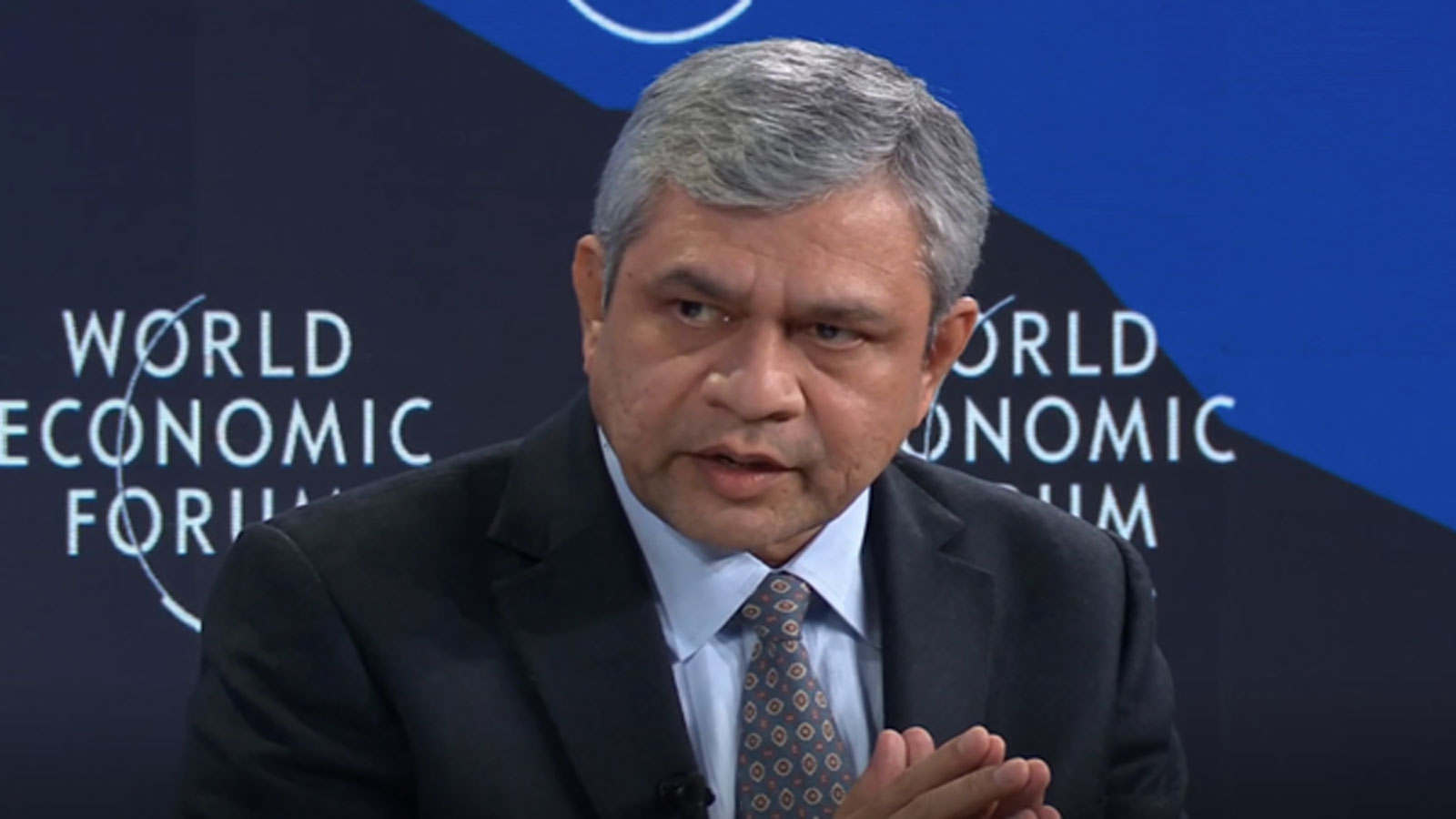
India made a strong impression at the World Economic Forum 2026 in Davos as Union Minister for Electronics and Information Technology Ashwini Vaishnaw asserted that the country belongs to the first group of globally AI-ready nations, driven by cost-effective innovation, large-scale deployment and a balanced governance framework.
Speaking at the high-level panel discussion titled “AI Power Play”, which examined the geopolitics, economics and governance of artificial intelligence, Vaishnaw highlighted India’s systematic progress across all five layers of the AI ecosystem – applications, models, chips, infrastructure and energy.
The panel, moderated by Ian Bremmer, President of Eurasia Group, featured prominent global voices including IMF Managing Director Kristalina Georgieva, Microsoft President and Vice Chair Brad Smith, and Saudi Arabia’s Investment Minister Khalid Al-Falih.
Vaishnaw stressed that India’s AI strategy prioritises real-world impact and return on investment (ROI) over the pursuit of excessively large models. “Nearly 95 per cent of practical use cases can be addressed using models in the 20–50 billion parameter range,” he said, noting that India has already developed a range of efficient AI models that are being deployed across sectors to improve productivity and service delivery.
He pointed out that this approach enables India to offer maximum economic return at significantly lower cost, making its AI solutions especially relevant to global challenges. Citing international assessments, the Minister said Stanford University ranks India third in AI penetration and preparedness, and second globally in AI talent availability.
Highlighting the government’s focus on democratising access to AI, Vaishnaw said India has addressed the challenge of limited GPU availability through a public-private partnership model. Under this initiative, 38,000 GPUs have been empanelled as a shared national compute facility, subsidised by the government and made available to students, researchers and startups at nearly one-third of prevailing global costs.
He also underscored India’s nationwide AI skilling programme, which aims to train 10 million people, enabling the IT sector and startups to leverage AI for both domestic and global markets.
On governance, Vaishnaw advocated a techno-legal approach to AI regulation. He said governance frameworks must go beyond legislation and incorporate technical solutions to address bias, authenticate deepfakes with legal accuracy, and ensure safe deployment through mechanisms such as machine unlearning.
Other panellists acknowledged India’s rising influence in the global AI landscape. Ian Bremmer observed that India has emerged as a major technological and geopolitical player over the past decade, while representatives from global institutions and industry highlighted India’s emphasis on diffusion, accessibility and sovereign capability as a model for emerging economies.












