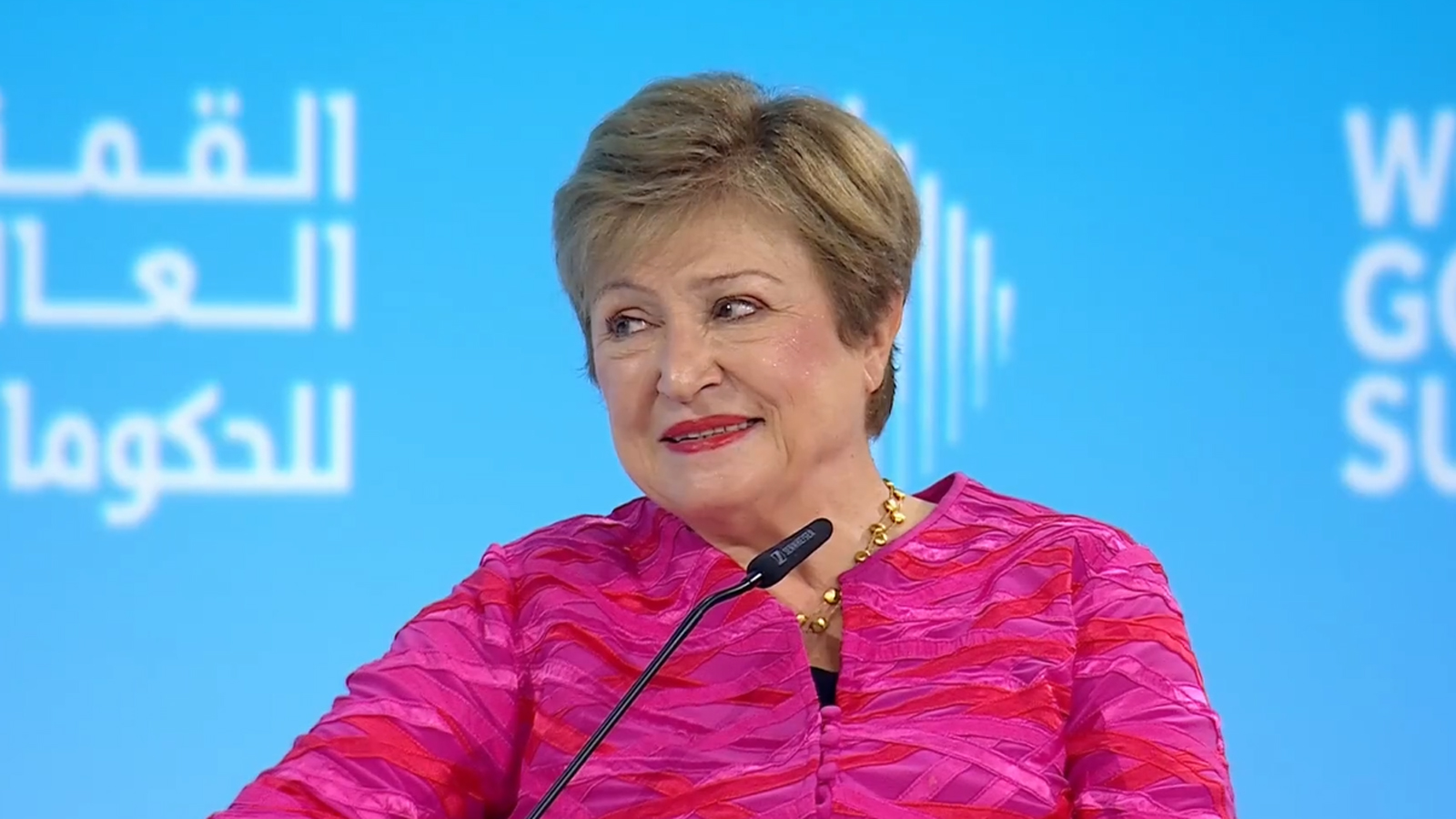
India’s economy is expected to remain resilient even as global growth slows amid war-driven disruptions, with strong fundamentals helping it outperform most economies, the International Monetary Fund’s Managing Director Kristalina Georgieva has said.
“Look at India today. India’s growth is more than two times higher than the average global growth,” Georgieva said at a press briefing during the IMF Spring Meetings on Wednesday (local time).
She attributed India’s relative strength to sustained policy improvements and institutional capacity built over the past decades. “That comes because of the strength of fundamentals,” she said, noting that economies with strong macroeconomic frameworks are better positioned to withstand external shocks.
The IMF chief stated that emerging market economies, including India, have significantly improved their policy frameworks, particularly in monetary policy. “In monetary policy, they are as good… or better than advanced economies,” she said, while acknowledging that further improvements are still needed in fiscal policy.
Georgieva said this progress has contributed to a more resilient global economy overall. “We have a more resilient world because of the resilience of many emerging market economies that have put in place independent central banks, fiscal councils, and built very strong reserves,” she said.
However, she cautioned that a prolonged conflict in the Middle East could still weigh on all economies, including India. “In an adverse scenario… we are going to see a slowdown in global growth,” she said, adding that global expansion could drop as low as 2 per cent if hostilities persist.
The impact is expected to be particularly significant for energy-importing economies. Georgieva noted that higher oil and gas prices would affect all countries, though the burden would be uneven. “The negative impact is highly asymmetric with the biggest burdens falling on countries that import energy,” she said.
India, along with other Asian nations, faces added pressure due to its dependence on energy imports from the Gulf. “Asia is very severely impacted because of the dependency of imports,” Georgieva said, though she added that the region’s strong policy track record is helping cushion the blow.
Despite these risks, she stated that countries like India, with robust domestic demand, institutional strength, and policy credibility, are likely to perform better than peers. “We do not see a scenario under which there would be a dramatic development,” she said, while cautioning that financial stability remains a key risk to monitor.
India has emerged as one of the fastest-growing major economies in recent years, supported by strong domestic consumption, infrastructure spending and reforms aimed at improving ease of doing business. Its growth trajectory has consistently outpaced global averages, making it a key driver of economic expansion in Asia.(IANS)