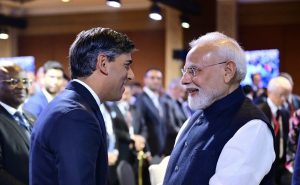









Prime Minister Narendra Modi concluded his visit to the United Kingdom, signing the Free Trade Agreement with the island nation. The FTA was being negotiated for a few years now, and the signing marks an important diplomatic win for the Modi Government.
As the world finds itself engulfed in tariff wars, initiated by the White House under Donald Trump, the FTA comes across as a sign of economic trust between two critical economies. While global trade is now plagued with an air of uncertainty and unpredictability, the FTA is a testament to the path of trade expansion and stability opted for by both governments.
Before we dig into the numbers, the successful diplomatic move is also a reminder of how the Modi Government has prioritised national interests over international intricacies. Back in 2022, when the West was sanctioning Russia, the Modi Government increased its oil imports from Russia. The decision insulated the Indian economy from double-digit energy inflation witnessed in Europe.
The FTA is also about capitalising on the economic relationship that has been steadily evolving over the last few years.
Over the past decade, bilateral trade between India and the UK has surged dramatically, expanding from £16.4 billion in 2015 to £42.6 billion in 2024, a remarkable 160 per cent increase. This evolution underscores India’s strengthening export prowess, particularly in services, while laying groundwork for deeper ties under the newly signed Free Trade Agreement (FTA).
In 2015, India’s goods imports from the UK stood at £3.9 billion, with services at £3.2 billion, against goods exports of £6.0 billion and services at £3.3 billion, yielding a £2.2 billion surplus. Trade remained steady at £16.4 billion in 2016 but climbed steadily thereafter, reaching £18.9 billion in 2017 and £22.3 billion in 2018, driven by rising exports.
A brief dip occurred in 2020 amid the pandemic, with total trade falling to £20.2 billion and surplus to £3.4 billion. Recovery was swift: by 2021, trade hit £25.2 billion, accelerating to £35.4 billion in 2022 and £39.4 billion in 2023. Services exports skyrocketed, from £3.3 billion in 2015 to £14.7 billion in 2024, while goods exports grew from £6.0 billion to £10.1 billion.
India’s consistent surplus, peaking at £8.4 billion in 2024, highlights its competitive edge in IT, pharmaceuticals, and engineering. With the FTA promising reduced tariffs, future frontiers in green tech and digital services beckon, fostering mutual prosperity.
Several sectors are expected to benefit from the FTA in India. The India-UK Free Trade Agreement (FTA) delivers substantial benefits through near-complete tariff reductions, granting Indian exporters duty-free access to the UK market in key sectors. This enhances competitiveness in labour-intensive industries and high-tariff segments, aligning with India’s export strengths.
In animal and marine products, tariffs up to 20 per cent are eliminated, with 99.3 per cent of animal tariff lines at zero duty. Base metals like aluminium (up to 10 per cent), iron & steel (2 per cent), and copper (4 per cent) now face zero duties. Chemicals, including organic and inorganic variants (up to 8 per cent), follow suit.
Electrical and mechanical machinery, previously taxed up to 14 per cent and 8 per cent respectively, gain full liberalisation. Leather and footwear shed duties of up to 16 per cent while textiles and clothing (up to 12 per cent) see complete elimination, boosting MSMEs in states like Uttar Pradesh and Tamil Nadu.
Processed foods achieve a major win, with 99.7 per cent tariff lines at zero duty despite prior peaks of 70 per cent. Gems & jewellery, furniture, and sports goods (up to 4 per cent) also benefit fully. Agri-products like fruits (20 per cent), spices (8 per cent), tea, and coffee (10 per cent) enter duty-free, except rice.
These concessions propel exports in marine, vegetable oils, and plant-based goods, supporting ‘Make in India’ and PLI schemes for employment-intensive sectors like textiles, leather, and artisanal products.
Beyond core sectors, the India-UK Free Trade Agreement (FTA) expands market opportunities in areas where India boasts robust export capabilities, previously hindered by moderate tariffs. This strategic access elimination fosters growth and competitiveness.
For marine and animal products, duties as high as 20 per cent are now zero, offering a major lift to exporters of seafood, dairy, and meat, enhancing supply chains and revenue streams.
Similarly, vegetable oils and plant-based items see tariff removal from up to 20 per cent, aiding shipments of edible oils, oilseed derivatives, and related commodities. This extends to packaged foods, tea, coffee, and spices, bolstering India’s agri-processing industry and supporting rural livelihoods through increased exports.
In emerging fields, chemicals, electrical machinery, mechanical machinery, and plastics/rubber benefit from full duty abolition, providing a crucial edge as India strengthens its global standing in these domains.
These enhancements dovetail with India’s developmental priorities, including the ‘Make in India’ initiative and Production Linked Incentive (PLI) Scheme.
The FTA emerges as a well-designed pact, yielding prompt and substantial advantages to employment-heavy sectors like textiles, leather, gems and jewellery, organic chemicals, plastics, artisanal goods, and processed foods, driving inclusive economic progress. A notable diplomatic victory indeed.