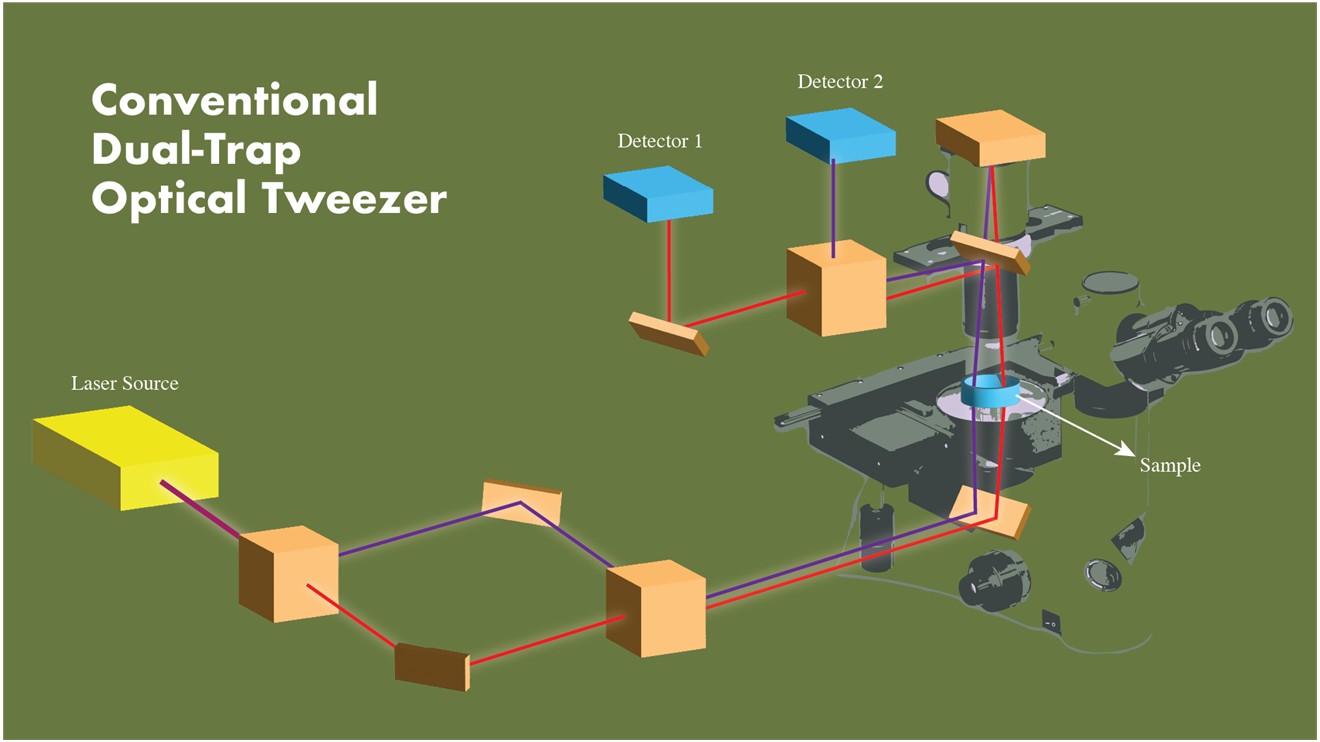
Researchers at the Raman Research Institute (RRI) have developed a novel dual-trap optical tweezers system, offering a more precise and versatile tool for manipulating single biomolecules and small particles. The innovation is expected to accelerate discoveries in fields including neuroscience, drug development, and medical research.
Optical tweezers, a Nobel Prize-winning technology in 2018, use light to manipulate microscopic objects and measure minute forces. While conventional dual-trap systems allow study of particle interactions and biopolymer mechanics, they are often limited by signal interference, complex alignment requirements, and difficulty in integrating with standard microscopy techniques.
The RRI team overcame these challenges with a confocal detection scheme, where each detector monitors only the light scattered back from its own trap, avoiding interference between the two traps. The system maintains precise alignment even when traps are moved, allowing for stable, long-duration experiments under varying conditions.
“The unique optical trapping scheme utilizes laser light scattered back by the sample for detecting trapped particle positions. This removes signal interference and integrates seamlessly with standard microscopes,” said Md Arsalan Ashraf, PhD scholar at RRI.
Unlike traditional systems, the new design eliminates cross-talk, enables independent measurements from both traps, and works compatibly with imaging techniques such as phase contrast and fluorescence. Its compact, modular configuration allows easy addition to existing microscopes without altering their basic structure.
“This single-module design makes high-precision force measurement studies of single molecules and manipulation of biological samples more convenient and cost-effective,” said Pramod A Pullarkat, lead principal investigator and faculty at RRI.
The innovative system, which addresses longstanding technical limitations of dual-trap optical tweezers, is being considered for patent protection and commercialization as a plug-and-play add-on for commercial microscopes.
The breakthrough marks a significant step in making advanced research tools more accessible to Indian scientists and promoting new avenues in nanoscience, biotechnology, and biomedical research.