A team of Indian researchers has pioneered a nanomaterial that can interact with neurons directly, potentially transforming therapies for brain disorders by avoiding invasive techniques
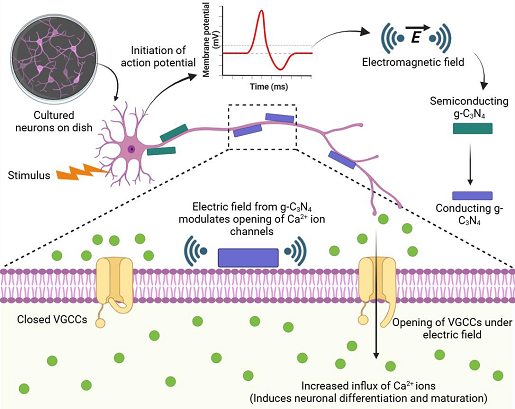
The team from the Institute of Nano Science and Technology (INST), an autonomous body under the Department of Science and Technology, has shown that graphitic carbon nitride (g-C₃N₄) can naturally interact with neurons, encouraging them to grow, mature and communicate more effectively.
The findings, published in the journal ACS Applied Materials & Interfaces, also revealed that the material boosts dopamine production in lab-grown brain-like cells and reduces toxic proteins linked to Parkinson’s disease in animal models.
Existing therapies such as deep brain stimulation require surgical implants, while other approaches rely on magnetic or ultrasound waves, which are either invasive or limited in scope. By contrast, g-C₃N₄ generates tiny electric fields in response to the brain’s own signals when placed near nerve cells. These fields trigger calcium channels on neurons, enhancing their growth and strengthening networks.
“This is the first demonstration of semiconducting nanomaterials directly modulating neurons without external stimulation,” said Dr. Manish Singh, who led the study. “It opens new therapeutic avenues for neurodegenerative diseases like Parkinson’s and Alzheimer’s.”
The researchers explained that the material acts like a smart switch, turning “on” in the presence of negative membrane potential to stimulate neurons, and switching “off” under positive potential to prevent fatigue. The hypothesis was validated through calcium imaging, gene expression and immunofluorescence studies.
Given the rising incidence of neurodegenerative conditions globally, the team said the biocompatible nanomaterial offers potential as a non-invasive therapy. It could also play a role in futuristic technologies such as “brainware computing”, where living brain tissues are coupled with semiconducting materials to function as biological processors.
“We believe this marks a paradigm shift in neuromodulation research. From treating brain injuries to managing neurodegeneration, semiconducting nanomaterials hold immense promise for the future,” Dr. Singh added, while cautioning that further preclinical and clinical trials are necessary before human applications.