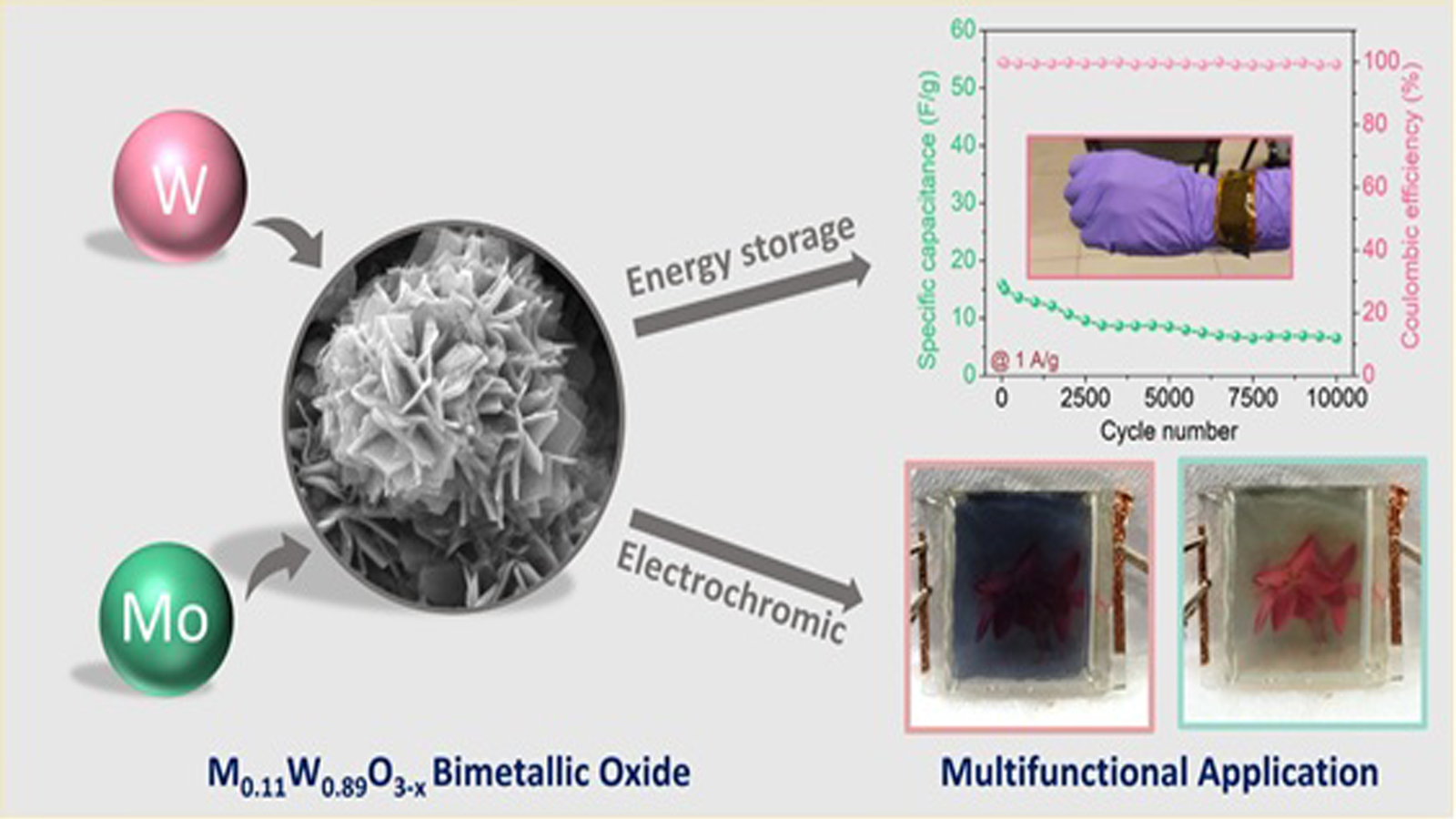
Scientists from Centre for Nano and Soft Matter Sciences (CeNS), Bengaluru have developed a novel smart material that can both store energy and visually indicate its charge level by changing colour, marking a significant breakthrough in next-generation energy storage technology.
The research team, led by Ashutosh Kumar Singh, has created an oxygen-deficient bimetallic oxide composed of molybdenum and tungsten. The material uniquely overcomes a long-standing limitation in electronics, where devices typically either store energy or display information—but rarely both.
In this innovation, the material changes colour based on its charge state—appearing blue when charged and turning transparent when discharged—allowing users to instantly gauge the energy level without additional sensors or displays.
Researchers explained that the key to this functionality lies in the oxide’s “oxygen-deficient” structure. By deliberately creating vacancies in the atomic lattice, the team enabled easier movement of ions within the material. As ions move during charging and discharging, they simultaneously alter the material’s electronic structure, resulting in a visible colour shift that acts as a real-time indicator.
The material was synthesised using a solvothermal method and has shown promising results in multiple applications. In electrochromic devices, it demonstrated strong optical performance, including a high optical modulation of 43% and efficient energy use, suggesting potential for smart windows and display technologies.
When tested as a supercapacitor electrode, the material exhibited high energy storage capacity and stability, maintaining performance over 10,000 charge-discharge cycles. It also proved durable under mechanical stress and varying environmental conditions.
In practical demonstrations, devices built using the material were able to power an LCD timer and light up an LED, highlighting its real-world applicability.
The findings, published in the journal Materials Chemistry A, point to future possibilities for integrating energy storage with visual feedback in applications ranging from consumer electronics to renewable energy systems.
Scientists say the innovation could pave the way for smarter, more efficient devices that combine functionality with intuitive user interaction.