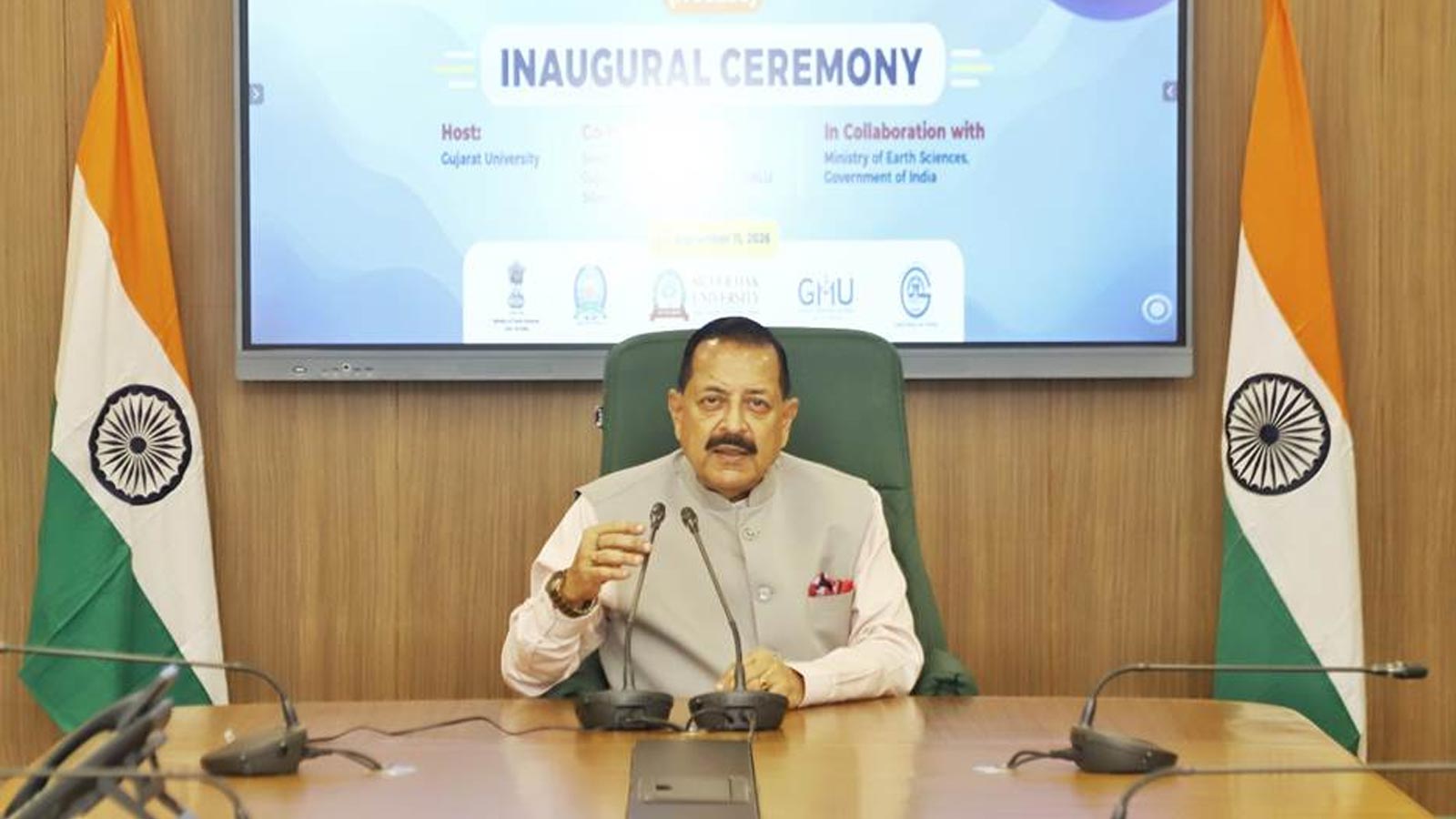
Union Minister of State (Independent Charge) for Science & Technology and Earth Sciences Jitendra Singh on Friday called for an integrated approach to India’s coastline, saying coastal ecology, security, economic development, technology and human development must be addressed as interconnected priorities.
Virtually addressing the National Conference on Coastal Ecology, Security and Sustainability (CCESS) 2026, Singh said India’s 11,000–12,000-km coastline offers significant opportunities for marine resources and the Blue Economy, while also requiring coordinated efforts to protect its fragile ecosystems.
Deep ocean exploration opens new opportunities
Singh highlighted the Deep Ocean Mission as an important initiative for exploring largely uncharted marine resources while strengthening India’s indigenous capabilities.
He pointed to the recent launch of the fully indigenous research vessel ORV Sagar Manthan as an example of India’s growing self-reliance in deep-ocean research and exploration.
The Minister said India is also developing robots and submersibles capable of exploring deep-ocean environments. Such technologies could open new possibilities for understanding and responsibly utilising marine resources, including metals, minerals and fisheries.
He said marine resources could contribute significantly to India’s future economic growth, particularly as the country seeks new sources of resources and opportunities.
Coastal communities central to sustainable development
Singh stressed that economic development of coastal resources must go hand in hand with environmental protection and improved livelihoods for coastal communities.
He said coastal communities are an integral part of the wider coastal ecosystem, with their livelihoods, traditional knowledge and participation playing an important role in sustainable coastal development.
The Minister also noted that India’s ports and coastal infrastructure are central to connectivity, trade and economic growth. Their sustainable development, he said, requires a strong scientific understanding of coastal and marine environments.
Technology to strengthen coastal security
Singh highlighted the growing role of technology in coastal security, saying ocean observation, surveillance, communication, remote sensing, data and emerging technologies can strengthen India’s preparedness and understanding of the marine environment.
He called for these capabilities to be brought together through a holistic “Coastal India” approach, with government and wider society working together rather than addressing individual challenges in isolation.
He said resilient coastal regions require healthy marine ecosystems, informed communities, effective governance and strong scientific capabilities.
Linking ocean science with policy
The Minister said the multidisciplinary nature of the CCESS 2026 conference provides an opportunity to bring together expertise from earth sciences, academia, defence, maritime institutions, legal fields, industry and coastal communities.
He emphasised the need to connect ocean science with national policy so that scientific knowledge can directly contribute to coastal planning and management.
Singh said India’s approach should move beyond separate sectoral interventions towards an integrated framework in which environmental sustainability, economic opportunity, scientific capability and coastal security reinforce one another.
“Swachh Sagar Surakshit Sagar” campaign to continue
Singh also highlighted the “Swachh Sagar Surakshit Sagar” campaign, which has been undertaken for the past five years.
He recalled that a 75-day campaign launched in 2022 brought together citizens and stakeholders across coastal States. The campaign will continue this year from September 12 to 19, with clean-up drives and participation from NGOs and other organisations.
A pledge to keep India’s coastline clean has also been introduced to strengthen citizen participation.
Singh said the broader objective should be to develop a holistic Coastal Bharat approach, where scientific knowledge is converted into collaboration, research priorities and practical action for a secure, sustainable and prosperous coastal future.