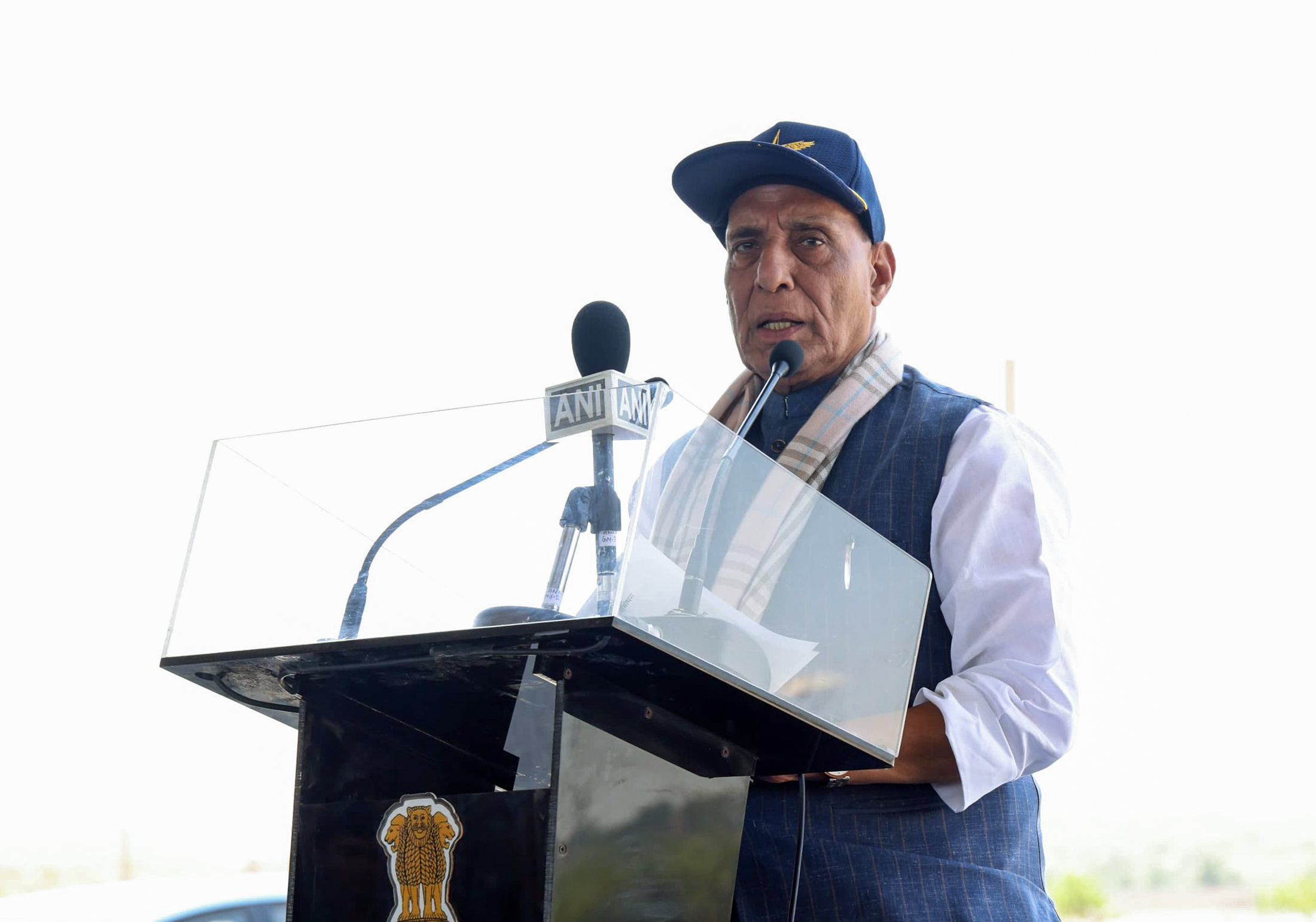
Defence Minister Rajnath Singh on Friday said that combating terrorism is now a core element of India’s defence doctrine, asserting the government’s unwavering resolve to eradicate “hybrid and proxy warfare.”
“Attacking and eliminating terrorism is the new normal,” Singh said while addressing air warriors at the Bhuj Air Force Station in Gujarat.
In a stern message to Pakistan, Singh cautioned that Operation Sindoor—India’s recent offensive against terror infrastructure—“is not over yet.” He added that the current ceasefire with Pakistan should be seen as “probation,” contingent on Islamabad’s actions.
“Our actions were just a trailer. We will show the full picture, if need be,” he warned. “India is prepared to mete out the harshest punishment if Pakistan fails to dismantle its terrorist networks.”
Singh accused Pakistan of rebuilding the very terror infrastructure destroyed by India during Operation Sindoor. He urged the International Monetary Fund (IMF) to reconsider its $1 billion assistance package to Islamabad, warning that the funds may be misused to finance terrorism.
“Pakistan will spend the tax collected from its citizens to give around Rs 14 crore to Masood Azhar, the head of Jaish-e-Mohammed terrorist organisation, even though he is a UN-designated terrorist. The Pakistan government has also announced financial assistance to rebuild the terror infrastructure of Lashkar-e-Taiba and Jaish-e-Mohammed located in Muridke and Bahawalpur. Certainly, a large part of IMF’s one billion dollars assistance will be used to fund the terror infrastructure. Will this not be considered indirect funding by IMF? Any financial assistance to Pakistan is no less than terror funding,” Singh said, adding, “India’s contributions to the IMF should not be used, directly or indirectly, to finance terrorism in Pakistan or anywhere else.”
He commended the Indian Air Force for its swift and decisive role in Operation Sindoor, stating that it destroyed terror camps in Pakistan and Pakistan-occupied Kashmir (PoK) in just 23 minutes.
“When missiles were dropped inside enemy territory, the world heard the echoes of India’s valour and might,” Singh said, adding that the IAF’s strikes on terror camps and air bases demonstrated the transformation in India’s war strategy and technological capabilities.
Singh also highlighted the superior performance of indigenous weaponry during the operation, including the BrahMos and Akash missile systems.
“Made-in-India weapons are now integral to our military strength. These are not only effective but impenetrable,” he said.
Reiterating the government’s commitment to modernising the armed forces, Singh noted that India is shifting from being a major defence importer to a growing exporter. “We used to rely heavily on imports, but today we manufacture artillery systems, radar, missile shields, drones, and counter-drone systems right here. And this is just the beginning,” he said.
Praising Bhuj as the “land of patriotism,” Singh recalled its strategic role in India’s victories over Pakistan in 1965 and 1971, and more recently, in the success of Operation Sindoor.