











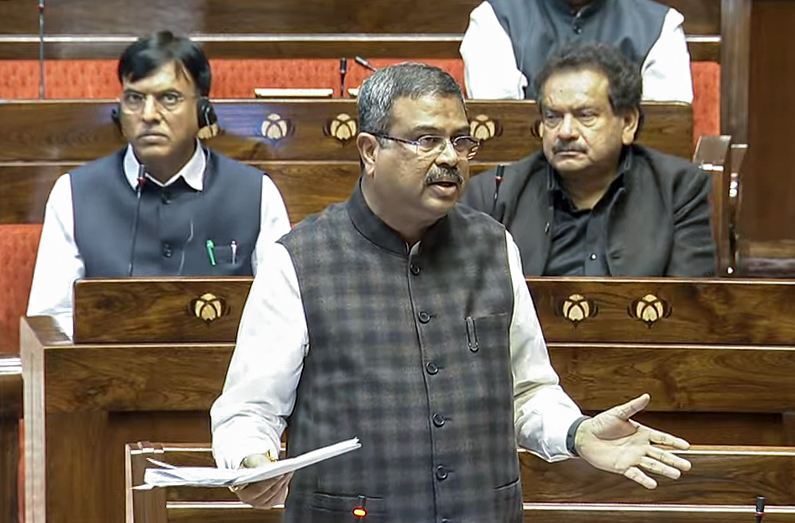
India’s school education system has seen steady progress over the past decade, with key initiatives focused on infrastructure development, digital inclusion, promotion of regional languages, and equity in education. Addressing a press conference in New Delhi, Union Education Minister Dharmendra Pradhan outlined these developments, emphasizing the holistic growth in school education under the government’s leadership.
Pradhan highlighted advancements in school infrastructure between 2013-14 and 2023-24. The availability of electricity in schools increased from 53% to 91.8%, while computer access improved from 24.1% to 57.2%. Internet facilities also witnessed growth, rising from 7.3% to 53.9%. Access to basic facilities such as drinking water increased from 83.2% to 98.3%, and handwashing facilities grew from 43.1% to 94.7%. Playground availability improved from 66.9% to 82.4%, and library facilities expanded from 76.4% to 89%. The government also addressed accessibility by increasing the availability of ramps from 56.8% to 77.1% and handrails from 33.9% to 52.3%. Rainwater harvesting infrastructure was implemented in more schools, growing from 4.2% to 28.4%.
The government increased its expenditure on education. Per-child expenditure grew from ₹10,780 in 2013-14 to ₹25,043 in 2021-22, marking an upward trend in funding dedicated to school education.
The minister also discussed the promotion of Bharatiya languages in school curricula. Textbooks for Classes 1 and 2 are now available in 23 Indian languages, and multilingual e-content in 126 Indian languages and 7 foreign languages has been developed on the DIKSHA platform. The government has launched educational channels catering to diverse audiences, including a Tamil-language channel in 2024, the ULLAS channel for adult education in September 2024, and a channel for hearing-impaired learners in Indian Sign Language by December 2024.
Student performance in board examinations has shown improvements over the years. There has been a 64% increase in the number of students securing higher grades in Class X and a 66% rise in performance in Class XII board exams.
The role of women in education has also been crucial, with the number of female teachers increasing by over 30% since 2014. Between 2014 and 2024, over 61% of teaching posts have been filled by women, who now represent the majority of the teaching workforce.
Pradhan emphasized advancements in quality and equity in Kendriya Vidyalayas (KVs) and Navodaya Vidyalayas (NVs). The representation of rural students in NVs rose from 78% in 2014 to 90% in 2024. The introduction of OBC reservations in 2021 increased the representation of students from these backgrounds to 38.83% in NVs and 29.33% in KVs by 2024. Furthermore, more than 45,000 students from these institutions qualified for NEET, and over 2,000 students secured IIT admissions without external coaching.
The number of CBSE-affiliated schools doubled between 2014 and 2024, growing from 14,974 to 30,415. Vocational education in schools also expanded, with the number of schools offering vocational courses increasing from 960 in 2014 to 29,342 in 2024. Enrollment in vocational education grew from 58,720 in 2014 to over 30.8 lakh in 2024.
Technology-driven reforms have also streamlined various processes, including admissions, teacher transfers, and CBSE affiliations. Schools have transitioned to e-office platforms, improving administrative functions and enhancing efficiency.
Efforts to align textbooks with the National Curriculum Framework continue, with competency-based textbooks now available for seven out of 15 grades. NCERT is expanding its annual printing capacity, from 5 crore to 15 crore textbooks, to keep up with growing demand.
The government has enhanced the PM POSHAN scheme. Between 2014 and 2024, the central government allocated over ₹1.04 lakh crore to support mid-day meals in schools, compared to ₹71,525 crore allocated in the previous decade. Meal costs were revised in December 2024, increasing to ₹6.19 for primary and Balvatika classes and ₹9.29 for upper primary classes.
To further improve learning outcomes, the government has set up 32 Vidya Samiksha Kendras, with 24 integrated into the Rashtriya VSK at NCERT. The PARAKH Rashtriya Sarvekshan, an assessment of learning outcomes, was conducted in December 2024, covering 23 lakh students across over 87,000 schools.







